EU told to prepare for flood of climate change migrants
Global warming threatens to severely destabilise the planet, rendering a fifth of its population homeless, top officials say
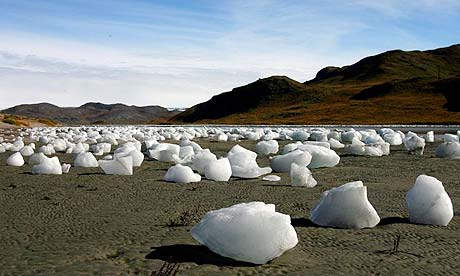
Ice boulders left behind after a flood caused by the overflowing of a lake in Greenland. Photograph: Uriel Sinai/Getty images
In its half-century history, the EU has absorbed wave upon wave of immigrants. There were the millions of political migrants fleeing Russian-imposed communism to western Europe throughout the cold war, the post-colonial and "guest worker" migrants who poured into western Europe in the boom years of the 1950s and 60s, the hundreds of thousands who escaped the Balkan wars of the 90s and the millions of economic migrants of the past decade seeking a better life.
Now, according to the EU's two senior foreign policy officials, Europe needs to brace itself for a new wave of migration with a very different cause - global warming. The ravages already being inflicted on parts of the developing world by climate change are engendering a new type of refugee, the "environmental migrant".
Within a decade "there will be millions of environmental migrants, with climate change as one of the major drivers of this phenomenon," predict Javier Solana and Benita Ferrero-Waldner, the EU's chief foreign policy coordinator and the European commissioner for external relations. "Europe must expect substantially increased migratory pressure."
They point out that some countries already badly hit by global warming are demanding that the new phenomenon be recognised internationally as a valid reason for migration.
The immigration alert is but one of seven "threats" that the two officials focus on in pointing to the security implications and the dangers to European interests thrown up by climate change.
Their report, the first of its kind to be tabled to an EU summit - opening on Thursday in Brussels - amounts to a wake-up call to the governments of Europe, a demand that they start taking account of climate change and its impact in their security and foreign-policy decisions.
The main message is that the immediate and devastating effects of global warming will be felt far away from Europe, with the poor suffering disproportionately in south Asia, the Middle East, central Asia, Africa and Latin America, but that Europe will ultimately bear the consequences.
This could be in the form of mass migration, destabilisation of parts of the world vital to European security, radicalisation of politics and populations, north-south conflict because of the perceived injustice of the causes and effects of global warming, famines caused by arable land loss, wars over water, energy, and other natural resources.
Solana and Ferrero-Waldner paint a picture of a very bleak and very messy new world order which may undermine the UN system.
"The multilateral system is at risk if the international community fails to address the threats. Climate change impacts will fuel the politics of resentment between those most responsible for climate change and those most affected by it ... and drive political tension nationally and internationally."
This is not all futurology. The document points out that last year the UN's appeals for emergency humanitarian aid were all, bar one, connected to climate change.
As far as international security is concerned, the report finds, global warming makes a bad situation worse.
"Climate change is best viewed as a threat multiplier which exacerbates existing trends, tensions and instability,"Solana and Ferrero-Waldner say. "The core challenge is that climate change threatens to overburden states and regions which are already fragile and conflict-prone. The risks include political and security risks that directly affect European interests."
The report highlights several forms of conflict that are likely to be driven by the planet heating up:
· "Reduction of arable land, widespread shortage of water, diminishing food and fish stocks, increased flooding and prolonged droughts are already happening in many parts of the world," Solana and Ferrero-Waldner say. Fresh water availability could fall by up to 30% in some regions, causing farming losses, surging food prices and shortages, and civil unrest. "Climate change will fuel existing conflicts over depleting resources."
· Around one-fifth of the planet's population inhabits coastal zones which are threatened by rising sea levels and natural disasters. The Caribbean, central America and the east coasts of China and India are most exposed. "An increase in disasters and humanitarian crises will lead to immense pressure on the resources of donor countries."
· The report notes that major land mass changes are expected in the course of the century from receding coastlines, meaning countries will lose territory, while desertification could have a similar effect. The result may be "a vicious circle of degradation, migration and conflicts over territory and borders that threatens the political stability of countries and regions".
· A similar result may be expected in failing states, where frustration and disenchantment breed ethnic and religious strife and political radicalisation.
· Competition for energy resources is already a cause of conflict. This may get worse, not least "because much of the world's hydrocarbon reserves are in regions vulnerable to the impacts of climate change and because many oil and gas producing states already face significant social, economic and demographic challenges."
Europe, the officials imply, needs to get its act together if there is to be any chance of managing the apocalyptic scenarios outlined. What the report does not say is that if demographics are any measure of potential power, Europe's task is that much harder.
The average European is currently aged 39 and Europeans, including Russians, make up some 11% of the world's population of 6.7 billion.
By 2050 that figure will have shrunk to 7%, with the average age of Europeans being over 47 and the elderly outnumbering children by more than two to one. A weaker Europe may have to cope with the challenges listed by Solana and Ferrero-Waldner, but environmental migrants may enlarge and rejuvenate its population.
Areas under threat
The Arctic
The speed of polar ice cap melting will have a large geostrategic impact, with conflicts likely over the vast new mineral resources that will become accessible, as well as the opening of new sea routes for international trade. Rival claims to the mineral wealth and shipping routes will challenge Europe's ability to secure its interests in the region.
Latin America
The Caribbean and central America are already badly affected by major hurricanes and extreme weather linked with El Niño. This will get worse, while weak governments will struggle to cope with social and political tension fuelled by climate change.
Africa
Particularly vulnerable because of its low ability to cope with climate change, which is already a factor contributing to the Darfur catastrophe and conflict in the Horn of Africa. Three-quarters of arable rain-fed land in north Africa and the Sahel could be lost. Some 5 million people in the Nile delta could be affected by land losses due to rising sea levels and salinisation by 2050.
Central Asia
Trouble ahead. The authoritarian regimes of the region will become increasingly important because of mineral wealth. But climate change means water shortages are already being felt. Kyrgyzstan has lost 1,000 glaciers over the past 40 years, while Tajikistan's glaciers have shrunk by one third. Farming and power generation are already being hit by water shortages.
Middle East
Water systems are already under intense stress, with around two-thirds of the Arab world dependent on water sources beyond their borders. Water supply might fall by 60% this century in Israel. Significant decreases expected to hit Turkey, Iraq, Syria and Saudi Arabia, further destabilising the "vitally strategic region".
South Asia
Almost two billion Asians live within 35 miles of a coast and many of them are likely to be threatened by rising sea levels. Damage to farming will make it difficult to feed rapidly swelling populations. Another billion people will be affected by a drop in meltwater from the Himalayas. These vulnerable populations will also be exposed to an increase in infectious diseases.


