Showing posts with label Middle East region. Show all posts

May 09, 2008

Middle east roundup (sigh, sigh, sigh)

Fighting pushing Lebanon toward another civil war

Fierce eruption grim reminder of 1975-90 conflict
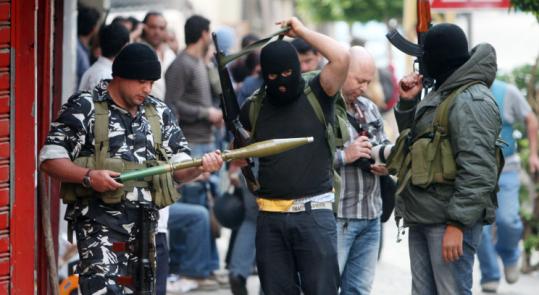
Shi'ite opposition militiamen checked weapons yesterday during clashes with pro-government supporters in Beirut.
Shi'ite opposition militiamen checked weapons yesterday during clashes with pro-government supporters in Beirut. (AFP/Getty Images)

By Borzou Daragahi Los Angeles Times / May 9, 2008

BEIRUT - Lebanon's long-simmering political crisis lurched deeper into violent civil conflict yesterday as rival bands of Shi'ite and Sunni gunmen battled in the streets for a second day and politicians took to the airwaves to denounce one another for pushing the country toward war.

Explosions and ferocious bursts of gunfire rattled central Beirut as groups allied with the Hezbollah-led opposition and the US-backed government fired machine guns, assault rifles, and rocket-propelled grenades toward each other and into the air in apparent shows of strength. The deep thuds of occasional mortar fire shook the earth as night fell.

Throughout the day, panicked civilians scurried for cover or loaded up on basic supplies, emptying supermarket shelves of frozen meats. Gunmen had blocked roads to the country's sole international airport as well as the main highways to Damascus, the capital of Syria, and to southern Lebanon, effectively placing the capital under siege.

Lebanese news sources said at least four people were killed in yesterday's fighting and a female bystander died of wounds sustained in the previous day's clashes. But information was scant as paramedics and security officials avoided areas of intense fighting that witnesses said resembled the scope of the all-out civil war that engulfed the country from 1975 to 1990.

By late night, US-backed government allies were calling for "dialogue" with Hezbollah even as fighting continued and allegations mounted that Shi'ite militiamen were raiding homes and offices of government supporters.

The violence came amid heightened regional tensions between the United States and Saudi Arabia, which strongly back the government, and Iran and Syria, which support Hezbollah and the opposition. The US blamed Hezbollah for the current unrest in Lebanon.

"Hezbollah needs to make a choice: Be a terrorist organization or be a political party, but quit trying to be both," US national security council spokesman Gordon Johndroe said yesterday. "They need to stop their disruptive activities now."

Tensions escalated Tuesday after the US-backed government voted to outlaw Hezbollah's communications network, which the group allegedly was expanding, and sack the Hezbollah-allied head of security at the international airport, who allegedly had begun harassing visitors suspected of political ties to the government.

The fiercest battles erupted following a televised speech yesterday afternoon by Hassan Nasrallah, the chief of the Shi'ite militia Hezbollah.

Nasrallah warned that the Lebanese Cabinet's decision to declare the group's fiber-optic system illegal was tantamount to a declaration of war and put the government squarely in the camp of Hezbollah's enemies, Israel and the United States, which consider the Shi'ite militia and political party a terrorist organization.

"This decision is first of all a declaration of war and the launching of war by the government . . . against the resistance and its weapons for the benefit of America and Israel," Nasrallah told reporters via teleconference.

"The communications network is the significant part of the weapons of the resistance," Nasrallah said. "I had said that we will cut the hand that targets the weapons of the resistance. . . . Today is the day to fulfill this decision."

Saad Hariri, leader of Lebanon's Sunni community and head of the parliamentary majority, appeared on television saying the government would ask the army to enforce the government's decision to uproot the telecommunications network and remove the head of airport security. "You say you don't want Sunni-Shi'ite strife and we don't want this to happen either," he said.

An analyst called the proposal a "small retreat" by Hariri's camp as the Lebanese Army lacks the strength or unity to confront Hezbollah or any other of Lebanon's major political groups. The army also coordinates closely with Hezbollah on security matters and has affirmed its support for "resistance" to Israel.

Supported by Iran and Syria, Hezbollah operates as a state within a state in Lebanon, with strongholds in southern and western Lebanon and southern suburbs of the capital. Its armed wing fought Israel to a standstill in a summer 2006 war. Although Hezbollah claimed victory in that conflict, the war upset Lebanon's fragile sectarian balance and precipitated an ongoing political crisis that has left the country without a president since November.

'We won't cut Iran, Hizbullah ties'
Jerusalem Post, Israel - 27 minutes ago
COM STAFF Syrian President Bashar Assad on Friday rejected Israel's demand that Syria cut its ties with Iran and Hizbullah. He said that detaching his ...
Fighting pushing Lebanon toward another civil war
Boston Globe, United States - 56 minutes ago
The violence came amid heightened regional tensions between the United States and Saudi Arabia, which strongly back the government, and Iran and Syria, ...
Shi'ite gunmen seize control of Beirut neighborhoods Jerusalem Post
Gunmen force pro-government Beirut TV off air Reuters
Shiite gunmen seize control of Beirut neighborhoods, 11 people killedInternational Herald Tribune


March 12, 2008

Environmental refugees, start to prepare!!

EU told to prepare for flood of climate change migrants

Global warming threatens to severely destabilise the planet, rendering a fifth of its population homeless, top officials say

This article appeared in the Guardian on Monday March 10 2008 on p6 of the UK news section. It was last updated at 09:26 on March 10 2008.

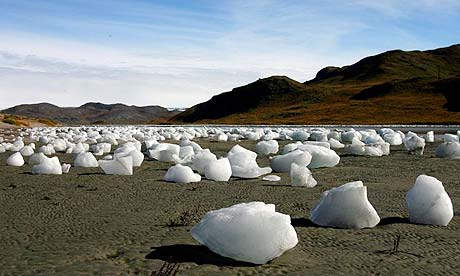
Ice boulders left behind after a flood caused by the overflowing of a lake in Greenland

Ice boulders left behind after a flood caused by the overflowing of a lake in Greenland. Photograph: Uriel Sinai/Getty images

In its half-century history, the EU has absorbed wave upon wave of immigrants. There were the millions of political migrants fleeing Russian-imposed communism to western Europe throughout the cold war, the post-colonial and "guest worker" migrants who poured into western Europe in the boom years of the 1950s and 60s, the hundreds of thousands who escaped the Balkan wars of the 90s and the millions of economic migrants of the past decade seeking a better life.

Now, according to the EU's two senior foreign policy officials, Europe needs to brace itself for a new wave of migration with a very different cause - global warming. The ravages already being inflicted on parts of the developing world by climate change are engendering a new type of refugee, the "environmental migrant".

Within a decade "there will be millions of environmental migrants, with climate change as one of the major drivers of this phenomenon," predict Javier Solana and Benita Ferrero-Waldner, the EU's chief foreign policy coordinator and the European commissioner for external relations. "Europe must expect substantially increased migratory pressure."

They point out that some countries already badly hit by global warming are demanding that the new phenomenon be recognised internationally as a valid reason for migration.

The immigration alert is but one of seven "threats" that the two officials focus on in pointing to the security implications and the dangers to European interests thrown up by climate change.

Their report, the first of its kind to be tabled to an EU summit - opening on Thursday in Brussels - amounts to a wake-up call to the governments of Europe, a demand that they start taking account of climate change and its impact in their security and foreign-policy decisions.

The main message is that the immediate and devastating effects of global warming will be felt far away from Europe, with the poor suffering disproportionately in south Asia, the Middle East, central Asia, Africa and Latin America, but that Europe will ultimately bear the consequences.

This could be in the form of mass migration, destabilisation of parts of the world vital to European security, radicalisation of politics and populations, north-south conflict because of the perceived injustice of the causes and effects of global warming, famines caused by arable land loss, wars over water, energy, and other natural resources.

Solana and Ferrero-Waldner paint a picture of a very bleak and very messy new world order which may undermine the UN system.

"The multilateral system is at risk if the international community fails to address the threats. Climate change impacts will fuel the politics of resentment between those most responsible for climate change and those most affected by it ... and drive political tension nationally and internationally."

This is not all futurology. The document points out that last year the UN's appeals for emergency humanitarian aid were all, bar one, connected to climate change.

As far as international security is concerned, the report finds, global warming makes a bad situation worse.

"Climate change is best viewed as a threat multiplier which exacerbates existing trends, tensions and instability,"
Solana and Ferrero-Waldner say. "The core challenge is that climate change threatens to overburden states and regions which are already fragile and conflict-prone. The risks include political and security risks that directly affect European interests."

The report highlights several forms of conflict that are likely to be driven by the planet heating up:

· "Reduction of arable land, widespread shortage of water, diminishing food and fish stocks, increased flooding and prolonged droughts are already happening in many parts of the world," Solana and Ferrero-Waldner say. Fresh water availability could fall by up to 30% in some regions, causing farming losses, surging food prices and shortages, and civil unrest. "Climate change will fuel existing conflicts over depleting resources."

· Around one-fifth of the planet's population inhabits coastal zones which are threatened by rising sea levels and natural disasters. The Caribbean, central America and the east coasts of China and India are most exposed. "An increase in disasters and humanitarian crises will lead to immense pressure on the resources of donor countries."

· The report notes that major land mass changes are expected in the course of the century from receding coastlines, meaning countries will lose territory, while desertification could have a similar effect. The result may be "a vicious circle of degradation, migration and conflicts over territory and borders that threatens the political stability of countries and regions".

· A similar result may be expected in failing states, where frustration and disenchantment breed ethnic and religious strife and political radicalisation.

· Competition for energy resources is already a cause of conflict. This may get worse, not least "because much of the world's hydrocarbon reserves are in regions vulnerable to the impacts of climate change and because many oil and gas producing states already face significant social, economic and demographic challenges."

Europe, the officials imply, needs to get its act together if there is to be any chance of managing the apocalyptic scenarios outlined. What the report does not say is that if demographics are any measure of potential power, Europe's task is that much harder.

The average European is currently aged 39 and Europeans, including Russians, make up some 11% of the world's population of 6.7 billion.

By 2050 that figure will have shrunk to 7%, with the average age of Europeans being over 47 and the elderly outnumbering children by more than two to one. A weaker Europe may have to cope with the challenges listed by Solana and Ferrero-Waldner, but environmental migrants may enlarge and rejuvenate its population.

Areas under threat

The Arctic

The speed of polar ice cap melting will have a large geostrategic impact, with conflicts likely over the vast new mineral resources that will become accessible, as well as the opening of new sea routes for international trade. Rival claims to the mineral wealth and shipping routes will challenge Europe's ability to secure its interests in the region.

Latin America

The Caribbean and central America are already badly affected by major hurricanes and extreme weather linked with El NiƱo. This will get worse, while weak governments will struggle to cope with social and political tension fuelled by climate change.

Africa

Particularly vulnerable because of its low ability to cope with climate change, which is already a factor contributing to the Darfur catastrophe and conflict in the Horn of Africa. Three-quarters of arable rain-fed land in north Africa and the Sahel could be lost. Some 5 million people in the Nile delta could be affected by land losses due to rising sea levels and salinisation by 2050.

Central Asia

Trouble ahead. The authoritarian regimes of the region will become increasingly important because of mineral wealth. But climate change means water shortages are already being felt. Kyrgyzstan has lost 1,000 glaciers over the past 40 years, while Tajikistan's glaciers have shrunk by one third. Farming and power generation are already being hit by water shortages.

Middle East

Water systems are already under intense stress, with around two-thirds of the Arab world dependent on water sources beyond their borders. Water supply might fall by 60% this century in Israel. Significant decreases expected to hit Turkey, Iraq, Syria and Saudi Arabia, further destabilising the "vitally strategic region".

South Asia

Almost two billion Asians live within 35 miles of a coast and many of them are likely to be threatened by rising sea levels. Damage to farming will make it difficult to feed rapidly swelling populations. Another billion people will be affected by a drop in meltwater from the Himalayas. These vulnerable populations will also be exposed to an increase in infectious diseases.

February 02, 2008

KEEP YOUR EYES ON IRAN!! internet is being played

AS RIGHT BEFORE 9/11, PATSY NATION'S INTERNET CUT OFF

Posted By: WhiteHorseRider <Send E-Mail>
Date: Friday, 1 February 2008, 10:17 p.m.


WHAT'S UP PEOPLE??!!
If the Bush administration is following their usual method of operation, something big is in the works. These acts of cutting off the patsy nation of Iran from their internet connections to the rest of the world may just be Bush's insurance that there can be no protest, nor denial, when the blame gets pinned on Iran for some impending new false-flag disaster/attack.
Just like right before 9/11.
~~~~~~~~~~~~~~~~~~~~~~~~~~~~~~~~~~
Middle East Internet Blackouts Spur Geopolitical Suspicions
Bloggers says big event could be right around the corner, Iran completely cut off

<http://www.propagandamatrix.com/articles/february2008/020108_internet_blackouts.htm>

Paul Joseph Watson
Prison Planet
Friday, February 1st, 2008

Unprecedented mass Internet outages throughout the Middle East and Asia after no less than four undersea Internet cables were cut without explanation are spurring suspicions that a major event of geopolitical proportions may be just around the corner.

Internet blackouts are impacting large tracts of Asia, the Middle East and North Africa after four undersea cable connections were severed. Egypt, Saudi Arabia, Qatar, the United Arab Emirates, Kuwait, Bahrain, Pakistan and India, are all experiencing severe problems.

According to InternetTraffic.com, Iran has been completely cut off from the Internet...
(snip)

ShareThis