Showing posts with label BP. Show all posts

November 23, 2010

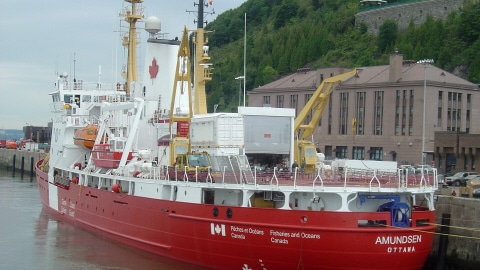
The Amundsen's Oil Service

Le brise-glace Amundsen
Photo: AFP / Clement SABOURIN
The icebreaker Amundsen in the port of Quebec

Oil companies have used a ship of the Canadian Coast Guard for their oil exploration in the Arctic. A situation raising the discontent of environmentalists.
Esso and BP have chartered the icebreaker Amundsen in partnership with a scientific group, to carry out their plans for exploration in the Beaufort Sea. One way to continue their exploration and assess the environmental impacts of their projects in the Arctic.
The Amundsen is the largest scientific research vessel in Canada and a symbol of climate change research in the North.
Esso has leased the ship for six weeks in 2009. BP has done the same thing this summer.
We know the total value of contracts between oil companies to ship the Coast Guard.We do know that Esso and BP have each paid at least $ 50 000 per day for access to scientific equipment of the Amundsen.
But this boat rentals, a pioneer of research on climate change, raise the outrage of environmentalists.
It is a kind of slap in the face of the international scientific community, the international community.
- Steven Guilbeault, a spokesman Équiterre
The scientific leader of the Amundsen, Louis Fortier, defends the use of oil by ship: "The general idea is to guide the development of exploration for oil, so [...] to minimize potential impacts on ecosystems, "he argues.
Coast Guard for his part said that the mission of the Amundsen is consistent with the priorities of the federal government has awarded exploration rights to oil companies in the Arctic.

The Amundsen

The CCGS Amundsen, a heavy icebreaker of the Canadian Coast Guard was called into service in 2003 and modernized. Some 30 million has been invested to transform it into a vessel for advanced scientific research in the Arctic.

Fisheries and Oceans Canada is a partner of an international scientific consortium that studies the effects of climate change on Arctic ecosystems. The consortium, which includes scientists from Canada and around the world, uses the Amundsen each year from May to October.

Source: Fisheries and Oceans Canada
With reporting by Jean-Philippe Robillard

October 22, 2010

Ok, where IS our outrage ??? After BP did the dirty deed(s)

6 Months Since BP Oil Spill, Writer and Environmentalist Terry Tempest Williams Asks "Where Is Our Outrage?"

From Democracy Now:

Six months ago, BP’s Deepwater Horizon oil rig blew up in the Gulf of Mexico, killing eleven workers and triggering the worst oil spill disaster in US history. More than 200 million gallons of oil spilled into the Gulf, polluting coastlines in Louisiana, Mississippi, Alabama and Florida. To mark the six-month anniversary, we speak to acclaimed writer and environmentalist Terry Tempest Williams, who spent two weeks traveling the Gulf Coast this summerTempest-williams.

Here is the rush transcript, the link will take you to the video ...

JUAN GONZALEZ: Six months ago, BP’s Deepwater Horizon oil rig blew up in the Gulf of Mexico, killing eleven workers and triggering the worst oil spill disaster in US history. The explosion leaked over 200 million gallons of oil, which is nearly five million barrels of oil, into the Gulf of Mexico and fouled coastlines in Louisiana, Missis

sippi, Alabama and Florida.

With the Macondo oil well now sealed, the spill is no longer in the headlines, and last week Interior Secretary Ken Salazar announced that the Gulf was once again, quote, "open for business." But much of the oil that gushed out of the blown-out well remains dispersed deep under the sea, and scientists are still unclear about the long-term effects of both the oil and the chemical dispersant on marine ecosystems.

AMY GOODMAN: Six months since the spill, lawmakers have been slow to take action and the House’s spill response bill remains stalled in the Senate. On Wednesday, three environmental groups sued BP, accusing the British oil giant of violating the Endangered Species Act. The suit, brought by Defenders of Wildlife, Gulf Restoration Network and the Save the Manatee Club, notes that at least twenty-seven endangered or threatened animal species live in the Gulf region, including five species of endangered sea turtles and fou

r species of endangered whales.

In a moment, we’ll be speaking with the acclaimed writer and environmentalist Terry Tempest Wiliams, who spent two weeks traveling the Gulf Coast this summer. She has written an extended piece about the stories she heard on her visit to what she calls the world’s largest offshore oil disaster. Her piece is called "The Gulf B

etween Us," and it was published in the November/December issue of Orion magazine. She is the author of several books, including most recently Finding Beauty in a Broken World and The Open Space of Democracy. She’ll be joining us from Salt Lake City, Utah, after this break.

[break]

AMY GOODMAN: We turn now to Terry Tempest Williams, writer, environmentalist. Her books include Finding Beauty in a Broken World and The Open Space of Democracy. Her latest piece in Orion magazine, an extended reflection on the BP oil spill, called "The Gulf Between Us."

Terry Tempest Williams, welcome to Democracy N

ow! from Salt Lake City. You went to the Gulf on this six-month anniversary. What are your reflections about what happened April 20th? I’ll never forget it because it was Earth Day.

TERRY TEMPEST WILLIAMS: That’s right. I think it changed all of us, who were paying attention. And, Amy, I just want to thank you for your program, first of all, that we can even have this conversation.

AMY GOODMAN: Well, thank you.

TERRY TEMPEST WILLIAMS: Reflections. It’s—yeah, you know, we hear that five million barrels of oil were released from the Macondo well. We know that [ 362] miles were oiled in four states, 400 species of animals threatened from this, 400 controlled burns that killed hundreds of sea turtles and untold numbers of dolphins and sea mammals. We’re told that it’s over, that the story is gone, as is the oil. And what I can tell you in reflecting over six months is that the oil is not gone. The people are still there, and they’re getting sicker and sicker.

And I just think it’s really important that, at this anniversary of six months, that we begin to really hear from the people on the ground. And that’s what my purpose was. You know, I have a pen. I’m a writer. I was home in Utah thinking, you know, what can I do? And I had to go. I had to see it for myself. So it was about ground truthing. It was about bearing witness. And I don’t think bearing witness is a passive act.

JUAN GONZALEZ: Well, Terry Tempest Williams, this is an extraordinary piece, as you talk about and you relate basically the words of a variety of people on the ground. And I was struck by one particular passage, when you were interviewing a Margaret Curole, and she says to you, "Here’s the truth. Where are the animals? There’s no too-da-loos, the little one-armed fiddler crabs. Ya don’t hear birds. From Amelia to Alabama, Kevin never saw a fish jump, never heard a bird sing. This is their nestin’ season. Those babies, they’re not goin’ nowhere. We had a very small pod of sperm whales in the Gulf, nobody’s seen ‘em. Guys on the water say they died in the spill and their bodies were hacked up and taken away." And she goes on to say, "Fish are swimming in circles. Dolphins are choking on the surface. It’s ugly, I’m tellin’ you. And nobody’s talkin’ about it. You’re not hearing nothin’ about it. As far as the media is reportin’, everythin’s being cleaned up and it’s not a problem." Tell us about some of these—

TERRY TEMPEST WILLIAMS: That’s the power of Margaret Curole.

JUAN GONZALEZ: Yes. What about some of the other stories?

TERRY TEMPEST WILLIAMS: You know, what I love about the voices in this piece, the voices in the Gulf that I heard, the people in place, standing up, standing for their home ground, was exactly that kind of passion, that kind of truth telling.

Margaret Curole and her husband Kevin are Cajun. They’re shrimpers. And they talked about how there’s two alternatives in the Gulf: you either shrimp or you work in the oil fields. And, you know, I learned something from them. I have been against, you know, deepwater drilling, and they were talking about the moratorium, how it needs to be lifted so that people can eat. So, it was through Margaret that I really began to see the complexity of this situation.

I love her feistiness. She, with an artist friend, created on the beach at Grand Isle human bodies that spelled out messages, which they took pictures of and texted to Congress, to the governor, to BP executives, to everyone in power they could think of. The three messages laid out in bodies were "Never again," "Paradise lost" and "WTF." What I can tell you about Margaret is that she received calls from the BP claims department saying to back off. She was taken to lunch by two agents from Homeland Security. And this is serious. And she said, "They want me to shut up, and I will not."

Another story, she told us if we wanted great Cajun food—and that we couldn’t understand this story unless we ate—to go to Becky Duet’s deli in Galliano, which is where they’re from in southern Louisiana. We went to Becky Duet’s deli, called Jordan’s, named after her son. It was 10:00 at night. The lights were still on. We walked in. She said, "The grill is closed." And then she proceeded to tell stories, that in Cajun country they’ve always viewed themselves as rich, that the bounty is from the waters, that as long as you had rice, beans and bread and had a chicken neck that you could throw into the bayou, you were wealthy. Just a few weeks ago, I received a note from Becky, who’s become a good friend. She said, "We’re starving, Terry. There are no fish in the waters. And any fish we would see, we would not eat."

These are the stories that are coming out of the Gulf. These are the stories that we’re not hearing from the media. I think about a group of women in gated communities in Alabama, just off of Mobile Bay, Orange Beach. These women took the situation into their own hands, because no one was responding. They had water samples taken, four, from very wealthy areas. The fourth one on Dauphin Island blew up and was deemed inconclusive. These women—Robin Young, a captain, Lori DeAngelis and her husband Mike—their blood tests came back high in cadmium and benzene. They’ve had chemically induced pneumonia. These are the stories, again, that we’re not hearing.

AMY GOODMAN: We’re talking to Terry Tempest Williams, writer and environmentalist. Her latest piece is in Orion magazine, called "The Gulf Between Us: Stories of Terror and Beauty from the World’s Largest Accidental Offshore Oil Disaster." Terry, tell us about Jerry Cope and Fish Camp Landing, the gated community in Orange Beach, Alabama.

TERRY TEMPEST WILLIAMS: Yeah, those were the women I was referring to. I met Jerry in March of 2009 at the climate action in Washington, DC. I call him a guerrilla journalist. While I was down there, he was there also with Charles Hambleton, one of the producers and members of the crew that you see in the film The Cove. They had heard about the bodies of dolphins being taken to dumps, refrigerated to Mexico. They wanted to do an investigative witnessing, if these stories were true. Jerry, in the three weeks that he was out on the Gulf, he also came down with chemical-induced pneumonia, ended up meeting these activists, these women in the gated community, and Robin Young among them, who started this organization called Guardians of the Gulf. It was there that he really saw on the ground, as did I, you know, what the situation is. These women were calling, as I said, for water samples, air samples, blood tests, to really show the seriousness of the public health issues. And again, these are the stories that we’re not hearing—upper respiratory disease, lots of skin infection, rashes.

When I was there, they were having to drain the swimming pools, because children were being sick. And, Amy, it just—it made you sick. You’d go down to Gulf Shores, and here were these seemingly pristine beaches, this Corexit green, this ungodly color, women, mothers, you know, overburdened, 110-degree heat. Their children were playing in the waves. It was like there was no connection between what was in the water and what was seeping into their children’s skin. I mean, the stories are heartbreaking.

We walked down the beach several miles to the Gulf Island National Seashore, again what seemed to be white pristine beaches. There had just been a thunderstorm. It was this eerie color of the water again. You half-expected the water to burst into flames with lightning strikes. Just then, a BP bus pulled up. Thirty workers, some of them in hazmat suits. We started talking to them, saying, "Well, it doesn’t look like there’s oil here." Two of the workers, African American men in their twenties, smiled and said, "Can we tell you that we just took out 2,000 pounds last night? We work from dusk to dawn under the cover of darkness."

JUAN GONZALEZ: You also talk about what’s—

TERRY TEMPEST WILLIAMS: That’s a ton of oil—I was just going to say that was a ton of oil taken out in a 100-yard swatch. Again, these are the stories we’re not hearing. I just talked to Robin yesterday, and she was saying that five minutes she had tar balls the size of baseballs. And, you know, you go down a foot, and that’s where the oil still remains.

JUAN GONZALEZ: You also talk about those workers and the boat captains that are still working for BP and some of the illnesses that they’re being exposed to, and also that their clothes are being confiscated while at same time BP is telling them that they probably just have dermatitis?

TERRY TEMPEST WILLIAMS: That’s right. The doctors don’t even know how to treat these diseases that are coming forward. Mike DeAngelis, married to Lori, both of them are captains. Lori runs a dolphin education cruise. She hasn’t been able to go out, because their boats have been registered for Vessels of Opportunity, because they needed the money, quite frankly. You know, these are people that are working-class people. Mike, as a captain, when they registered their boat, was getting paid $1,200 a day, $200 for extra crew members. And what were they doing? Nothing. There was a joke around the Gulf that you’re on BP time: being paid for doing nothing.

One of the most moving stories was really flying with a barefoot pilot named Tom Hutchings. In the American Southwest, we would call him a coyote. Again, an activist, he was taking people, as a volunteer for SouthWings, anyone who would go with him, to fly over the Macondo well site. We went with him on Day 100. Upper right-hand corner of the New York Times, you know, remember the article that said most of the oil is gone, 80 percent. You remember a week later, Carole Browner of the Obama administration said 75 percent gone, poof, Mother Nature is doing her job. What I can tell you is that as we flew out to the Gulf to what they call "the source" to see the Deepwater Horizon rigs, for as far as we could see, for as wide as we could see, for as long as we could bear it, oil. All we could see was oil. I mean, it’s just—I wonder, where is our outrage? And I was saying to Tom, this brilliant pilot, you know, that must have made twenty, thirty, forty flights at his own expense, "Why isn’t this story being told?" And he was saying that most of what we’ve heard has been shore-based knowledge. I mean, there were rivers of oil as wide as the Mississippi itself. Stunning. When I asked him what has stayed in his mind most in terms of his witnessing, he said that when they were burning the oil off the surface of the sea, he remembers on the edge of the flames seeing a pod of dolphins, side by side by side by side, watching, simply watching the ocean burn.

I think the other untold story are the dispersants. We know, thanks to Congressman Markey from Massachusetts, that after the EPA said, "Please, please," to BP, "find another dispersant that is less toxic," what we know now is that our Coast Guard, the United States Coast Guard, gave BP seventy-four exceptions in forty-eight days. And that’s the untold story. And I think that’s where so much of this illness is rising from. And we hear from the scientists, two inches of oil on the bottom of the sea. The scientist Samantha Joye said it’s a "graveyard for the macrofauna" and that the Gulf is dying from the bottom up. And again, that’s what I wanted to see, is what are the stories from the ground up, from the people who live there? Again, witness is not a passive act.

JUAN GONZALEZ: And as you mention, this is not just a regional catastrophe, but this fall a billion birds will migrate from, of course, North America through the Gulf of Mexico and the area, and the impact could then obviously spread for the bird population throughout the hemisphere.

TERRY TEMPEST WILLIAMS: That’s correct. And as we speak, as you say, a billion birds migrating through the Gulf of Mexico. The Mississippi Delta sees 70 percent of our waterfowl. You know, I think that’s the other untold story that touched me so deeply, was the beauty. It’s still there, against all odds. The Gulf is still there. And you fly over and see these beautiful islands, these islands beaded with birds, pelicans, skimmers—the feathered skimmers, not the boats—piping plovers, who are endangered. You know, we’d fly over and see, you know, these extraordinary manta rays, twenty-five-foot wing span, 3,000 pounds, looking like black angels on the turquoise water. It’s such an extraordinary landscape. I had no idea. And I think what’s interesting—and I do have faith in Obama’s commission, that’s saying, let’s look not at the protection of putting more levees, more canals, that cut up the system, the ecosystem, but let’s think about, really, restoration, even a full restoration project of the Mississippi Delta, the Mississippi River itself. And that’s where I see the hope.

AMY GOODMAN: Terry Tempest Williams, we want to thank you very much for being with us, writer, environmentalist. Her books include Finding Beauty in a Broken World and The Open Space of Democracy. Her latest piece was just published in Orion magazine on the six-month anniversary of the Gulf oil spill. It’s called "The Gulf Between Us." She was speaking to us from Salt Lake City, Utah.

June 19, 2008

WAR CRIMES DOSSIER: Oil: Hardly Suprising Iraki newz

Giant Oil Companies to Return to Iraq Under No Bid Contracts

Published on Thursday, June 19, 2008.

Source: International Herald Tribune

BAGHDAD: Four Western oil companies are in the final stages of negotiations this month on contracts that will return them to Iraq, 36 years after losing their oil concession to nationalization as Saddam Hussein rose to power.

Exxon Mobil, Shell, Total and BP — the original partners in the Iraq Petroleum Company — along with Chevron and a number of smaller oil companies, are in talks with Iraq's Oil Ministry for no-bid contracts to service Iraq's largest fields, according to ministry officials, oil company officials and an American diplomat.

The deals, expected to be announced on June 30, will lay the foundation for the first commercial work for the major companies in Iraq since the American invasion, and open a new and potentially lucrative country for their operations.

The no-bid contracts are unusual for the industry, and the offers prevailed over others by more than 40 companies, including companies in Russia, China and India. The contracts, which would run for one to two years and are relatively small by industry standards, would nonetheless give the companies an advantage in bidding on future contracts in a country that many experts consider to be the best hope for a large-scale increase in oil production.

There was suspicion among many in the Arab world and among parts of the American public that the United States had gone to war in Iraq precisely to secure the oil wealth these contracts seek to extract. The Bush administration has said that the war was necessary to combat terrorism. It is not clear what role the United States played in awarding the contracts; there are still American advisers to Iraq's Oil Ministry.

Sensitive to the appearance that they were profiting from the war and already under pressure because of record high oil prices, senior officials of two of the companies, speaking only on the condition that they not be identified, said they were helping Iraq rebuild its decrepit oil industry.

For an industry being frozen out of new ventures in the world's dominant oil-producing countries, from Russia to Venezuela, Iraq offers a rare and prized opportunity.

While enriched by $140 per barrel oil, the oil majors are also struggling to replace their reserves as ever more of the world's oil patch becomes off limits. Governments in countries like Bolivia and Venezuela are nationalizing their oil industries or seeking a larger share of the record profits for their national budgets. Russia and Kazakhstan have forced the major companies to renegotiate contracts.

The Iraqi government's stated goal in inviting back the major companies is to increase oil production by half a million barrels per day by attracting modern technology and expertise to oil fields now desperately short of both. The revenue would be used for reconstruction, although the Iraqi government has had trouble spending the oil revenues it now has, in part because of bureaucratic inefficiency.

For the American government, increasing output in Iraq, as elsewhere, serves the foreign policy goal of increasing oil production globally to alleviate the exceptionally tight supply that is a cause of soaring prices.

The Iraqi Oil Ministry, through a spokesman, said the no-bid contracts were a stop-gap measure to bring modern skills into the fields while the oil law was pending in Parliament.

It said the companies had been chosen because they had been advising the ministry without charge for two years before being awarded the contracts, and because these companies had the needed technology.

A Shell spokeswoman hinted at the kind of work the companies might be engaged in. "We can confirm that we have submitted a conceptual proposal to the Iraqi authorities to minimize current and future gas flaring in the south through gas gathering and utilization," said the spokeswoman, Marnie Funk. "The contents of the proposal are confidential."

While small, the deals hold great promise for the companies.

"The bigger prize everybody is waiting for is development of the giant new fields," Leila Benali, an authority on Middle East oil at Cambridge Energy Research Associates, said in a telephone interview from the firm's Paris office. The current contracts, she said, are a "foothold" in Iraq for companies striving for these longer-term deals.

Any Western oil official who comes to Iraq would require heavy security, exposing the companies to all the same logistical nightmares that have hampered previous attempts, often undertaken at huge cost, to rebuild Iraq's oil infrastructure.

And work in the deserts and swamps that contain much of Iraq's oil reserves would be virtually impossible unless carried out solely by Iraqi subcontractors, who would likely be threatened by insurgents for cooperating with Western companies.

Yet at today's oil prices, there is no shortage of companies coveting a contract in Iraq. It is not only one of the few countries where oil reserves are up for grabs, but also one of the few that is viewed within the industry as having considerable potential to rapidly increase production.

David Fyfe, a Middle East analyst at the International Energy Agency, a Paris-based group that monitors oil production for the developed countries, said he believed that Iraq's output could increase to about 3 million barrels a day from its current 2.5 million, though it would probably take longer than the six months the Oil Ministry estimated.

Fyfe's organization estimated that repair work on existing fields could bring Iraq's output up to roughly four million barrels per day within several years. After new fields are tapped, Iraq is expected to reach a plateau of about six million barrels per day, Fyfe said, which could suppress current world oil prices.

The contracts, the two oil company officials said, are a continuation of work the companies had been conducting here to assist the Oil Ministry under two-year-old memorandums of understanding. The companies provided free advice and training to the Iraqis. This relationship with the ministry, said company officials and an American diplomat, was a reason the contracts were not opened to competitive bidding.

A total of 46 companies, including the leading oil companies of China, India and Russia, had memorandums of understanding with the Oil Ministry, yet were not awarded contracts.

The no-bid deals are structured as service contracts. The companies will be paid for their work, rather than offered a license to the oil deposits. As such, they do not require the passage of an oil law setting out terms for competitive bidding. The legislation has been stalled by disputes among Shiite, Sunni and Kurdish parties over revenue sharing and other conditions.

The first oil contracts for the majors in Iraq are exceptional for the oil industry.

They include a provision that could allow the companies to reap large profits at today's prices: the ministry and companies are negotiating payment in oil rather than cash.

"These are not actually service contracts," Benali said. "They were designed to circumvent the legislative stalemate" and bring Western companies with experience managing large projects into Iraq before the passage of the oil law.

A clause in the draft contracts would allow the companies to match bids from competing companies to retain the work once it is opened to bidding, according to the Iraq country manager for a major oil company who did not consent to be cited publicly discussing the terms.

Assem Jihad, the Oil Ministry spokesman, said the ministry chose companies it was comfortable working with under the charitable memorandum of understanding agreements, and for their technical prowess. "Because of that, they got the priority," he said.

In all cases but one, the same company that had provided free advice to the ministry for work on a specific field was offered the technical support contract for that field, one of the companies' officials said.

The exception is the West Qurna field in southern Iraq, outside Basra. There, the Russian company Lukoil, which claims a Saddam-era contract for the field, had been providing free training to Iraqi engineers, but a consortium of Chevron and Total, a French company, was offered the contract. A spokesman for Lukoil declined to comment.

Charles Ries, the chief economic official in the American Embassy in Baghdad, described the no-bid contracts as a bridging mechanism to bring modern technology into the fields before the oil law was passed, and as an extension of the earlier work without charge.

To be sure, these are not the first foreign oil contracts in Iraq, and all have proved contentious.

The Kurdistan regional government, which in many respects functions as an independent entity in northern Iraq, has concluded a number of deals. Hunt Oil Company of Dallas, for example, signed a production-sharing agreement with the regional government last fall, though its legality is questioned by the central Iraqi government. The technical support agreements, however, are the first commercial work by the major oil companies in Iraq.

The impact, experts say, could be remarkable increases in Iraqi oil output.

While the current contracts are unrelated to the companies' previous work in Iraq, in a twist of corporate history for some of the world's largest companies, all four oil majors that had lost their concessions in Iraq are now back.

But a spokesman for Exxon said the company's approach to Iraq was no different from its work elsewhere.

"Consistent with our longstanding, global business strategy, ExxonMobil would pursue business opportunities as they arise in Iraq, just as we would in other countries in which we are permitted to operate," the spokesman, Len D'Eramo, said in an e-mailed statement.

But the company is clearly aware of the history. In an interview with Newsweek last fall, the former chief executive of Exxon, Lee Raymond, praised Iraq's potential as an oil-producing country and added that Exxon was in a position to know. "There is an enormous amount of oil in Iraq," Raymond said. "We were part of the consortium, the four companies that were there when Saddam Hussein threw us out, and we basically had the whole country."

March 28, 2008

The "West's" view of the Iraki oil situation .

Exxon Mobil Lobby Spent $16.9M

Thu Mar 27, 2008

This is pocket change to Exxon, cheap protection for their racket. -oom

Exxon Mobil spent $16.9M lobbying
March 19, 2008
http://money. cnn.com/news/ newsfeeds/ articles/ newstex/AFX-
0013-23905827. htm
<http://money. cnn.com/news/ newsfeeds/ articles/ newstex/AFX- 0013-23905827. htm>

WASHINGTON (AP) - Exxon Mobil (NYSE:XOM) Corp., the largest U.S. oil
company, spent more than $16.9 million to lobby the federal government
in 2007, according to a disclosure form. The company lobbied on
various appropriations bills and on legislation dealing with Federal
Aviation Administration reauthorization, patent reform, taxes and
royalties, international relations and trade agreements, lobbying
reform, railroad security and more, according to the form posted
online Feb. 14 by the Senate's public records office.

Irving, Texas-based Exxon Mobil spent $10.5 million in the second half
of 2007 to lobby on those issues. The energy bill President Bush
signed in December did not include billions of dollars in higher taxes
for large oil companies that many Democrats wanted to use to fund tax
breaks for various clean energy (NASDAQ:CLNE) industries.

Similar proposals were revived earlier this month and are working
their way through Congress. Besides Congress, Exxon Mobil lobbied the
White House, Federal Energy Regulatory Commission, U.S. Trade
Representative' s office, the departments of Energy, Defense, Interior,
State, Commerce, Homeland Security and more. Lobbyists are required to
disclose activities that could influence members of the executive and
legislative branches, under a federal law enacted in 1995.

===

Iraq to pay oil firms to boost its output

By Randy Fabi and Ahmed Rasheed
http://www.guardian .co.uk/feedartic le?id=7397775
<http://www.guardian .co.uk/feedartic le?id=7397775>

BAGHDAD, March 19 (Reuters) - The Iraqi government is expected to pay
up to $2.5 billion to five top oil companies to increase the country's
oil output by nearly a quarter, a government adviser told Reuters on
Wednesday.In what would be the biggest foreign involvement for
decades, Baghdad is close to signing technical support contracts with
BP, Royal Dutch Shell, Exxon Mobil, Chevron and Total.

Thamir Ghadhban, energy adviser to Iraq's prime minister, said he
expected the contracts, which would add 500,000 barrels per day (bpd)
to current production of 2.27 million bpd, would be signed by early
next month.

"There is a rough estimate that it could cost about $400 to $500
million per field," he said in an interview."So a total could be up to
between $2 (billion) and $2.5 billion over two years that should be
paid by the government to companies.

"With oil prices at around $100 a barrel, the contracts could mean
extra revenues to Iraq of around $1.5 billion a month before costs,"
according to Reuters calculations.

Ghadhban said Iraqi representatives met with company officials last
week in Amman, Jordan, to discuss final details of the initially
two-year contracts, including whether payment would be by cash or by
oil."As far as we are concerned, everything is positive and it's a
matter of time for the minister of oil and oil companies to finalize
and shake hands," he said.

Shell is negotiating for the northern Kirkuk oilfield and is also in
talks, along with BHP Billiton, for the development of the Maysan
fields.BP also has its eyes on Iraq's southern Rumaila field, while
Exxon wants the contract for the Zubair oilfield in Basra.

Finally, Chevron and Total are looking to work together to develop the
West Qurna oilfield.

Ghadhban said he expected the companies to boost output by around
100,000 bpd at each of the fields
.

HEAD START

The ongoing talks have also given the five major oil companies a head
start in efforts to bid for future oil contracts.

"I have no doubt whatsoever those five major companies are going to be
qualified," he said. "They are major oil companies and of course they
will be qualified."

More than 100 companies have registered to compete for oil extraction
and service contracts to help develop Iraq's oil reserves, the world's
third largest.

Ghadhban said the government was expected to announce the list of
qualified companies next month, a month later than initially
expected.He said the technical support contracts with the five oil
majors needed to be finalized before the government could move on to
other contracts.

===

Forbidden fields: Oil groups circle the prize of Iraq's vast reserves

By Roula Khalaf and Steve Negus
March 19 2008
Financial Times

http://www.ft. com/cms/s/ 0/5b24f674- f5e6-11dc- 8d3d-000077b0765 8.html?nclick_ check=1

Royal Dutch Shell has been quietly working with Iraq's oil ministry
over the past two years, advising it on how to increase the production
of two oilfields. Under an agreement struck after the 2003 invasion,
no one from the company, Europe's largest oil group, has set foot in
the troubled country; instead, monthly face-to-face meetings with the
oil ministry have been held in Amman, the Jordanian capital, and
weekly contact has been maintained by video-link.

The Shell-financed project and the attention showered on Baghdad
appears to be paying off: Shell is now negotiating a technical support
agreement in which it will be compensated for helping upgrade
production of producing fields. The oil company will again set up a
team outside Iraq, helping, among other things, to bring new equipment
into the country and training Iraqis in its use. Shell is one of
several inter­national oil companies including BP and the US groups
Exxon Mobil and Chevron that have been tapping into Iraq's oil
industry by remote control. But now, five years after the invasion,
the oil groups are hoping to take their involvement in the country to
a new level. Baghdad, desperate to increase oil production yet starved
of investment, is starting to dangle what the companies have been
after all along: a chance to develop and later explore what may be the
world's most promising untapped oil reserves. Indeed, as the companies
gear up for technical support agreements, they are also registering to
pre-qualify for the first bidding round of oil development contracts
that are to be offered by Baghdad.

"The [initial projects] were done to work with the Iraqis, get a
feeling for fields and build relationships and knowledge," says one
oil executive, speaking of the assistance projects provided so far.

With parts of the global oil industry threatened with nationalisation
and much of the Middle East still closed to foreign ownership of
reserves, access to Iraq, with the world's third-largest oil reserves,
has long been viewed as a huge prize. Although no decision has yet
been made in Baghdad over the nature of the development or the
eventual exploration contracts that will be on offer, Iraq could prove
one of the rare countries in the region where companies will be
allowed to claim reserves as their own.

"This is the big frontier,"
says Raad Alkadiri, a senior director at
Washington-based PFC Energy. According to the oil ministry, only 27
out of 80 discovered fields are producing in Iraq, the result of
decades of under-investment. A report by Wood Mackenzie, the
consultancy, meanwhile says the scale of Iraq's remaining oil
resources surpasses all other countries in the Middle East, including
Saudi Arabia, and its high-quality reservoirs ensure that production
costs would be very low. But Iraq is also a dangerous frontier.
Companies invited to invest in its oil industry and satisfy
Baghdad's plans at least to double oil production from the current
2.5m barrels a day will be walking into a political, security and
legislative minefield. Their involvement threatens to exacerbate the
sectarian tensions that have torn the country apart since the US-led
invasion.

International oil companies acknowledge that security, although better
over the past year, will still need to improve significantly before
workers are dispatched to Iraq. The weakness of the central government
and its patchy control over the southern part of the country, home to
80 per cent of proved oil reserves, will also be taken into account.
Perhaps most important, however, is that they could be entering a
country with deep political fissures and lingering anger at foreign
intervention, without clear legislation allowing for foreign
participation. Despite American pressure and government desperation, a
law to regulate foreign access to the oil industry has languished in
the Iraqi parliament, a victim of sectarian disputes, particularly
between the Kurds and Arabs. Frustrated by the delays, and virtually
giving up on a successful outcome, the oil ministry has now invited
oil companies to pre-qualify for development of existing fields and
says a cabinet decision will be enough to legitimise foreign
participation. Later bidding rounds are envisaged for exploration
contracts.

Officially, companies say they will insist on having new legislation
in place before investing the billions of dollars that would be needed
for development and exploration. Yet the absence of a law is not
preventing them from embarking on negotiations.
"The companies are positioning themselves; they're playing the game and the oil ministry is trying to create a game for them to play,"
says Mr Alkadiri.
"Of course you can hit a whole set of problems and the companies are aware
of that and they will factor it in. But [outside Iraq] there are no
such reserves in an un­explored territory."

Adding to the complications is uncertainty over who has the rights to
sign contracts in Iraq. The Kurdish regional government, based in
Irbil, claims that the constitution gives it power over its own
resources within the borders of Kurdistan, while the government in
Baghdad rejects this claim completely. It insists it has the sole
constitutional authority to dispose of Iraq's oil resources. A further
difficulty is that oil is unevenly distributed throughout the ethnic
regions of Iraq, with resources concentrated in the Shia south of the
country and the Kurdish north. The minority Sunni Arabs, who formerly
controlled the levers of power under Saddam Hussein, can boast few oil
reserves in their ethnic areas. Their priority in negotiating in the
new Iraq has been to ensure they receive their fair share of oil
revenues. But the competing expectations of Iraq's communities have
never been confronted head on, and were sidestepped by the framers of
the constitution, agreed in 2005, by means of ambiguous language.
Specifically, the constitution' s article 112 says the "federal
government, with the producing governorates and regional governments"
should manage oil and gas, but only from "present" fields. The
document's Article 115, meanwhile, declares that "all powers not
stipulated in the exclusive powers of the federal government" belong
to local or regional authorities. The KRG has taken this to mean that
the federal government has the conditional right to manage fields
currently producing, but that a regional government such as itself has
the power to manage exploration and the production from newly
discovered fields. To exploit this loophole, the KRG has passed its
own oil law, which allows it to sign contracts with foreign oil
companies. It has signed such agreements with several (smaller) groups
from Norway, Turkey, Austria, South Korea and other countries in the
face of Baghdad's objections.

"In the Kurdistan region, there is a constitution and there is a law.
We have two instruments that we can rely upon: the law and the
constitution are a pair, and they're consistent and in harmony with
each other in our case," says Ashti Hawrami, KRG oil minister.

Baghdad, however, has declared the KRG contracts ­illegal,
blacklisting companies that deal with the Kurdistan region and, more
recently, ­cancelling export deals with South Korean and Austrian
groups that signed exploration deals with the KRG. This has kept
bigger companies away from the north. The Kurds' assertive attitude
has heightened the Sunni Arabs' attachment to strong central control
over the country's regions and their inclination towards economic
nationalism. Their political leaders have pressed for the constitution
to be rewritten to strengthen the federal government and reduce the
powers of the KRG. With no agreement on the constitution, the
hydrocarbons legislation which would set terms for foreign oil
companies along with an agreement on the sharing of oil revenues
locally was controversial from the start.

After months of wrangling, the Iraqi cabinet in February 2007 came to
an agreement on a draft framework that did not include revenue-sharing
legislation. Even that has not been passed by parliament. Moreover, as
talks over the oil law have dragged on, opposition to the
production-sharing agreements (PSAs) favoured by western oil
companies, once relatively muted, has grown among the majority Shia as
well underlining a resurgence in nationalism as much as a reaction
to Kurdish unilateralism. According to Hussein Shahristani, the oil
minister, the cabinet's approval of a draft hydrocarbons law last year
made no reference to PSAs, and what his ministry will offer companies
are "model contracts" that would attempt to balance investors'
expectations of financial return against domestic political concerns,
not least the determination of Iraqis to maintain ownership and
control of oil wealth. Kurdish officials, however, say the contracts
envisaged by Baghdad are PSAs in all but name.

"What's happening is that various parties are jostling for position
now rather than reaching agreement on the oil legislation,
says Yahia Said, Iraq expert and Middle East director at Revenue Watch, a project
at the London School of Economics.
"The KRG is trying to move with as many facts on the ground as possible and the federal government is trying to show that it's in control."
Apotential flashpoint for the oil dispute between Kurds and Arabs is in the oil field of Kirkuk, the
city that Kurds claim as part of their region but whose status is to
be settled by a long-delayed referendum. It is to minimise the risk
of such confrontation that the US has put enormous pressure on Iraq's
politicians to agree the hydrocarbons legislation. Judging it a
crucial element for Iraqi stability, the Bush administration listed
the oil law as one of the benchmarks the Baghdad government was
expected to achieve as the US military surge helped to reduce violence
over the past year.

Even with the likelihood of an oil law approval fading, US officials
continue to insist that it is essential for signing oil contracts with
foreign groups. For international oil companies, the hope is that as
the negotiations proceed over the next year, Iraq's political and
legislative landscape will gain more clarity. Iraqi experts, however,
warn that the oil law may be dead and Baghdad's only choice,
ironically, will be to fall back on legislation from the Saddam
Hussein era. Although meant to protect the nationalised status of the
industry, the legislation did not stop the previous regime from
negotiating specific contracts with foreign companies, which were then
agreed by the rubber-stamp parliament.

"The ministry might be able to get away with [contracts] by leaning on
Saddam-era regulations. Saddam negotiated contracts that were not PSAs
[the oil companies' preferred arrangement] but with Iraq the only
remaining major resource in the world, companies will have to have
some investment there," says Tariq Shafiq, a former director of Iraq's
national oil ­company.

Shut out elsewhere, executives await the end of a long exile Just
months before US tanks rolled into Baghdad and Saddam Hussein was
toppled, US government officials met allies from Iraq's opposition and
decided it was in the country's interest for a new government to open
its oil industry to foreign participation as quickly as possible,
writes Dino Mahtani.

The so called "Oil and Energy" working group of the US state
department, which met four times in 2002 and 2003 and included
influential Iraqi exiles, had put forward the idea as a crucial plank
in Iraq's postwar reconstruction plans. Increased foreign
participation in Iraq's oil industry, members argued, would help
revitalise its most important economic lifeline ravaged by years of
neglect and under investment under Saddam's regime. But it would also
get US oil companies close to Iraq's reserves, which remain
significantly under-exploited compared with those of other big
producers and, according to some geologists, could hold the world's
largest deposits, surpassing even those of Saudi Arabia. The Middle
East has largely been off-limits to international oil companies ever
since a wave of oil industry nationalisation swept the region,
starting in the 1950s.

In Iraq's case, the military coup that forced out the British- and
US-backed royal family in 1958 was followed by the gradual takeover
over the next 14 years of the Iraq Petroleum Company, previously a
concession that gave ownership of Iraq's oil reserves to a consortium
dominated by US, British and French interests. Access to Iraqi oil
today would give western oil companies an important foothold in the
Middle East, home to about 60 per cent of global oil reserves, at a
time when resource nationalism is on the rise and companies are having
trouble finding new oil reserves to replace those they exhaust. The
reserves they claim are a main determinant of their stock prices.

Western oil executives had long been impatient with the reluctance of
Middle Eastern countries to open up to foreign participation. This was
summed up in 1999 by the US vice- president Dick Cheney (below), then
a director at the oil fields services company Halliburton.

"Even though companies are anxious for greater access there, progress continues to be slow."
he said in a speech to the oil industry. After
the US invasion, American officials collaborated closely with their
Iraqi political allies and oil industry executives. Many members of
the Oil and Energy working group had pushed for production-sharing
agreements to be introduced in Iraq after the invasion. These
arrangements would allow companies to claim a share of the reserves
produced as their own, at least for accounting purposes.

In effect, such contracts would amount to a significant step in
reversing Iraq's nationalisation process. The oil industry was
well-placed to lobby for such an arrangement. After the invasion,
former executives of big multinationals acted as consultants to the
new Iraqi oil ministry. The US then hand-picked oil ministry officials
under the coalition provisional authority, which eventually handed
over to the interim government of Iyad Allawi. This in turn advocated
partly privatising Iraq's oil industry. When a transitional government
came into place, the US backed Ahmad Chalabi a man who famously said
in 2002 that
"US oil companies will have a big shot at Iraqi oil"
to chair Iraq's Energy Council.

Today, however, the openness of Iraq's oil industry to foreign
participation is still in doubt, not only because of the security
situation. Iraq has no national oil law in place. Its constitution is
vague about the degree of control regional governments can exert over
oil policy.

Iraqi officials know they will have the power to dictate terms to
foreign oil companies. "Iraq is definitely in the driver's seat. They
[the government] know they have one of the most prolific resources
left in the world," says Bob Fryklund, vice-president of IHS, the
international consultancy.

Energy producers such as Russia, Venezuela and Algeria have typified a
new wave of resource nationalism, in effect expropriating foreign
ownership of oil projects. In Libya, another country whose oil
industry has only just opened up to foreign participation after years
of sanctions, the government has now increased its take from all oil
projects to an average of 95 per cent, from 81 per cent in 2000. Even
in Kurdistan, where the regional authority has signed
production-sharing agreements, the government's take of future oil
produced is estimated at 87 per cent, says Mr Fryklund. Oil industry
executives say their companies will not invest if they do not get a
significant part of "the upside", industry jargon for expected
increases in production.

But Tariq Shafiq, a former director of Iraq's national oil company,
says companies would be prepared to accept variations of service
contracts that pay companies fixed returns rather than rewarding them
with control over reserves.
"Given how prolific Iraq is, the return
to international oil companies [under service contracts] would be just
as favourable as under investment [contracts]. And I believe the
companies are aware of that,"
he says.

===

US Company to Help Expand Iraqi Refinery
By SINAN SALAHEDDIN

http://ap.google. com/article/ ALeqM5i3MIE14CmM Tl3e-zkwuFBsPOsO eQD8VGQ6OG0

BAGHDAD (AP) Iraq's Oil Ministry has signed a contract with the
Colorado Industrial Construction Services Co. to help expand a
refinery in Najaf, south of Baghdad, an official said Wednesday. The
$85 million contract is designed to increase the refinery's current
capacity of 20,000 barrels of oil per day by roughly 10,000 barrels
per day, a senior ministry official said.

"We are expecting the work to be done in one year or one year and a
half," the official told The Associated Press, speaking on condition
of anonymity because of a lack of authorization to release the
information. The Colorado-based company did not respond to telephone
calls seeking confirmation.

The refinery, about 100 miles south of Baghdad, was constructed in
October 2006 to help meet increasing needs in central Iraq for
petroleum products, including kerosene. The U.S. company will build a
third production unit, the official said.

Last week, the oil ministry inaugurated a second production unit at
the facility and pledged more refineries would be built across the
country, including in Nasiriyah and Karbala, two other cities in the
predominantly Shiite south. Together the new refineries will be able
to refine more than 450,000 barrels daily, it said.

Iraq has the world's third-largest known crude oil reserves, with an
estimated 115 billion barrels, but it suffers acute shortages in
petroleum products as most infrastructure has been damaged or
destroyed after years of U.N. sanctions and then five years of war.

Iraq's three main oil refineries are running at roughly half the
700,000 barrels daily capacity they maintained before the U.S.-led
invasion on March 20, 2003. The shortfall has forced Iraq to turn to
imports from neighboring Iran, Kuwait and Turkey. The country has been
forced to import about 8,000 tons each day, or about 60,000 barrels,
according to figures released last month by the State Oil Marketing
Organization. Insurgents frequently attack pipelines, hoping to rob
the government of oil revenue.

Also of interest in very recent news:


Javno.hr
Global Insight: Violence in Southern Iraq threatening oil exports
Petroleumworld.com, Venezuela - 7 hours ago
New constitutional allowances for provinces to be bound together into autonomous regions of the likes of the northern Iraqi Kurdistan region are also coming ...
Democracy in the making Ha'aretz
all 710 news articles »
Heritage Oil announces intention to list on the London Stock Exchange
Canada NewsWire (press release), Canada - 1 hour ago
The timing is opportune given the high-impact drilling campaigns we will undertake in Uganda and Kurdistan this year. I am delighted to welcome General Sir ...
Shareholders of Heritage Oil Corporation Overwhelmingly Approve ... CNW Telbec (Communiqués de presse)
all 2 news articles »

BBC News
Return to Kurdistan
BBC News, UK - 26 Mar 2008
Kurdistan's future will be difficult enough, with or without the oil from Kirkuk, and these passionate students are the key to the region's growth. ...

Ghana Broadcasting Corporation
Five Years On - Invasion And occupation
CounterCurrents.org, India - 14 hours ago
The Turkish government is negotiating oil concessions with the Kurdish “Regional” government and Turkish companies have been heavily investing in the area. ...
Wobbling all over the place Economist
all 9 news articles »
KRG Natural Resources Ministry: Oil, gas, mining sector appointments
Kurdistan Regional Government, Iraq - 25 Mar 2008
As well as developing a robust private sector, the MNR’s petroleum programme will include the institutional development of a Kurdistan National Oil Company ...

San Diego Union Tribune
Iraqi Forces Clash With Sadr Militants in Basra for Third Day
Bloomberg - 22 hours ago
An oil pipeline in southern Iraq was on fire after a bomb exploded underneath it, the Associated Press reported, citing an unidentified official in Basra. ...
The Shiite - Shiite "Awakenings"...or Chalabi's revenge ? uruknet.info
Good Morning, Vietnam! Huffington Post
Iraqi Prime Minister Gives Shiite Militia 72 Hours to Surrender Bloomberg
Bloomberg - Bloomberg
all 3,964 news articles »

AFP
Norway's DNO revises oil deal with Iraq's Kurdish authorities
AFP - 14 Mar 2008
OSLO (AFP) — Norwegian oil company DNO International said Friday it had revised an agreement with Kurdish authorities on splitting oil production in two ...
Dispute over Kurdistan oil deals might be solved at federal court ...
International Herald Tribune, France - 10 Mar 2008
A national oil and gas law is stuck in parliament, with Kurdish and Arab leaders fighting over who has the final say in managing oil and gas fields. ...
Oil-rich Kurdistan still under thumb of Baghdad ministers
The Herald, UK - 20 Mar 2008
Kurdistan's oil minister, Ashti Harami, told us there are no limits to the success they can achieve: "You could create a new Dubai in every city in Iraq. ...
Iraq says it won't recognize oil deals with regional Kurdish ...
International Herald Tribune, France - 8 Mar 2008
AP ANKARA, Turkey: Iraq's oil minister said Saturday his government will not recognize any oil deals that the northern Kurdish self-governing region has ...

ShareThis