Showing posts with label Africa. Show all posts

April 23, 2008

Bishop Gilbert Deya tells Apn by Phone that ODM-K has promised him to become Kenya’s High Commissioner to London

Posted by africanpress on March 9, 2007

The offer of the job is as a result of Deya’s participation in ensuring funding of the election campaigns in Kenya.

Shocking news now coming out from the UK in connection with Deya’s involvement in ODM-Kenya’s cancelled trip and the promises he has been given if he helps the party with funding does not go down well with ODM-K leaders who say they are against corruption. Secret deal of this kind amounts to corruption. Giving away the post of High Commissioner in exchange with the money secretly raised by someone wanted by Kenya on the crime of child traffincking.

APN has managed to get in touch with Deya through the phone. He has revealed that there is a deal that has been struck between him and the ODM-Kenya leadership, adding that as a Kenyan he has a right to actively get involved in the ODM-K politics and also to use his influence in raising money for the party from his friends and his followers.

Deya says he has been offered to become Kenya’s High Commissioner to London if ODM-Kenya takes over power in Kenya after the coming elections.

Deya who has been accused of child trafficking, and is wanted in Kenya says that the ODM-K is a willing partner in the deal and he will raise a large sum of money that will be used in the campaigns in Kenya.

The man does not lack surprises to tell the Kenyans. When asked about the child trafficking case in Kenya and how he could be given such a high position when Kenya wants to prosecute him, Deya says that the new government of ODM-K has entered into a memorandum of understanding with Deya Ministries that the charges will be dropped if ODM-Kenya takes over, thereafter, his appointment will be made public on the 25th of February 2008.

When Apn told him that it did not make sense especially when he had a concrete date for his appointment, the man was insistant saying that according to the deal the appointment would have to wait for 2 months because a new ODM-K attorney general would have to process the case and have it withdrawn.

This now confirms why he was secretly involved in raising over 10 000 pounds and willing to clear all the bills that ODK-K leaders would incur in connection with the UK trip.

It has also emerged that the ODM-Kenya leaders while in London with Deya, were to discus unity and also agree on who the flag bearer will be. This is scary because ODM-K leaders are now allowing Deya to be a mediator in looking for a solution on who the flag bearer should be in the coming presidential elections.

Related stories:

By Korir, African Press in Norway, apn, africanpress@chello.no, tel +47 932 99 739 +47 6300 2525

Cabinet list fuels anti-Kalonzo sentiments in Ukambani
Daily Nation, Kenya - Apr 18, 2008
But the crusade flopped and Mrs Ngilu and Mr Mwau were among four candidates who defied the ODM-K sweep of the region’s 17 parliamentary seats. ...

KPLC asked to connect water firms
Daily Nation, Kenya - Apr 16, 2008
Mr Charles Kilonzo (Yatta, ODM-K) said the recent cholera outbreak in some parts of the country was a result of the power disconnections to water companies ...


April 09, 2008

10 Top Environmental Headlines of the Week

Written by Gavin Hudson

Published on April 5th, 2008


1. Asia — United Nations Climate Change Talks: “Kyoto II” climate talks open in Bangkok

“Kyoto II” climate talks open in Bangkok - Reuters“The first formal talks in the long process of drawing up a replacement for the Kyoto climate change pact opened in Thailand on Monday with appeals to a common human purpose to defeat global warming.

‘The world is waiting for a solution that is long-term and economically viable,’ U.N. Secretary-General Ban Ki Moon said in a video address to the 1,000 delegates from 190 nations gathered in Bangkok.

The week-long meeting stems from a breakthrough agreement in Bali last year to start negotiations to replace Kyoto, which only binds 37 rich nations to cut emissions of greenhouse gases by an average of five percent from 1990 levels by 2012.” (Source: Reuters)

Europe held a the European Climate Conference as well this week in Rovigo, Italy, “to encourage capacity-building from city to city regarding climate change.”

2. Africa — The Play Pump and the Electric See-Saw

The Play Pump and the Electric See-Saw - EcoWorldlyThe Play Pump is back in the headlines with an article at TreeHugger, Hybrid Merri-Go-Round Water Pump Saves Lives in Africa. EcoWorldly’s Sam Aola Ooko recently covered the Play Pump from Kenya:

“Hailed by the World Bank as ‘one of the world’s most innovative designs capable of providing self sustainable free clean water to poor communities, as well as being an effective delivery system for social messages’, the PlayPump system is a merry go round that pumps water from a ground source as children spin, and they like working hard at it.”

This Week, Sam followed up on the Play Pump concept with news of another breakthrough invention, “a see-saw that generates electricity when played on by children.” (Sources: TreeHugger via Digg; EcoWorldly Play Pump; EcoWorldly Electric See-Saw)

3. North America — $3 Billion Solar Power Deal Signed By California Utility

$3 Billion Solar Power Deal Signed By California Utility - Metaefficient“Pacific Gas & Electric today will announce a deal to buy as much as 900 megawatts of electricity. It will be enough to power 540,000 California homes each year, and involve the construction of five solar power plants during the next decade. The company to build the solar-thermal power plants in the Mojave Desert is BrightSource Energy.

Building all five plants in the Mojave will cost $2 billion to $3 billion, Woolard said. The project, which faces regulatory and financing hurdles, could mean 2,000 construction jobs, and employ about 1,000 workers to operate the plants.” (Source: MetaEfficient via ENN; More Reading: LA Times)

4. Europe — New Wind Power Record in Spain: 40.8% of Total Demand!

40.8% of Total Demand - Treehugger“Last year we wrote about Spain’s wind power production record, which was 27% at the time. That seemed like a lot, but a week ago, Spain’s wind turbines produced 40.8% of total demand, or 9,862 megawatts of power.

Spain, which along with Germany and Denmark, is among the three biggest producers of wind power in the European Union, is aiming to triple the amount of energy it derives from renewable sources by 2020.

Spain’s wind power industry currently enjoys a 30% annual growth rate.” (Source: TreeHugger via Reddit)

5. Australia — Farmers Invest In Diesel-Producing Trees

Farmers Invest In Diesel-Producing Trees - Gas 2.0“Farmers in Northern Queensland, Australia, are investigating another approach to producing renewable fuel: growing diesel trees. As weird as that sounds, it’s real, and it isn’t a scientific breakthrough. We’ve actually known about the trees for over 300 years.

As Treehugger reported earlier this week, farmers in the more tropical region Queensland purchased about 20,000 Brazilian diesel trees, or Copaifera langsdorfii, with the intention of having a living oil-mine in 15 years. According to Purdue University, a 100 acre plot of trees could produce about 25 barrels of oil per year.” (Source: Gas 2.0)

This week also witnessed the Fourth Annual Biofuels Americas Conference and Expo in Mexico City.

6. South America — Prefab: Residencia RR Sustainable Style in São Paulo

Residencia RR Sustainable Style in São Paulo - Inhabitat“Just off the Brazilian coast in São Paulo, architect Andrade Morettin has created Residencia RR - a stunning summer abode nestled amidst the dense vegetation and semi-tropical, hot, humid climate of Itamambuca in the state’s north coast. Responding to the local environment, House RR is selectively protected from and open to the elements. Under a primary “shell” the home shelters from intense sun and rains but allows much desired natural cross-ventilation to permeate through living spaces. With prefabricated components and an elevated foundation, the construction sits lightly on its site with a low ecological impact.” (Source: Inhabitat via MindBodyGreen)

7. Asia — Olympic Commission Says Air Quality at Beijing Games Can Cause Athletes Health Damage

Olympic Commission Says Air Quality at Beijing Games Can Cause Athletes Health Damage - The LOHASIAN“Olympic Commission Says Air Quality at Beijing Games Can Cause Athletes Health Damage. More news from the Olympic drama in Beijing. While Beijing has stated that they plan to take half of its 3.5 million cars off the roads and partially shut down industry in the capital and surrounding provinces for two months for the Olympics (to improve air quality), concerns continue that no shut down will do enough to allow for athletes to safely compete.

In the most recent turn of events, just yesterday, Hein Verbruggen (Chairman of the IOC coordination commission) said that there is a chance that athletes involved in endurance events can suffer health damage if they partook in the events for longer than an hour.” (Source: The LOHASIAN)

8. South America — Patagonia’s Pascua River Threatened By Massive Dam Project

Patagonia’s Pascua River Threatened By Massive Dam Project - Toward Freedom“Few people in the world have ever seen the pristine, 62-kilometer Pascua, which until as recently as 1898 was completely unknown to European settlers. Nor is the river completely anonymous, thanks to a controversial hydroelectric project being planned by Endesa, a Spanish-Italian enterprise, and Colbún, a Chilean energy company owned by the influential Matte family.

Via a joint entity called HidroAysén, the two companies look to build five massive dams in Aysén (Region XI) that would together generate some 2,750 MW of electricity – roughly equivalent to 20 percent of Chile’s current overall generating capacity. Three of those dams are slated for the Pascua. The other two would be built along the Baker River, Chile’s most voluminous, which is located farther north” (Source: Toward Freedom via Care2.)

9. World — Indigenous people should be involved in climate policy

Involve indigenous people in climate policy - International Union for Conservation of Nature“The Intergovernmental Panel on Climate Change (IPCC) Fourth Assessment Report published in early 2007 confirmed that global climate change is already happening. The report found that communities who live in marginal lands and whose livelihoods are highly dependent on natural resources are among the most vulnerable to climate change. Many indigenous and traditional peoples who have been pushed to the least fertile and most fragile lands as a consequence of historical, social, political and economic exclusion are among those who are at greatest risk.

On the other hand, people living in marginal lands have long been exposed to many kinds of environmental changes and have developed strategies for coping with these phenomena. They have valuable knowledge about adapting to climate change, but the magnitude of future hazards may exceed their adaptive capacity, especially given their current conditions of marginalization.” (Source, PDF: International Union for Conservation of Nature via ENN)

10. Antarctica — Airborne Study Of Arctic Atmosphere, Air Pollution Launched

Airborne Study Of Arctic Atmosphere, Air Pollution Launched - ENN“This month, NASA begins the most extensive field campaign ever to investigate the chemistry of the Arctic’s lower atmosphere. The mission is poised to help scientists identify how air pollution contributes to climate changes in the Arctic.

The recent decline of sea ice is one indication the Arctic is undergoing significant environmental changes related to climate warming. NASA and its partners plan to investigate the atmosphere’s role in this climate-sensitive region with the Arctic Research of the Composition of the Troposphere from Aircraft and Satellites (ARCTAS) field campaign.” (Source ENN)

March 12, 2008

Environmental refugees, start to prepare!!

EU told to prepare for flood of climate change migrants

Global warming threatens to severely destabilise the planet, rendering a fifth of its population homeless, top officials say

This article appeared in the Guardian on Monday March 10 2008 on p6 of the UK news section. It was last updated at 09:26 on March 10 2008.

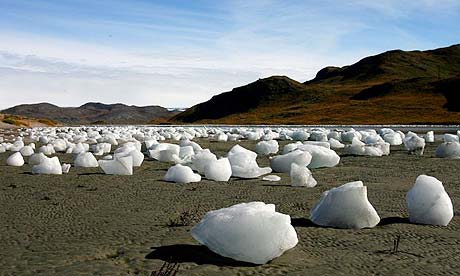
Ice boulders left behind after a flood caused by the overflowing of a lake in Greenland

Ice boulders left behind after a flood caused by the overflowing of a lake in Greenland. Photograph: Uriel Sinai/Getty images

In its half-century history, the EU has absorbed wave upon wave of immigrants. There were the millions of political migrants fleeing Russian-imposed communism to western Europe throughout the cold war, the post-colonial and "guest worker" migrants who poured into western Europe in the boom years of the 1950s and 60s, the hundreds of thousands who escaped the Balkan wars of the 90s and the millions of economic migrants of the past decade seeking a better life.

Now, according to the EU's two senior foreign policy officials, Europe needs to brace itself for a new wave of migration with a very different cause - global warming. The ravages already being inflicted on parts of the developing world by climate change are engendering a new type of refugee, the "environmental migrant".

Within a decade "there will be millions of environmental migrants, with climate change as one of the major drivers of this phenomenon," predict Javier Solana and Benita Ferrero-Waldner, the EU's chief foreign policy coordinator and the European commissioner for external relations. "Europe must expect substantially increased migratory pressure."

They point out that some countries already badly hit by global warming are demanding that the new phenomenon be recognised internationally as a valid reason for migration.

The immigration alert is but one of seven "threats" that the two officials focus on in pointing to the security implications and the dangers to European interests thrown up by climate change.

Their report, the first of its kind to be tabled to an EU summit - opening on Thursday in Brussels - amounts to a wake-up call to the governments of Europe, a demand that they start taking account of climate change and its impact in their security and foreign-policy decisions.

The main message is that the immediate and devastating effects of global warming will be felt far away from Europe, with the poor suffering disproportionately in south Asia, the Middle East, central Asia, Africa and Latin America, but that Europe will ultimately bear the consequences.

This could be in the form of mass migration, destabilisation of parts of the world vital to European security, radicalisation of politics and populations, north-south conflict because of the perceived injustice of the causes and effects of global warming, famines caused by arable land loss, wars over water, energy, and other natural resources.

Solana and Ferrero-Waldner paint a picture of a very bleak and very messy new world order which may undermine the UN system.

"The multilateral system is at risk if the international community fails to address the threats. Climate change impacts will fuel the politics of resentment between those most responsible for climate change and those most affected by it ... and drive political tension nationally and internationally."

This is not all futurology. The document points out that last year the UN's appeals for emergency humanitarian aid were all, bar one, connected to climate change.

As far as international security is concerned, the report finds, global warming makes a bad situation worse.

"Climate change is best viewed as a threat multiplier which exacerbates existing trends, tensions and instability,"
Solana and Ferrero-Waldner say. "The core challenge is that climate change threatens to overburden states and regions which are already fragile and conflict-prone. The risks include political and security risks that directly affect European interests."

The report highlights several forms of conflict that are likely to be driven by the planet heating up:

· "Reduction of arable land, widespread shortage of water, diminishing food and fish stocks, increased flooding and prolonged droughts are already happening in many parts of the world," Solana and Ferrero-Waldner say. Fresh water availability could fall by up to 30% in some regions, causing farming losses, surging food prices and shortages, and civil unrest. "Climate change will fuel existing conflicts over depleting resources."

· Around one-fifth of the planet's population inhabits coastal zones which are threatened by rising sea levels and natural disasters. The Caribbean, central America and the east coasts of China and India are most exposed. "An increase in disasters and humanitarian crises will lead to immense pressure on the resources of donor countries."

· The report notes that major land mass changes are expected in the course of the century from receding coastlines, meaning countries will lose territory, while desertification could have a similar effect. The result may be "a vicious circle of degradation, migration and conflicts over territory and borders that threatens the political stability of countries and regions".

· A similar result may be expected in failing states, where frustration and disenchantment breed ethnic and religious strife and political radicalisation.

· Competition for energy resources is already a cause of conflict. This may get worse, not least "because much of the world's hydrocarbon reserves are in regions vulnerable to the impacts of climate change and because many oil and gas producing states already face significant social, economic and demographic challenges."

Europe, the officials imply, needs to get its act together if there is to be any chance of managing the apocalyptic scenarios outlined. What the report does not say is that if demographics are any measure of potential power, Europe's task is that much harder.

The average European is currently aged 39 and Europeans, including Russians, make up some 11% of the world's population of 6.7 billion.

By 2050 that figure will have shrunk to 7%, with the average age of Europeans being over 47 and the elderly outnumbering children by more than two to one. A weaker Europe may have to cope with the challenges listed by Solana and Ferrero-Waldner, but environmental migrants may enlarge and rejuvenate its population.

Areas under threat

The Arctic

The speed of polar ice cap melting will have a large geostrategic impact, with conflicts likely over the vast new mineral resources that will become accessible, as well as the opening of new sea routes for international trade. Rival claims to the mineral wealth and shipping routes will challenge Europe's ability to secure its interests in the region.

Latin America

The Caribbean and central America are already badly affected by major hurricanes and extreme weather linked with El Niño. This will get worse, while weak governments will struggle to cope with social and political tension fuelled by climate change.

Africa

Particularly vulnerable because of its low ability to cope with climate change, which is already a factor contributing to the Darfur catastrophe and conflict in the Horn of Africa. Three-quarters of arable rain-fed land in north Africa and the Sahel could be lost. Some 5 million people in the Nile delta could be affected by land losses due to rising sea levels and salinisation by 2050.

Central Asia

Trouble ahead. The authoritarian regimes of the region will become increasingly important because of mineral wealth. But climate change means water shortages are already being felt. Kyrgyzstan has lost 1,000 glaciers over the past 40 years, while Tajikistan's glaciers have shrunk by one third. Farming and power generation are already being hit by water shortages.

Middle East

Water systems are already under intense stress, with around two-thirds of the Arab world dependent on water sources beyond their borders. Water supply might fall by 60% this century in Israel. Significant decreases expected to hit Turkey, Iraq, Syria and Saudi Arabia, further destabilising the "vitally strategic region".

South Asia

Almost two billion Asians live within 35 miles of a coast and many of them are likely to be threatened by rising sea levels. Damage to farming will make it difficult to feed rapidly swelling populations. Another billion people will be affected by a drop in meltwater from the Himalayas. These vulnerable populations will also be exposed to an increase in infectious diseases.

February 17, 2008

Indigenous People Demand More Over Medicinal Plants


(an oldie but informative)

(The Monitor (Uganda) Via Thomson Dialog NewsEdge)Indigenous peoples and peasant farmers who have helped develop the world's plant genetic resources through their traditional knowledge say negotiations aimed at the commercial exploitation of plants must involve them from the very start.

But their demands have turned into a long-running dispute over sovereignty, national boundaries and ownership of knowledge. As the Curitiba meeting of the UN Convention on Biological Diversity (CBD) drew to a close in Curitiba recently, the men and women who nurture the world's biodiversity struggled to make their voices heard.

Although the Convention itself was supportive of traditional knowledge and so-called benefit sharing, many government delegations did not include members of indigenous populations. And those indigenous peoples who were able to make it to Curitiba want to maintain an independent voice that recognises their special position.

"There is a proposal to include indigenous people as part of country delegations. But there is a problem: in the Philippines there are 110 indigenous peoples groups but the government would only allow one or two onto the delegation," said Victorino Saway, a representative of the Panagtagbo people who live on Mindanao Island.

He added: "When you are part of a delegation, you speak their language. You will be controlled - your language will be controlled."

At the CBD negotiations, the issue was termed Access and Benefit Sharing (ABS), but the official title masked potentially difficult aspects relating to economics, politics and culture.

Indigenous peoples and smallholder farmers, through their traditional knowledge, innovation and practices have over centuries developed and nurtured plant species for agricultural and medicinal use, contributing not only to 'development' but also to cultural and biological diversity.

But now companies are developing medicines and crops that take advantage of these plant genetic resources.

Keen to protect their financial interests - and recoup the investment made into research and development - companies usually protect their products with patents. This means that from time to time, a new product comes on the market and reaps massive profits for the company.

Indigenous people and some developing countries with high levels of biodiversity are now demanding ownership over what they claim are their genetic resources. And they want to be part of negotiations about how these resources are used, by whom, and on what terms.

A central issue is the concept of Prior Informed Consent (PIC) - an approach supported by the CBD. "The prior informed consent of knowledge-holders must be attained before their knowledge can be used by others," the CBD says.

Saway agrees: "If prior informed consent is ignored, there will be no basis for negotiations. It provides a basis for saying yes or no to access."

Perhaps the most contentious issue surrounding ABS is that of national sovereignty. As with other international agreements signed by governments on behalf of their peoples, national sovereignty forms the very basis of the CBD.

So when an indigenous group claims knowledge of a plant, or demands to be involved in negotiations, their government can say that the knowledge belongs to the country as a whole, and will therefore be negotiated by the national government.

Sylvester Rogers from Senegal, who works for the Community Biodiversity Development Conservation Network, told the meeting: "We believe that recognition and protection of the rights of indigenous and local communities with regard to agro-biodiversity and their traditional knowledge is non-negotiable and integral to any strategies and efforts towards the sustainable management and use of biodiversity."

Without that recognition and protection, he said, the utilisation of biodiversity will be nothing more than economic and commercial transactions, reducing indigenous people and local communities to "mere vendors of biological resources without respect to deeply held spiritual, cultural and socio-economic connections to the earth and biodiversity."

Indigenous people have a powerful backer in Tewolde Egziabher, an Ethiopian environmentalist and scientist who heads the African Group at CBD negotiations. He supports an international regime which includes PIC and certificates of origin of knowledge.

Such a regime, some campaigners say, would not only lead to fair and equitable sharing of the world's biological wealth, but also result in fewer patent disputes, some of which have grabbed headlines in recent years.

One such case involved the Hoodia plant, which pitted the San population of southern Africa - supported by a coalition of NGOs - against western and other pharmaceutical firms.

The Hoodia is a succulent plant - found in the Kalahari Desert - that can suppress appetite, and could potentially be used as an anti-obesity drug.

The plant's active ingredient was patented by a South African research institute in the late 1990s. It gave a license to a British company, which in turn sold additional development and marketing licenses to Pfizer, the multinational drug company, and the food giant Unilever.

After a protracted dispute, a deal was struck with the South African research institute in 2003 whereby the San people of South Africa, Namibia, Botswana, Zambia and Angola would receive a percentage of the royalties from the sales of any future drugs produced from their knowledge of the Hoodia plant.

The San based their claims on a CBD provision, which says should get a share of benefits resulting from the commercial use of local genetic resources and traditional knowledge. But there are countless examples where indigenous populations have lost out, as Ujalla Masdik, an Indian campaigner, reminded the conference.

She referred to a case involving an energy-giving plant used by Kani tribal people in the southern Indian state of Kerala. "Discovered" accidentally by members of an Indian scientific expedition in the early 1990s, the plant, known by the Kani as arogyapacha, was tested by a local research institute.

The institute then obtained a license from the Kerala Drug Control Department to produce and market a tonic based on the plant. It was named Jeevani (derived from the Sanskrit word meaning 'life').

The product was patented in 1996, following which the research institute transferred the production license to a local drug manufacturer. Although the Kani Trust received half the license fee and royalty, they were not involved in the negotiations.

"Some countries have made local or national laws about indigenous people, but others don't recognise them, or say 'we are all indigenous people'," said Saway of the Philippines.

Saway and his colleagues, working in the Mount Kitanglad region of the Philippines, have drawn up an inventory of plants based on their traditional knowledge, which the community "claims as our own".

As a precaution, the inventory has been written in the community's language and the plants' uses have not been explained. "We also have our cultural guards who will apprehend anyone taking our customary rights without our consent," he added.

The biotechnology industry, the usual target of attacks by NGOs and activists working on biodiversity issues, backs an access and benefit sharing system that is workable and provides value for use of genetic resources.

Alwin Kopse, a spokesman for the biotech corporation, Syngenta, said he supported national regimes that were "practical and transparent". Certificates of origin, he said, might be easier to obtain for products derived directly from plants, rather than those that were indirectly derived.

Another problem with issuing certificates of origin, Kopse said, was that certain genetic resources are shared across different countries or indigenous peoples. "What we want is a workable benefits access regime" - one that is not loaded with technocratic stamps, which, he argued "may turn out to be costly".

He accepted that the industry should now be prepared to pay for access to genetic resources but said Syngenta prefers to offer "other benefits" rather than hard cash.

If the CBD protocol on access and benefit sharing is to work, Kopse pointed out, it would be important to define the nature of benefits and who should receive them - a complex set of issues in his view.

Distributed by AllAfrica Global Media. (allafrica.com)

February 16, 2008

Tanzanian says it better than I can .. what's wrong with the US foreign policy

By Inviting Bush We Are Dishonouring Ourselves

Hamza Mustafa Njozi (2008-02-12)

“To sin by silence when they should protest makes cowards of men” – Abraham Lincoln

It would seem to me that there are certain moral limits beyond which no one can cross without forfeiting one’s honour and human dignity. Our seemingly voluntary decision to invite and to entertain a hated war criminal for four days in our beautiful land will probably go down in history as marking the darkest moment in our political history so far. I recall, not without pride, that in 2003 as members of the University of Dar es Salaam Academic Assembly [UDASA], we prevented the then U.S. Ambassador to Tanzania from visiting the Mlimani main campus. The university’s long-standing intellectual tradition was too noble to be soiled by a representative of a war criminal who was, and still is, butchering innocent people in Iraq and Afghanistan. This is as it should be. Intellectuals should keep the beacon of freedom and justice burning even during the darkest night of unbridled tyranny.

And now, Kwame Nkrumah’s worst fears have come to pass. Tanzania, a former Frontline State, is feverishly preparing itself to participate in a macabre dance with the deadliest twenty-first century harpy, “a monster who entices its victims with sweet music.” Tanzania is apparently following the footsteps of Uganda and Ethiopia. In whose interest? Let us begin by listening to the sweet music as performed by the U.S. Ambassador to Tanzania and sickeningly echoed by some of our leaders.

The Sweet Music of Economic Gain

According to the American Ambassador, Mr. Mark Green, President Bush’s visit to Tanzania will stimulate investment because for four days the world media would focus on Tanzania. Of course, Mr. Green dismissed claims about Bush’s keen interest to station AFRICOM in Tanzania. Instead, Bush’s noble intentions include intensifying the fight against malaria and Aids. To this end, Tanzania will receive $818.4 million to fight Aids. During the visit, Bush would also highlight his country’s commitment to improving health in Africa. In summary, the iron spine of the argument justifying Bush’s trip is economic gain, both, actual and prospective.

Unless if Tanzanians wish to fall prey to racist reasoning, Mr. Green’s story is nothing but an attempt to disguise ignoble motives beneath a glittering façade of altruism. Why should Mr. Bush be so concerned about improving the health condition of Tanzanians and at the same time use the most sophisticated weapons to kill and maim, with zest and ruthlessness, the Iraqis and Afghans and now the Somalis? Why? Is it because we are black and they are Arab? In his recent State of the Union Address, Mr. Bush, amid cheers from his sycophants, vowed to heighten his hawkish policies world wide. And yet, Mr. Bush is so kind and altruistic to Tanzanians. Why? Of course we know from history that even the sordid intentions of tyrants are always dressed up in glowing principles. Hitler occupied Czechoslovakia because he wanted to promote peace and social welfare for all; Mussolini invaded Ethiopia because he wanted to liberate the savages; Japan invaded China to create an earthly paradise; the US and UK invaded Iraq because Saddam Hussein had Weapons of Mass Destruction; and so on and so forth.

Thomas Jefferson on Profession of Noble Intent

Commenting on the famous claim by the British Imperialists that they were fighting for the liberation of mankind, Thomas Jefferson, wrote, as quoted in Noam Chomsky’s Hegemony or Survival, "We believe no more in Bonaparte’s fighting merely for the liberties of the seas, than in Great Britain’s fighting for the liberties of mankind. The object is the same, to draw to themselves the power, the wealth, and the resources of other nations."

“A century later,” writes Chomsky, “Woodrow Wilson’s secretary of state, Robert Lansing, commented scornfully on ‘how willing the British, French or Italians are to accept a mandate’ from the League of Nations, as long as ‘there are mines, oil fields, rich grain fields or railroads’ that will make it a profitable undertaking.’ These ‘unselfish governments’ declare the mandates must be accepted ‘for the good of mankind’: ‘they will do their proper share by administering the rich regions of Mesopotamia, Syria, & c.’ The proper assessment of these pretensions is ‘so manifest that it is almost an insult to state it’. (p. 48)

To their credit, American leaders saw through such pretensions, and dismissed them for what they were. They knew the real motive was to grab the wealth and resources of other nations. We should apply the same standard in assessing the noble intent of Mr. Bush.

The Transparency of American Motives

Since the Americans know that their real motive is to pillage and loot the wealth and resources of other nations, they have often demonstrated by their behaviour that they must have unhindered access to all resources of the world. To achieve this end, they have stationed military bases all over the world. The goal of their grand strategy is to prevent any challenge to the power, position, and prestige of the United States. Since securing the supplies of oil enables the Americans to have power over her rivals and competitors, successive US governments have bombed, occupied or controlled countries with rich oil deposits. According to a government daily newspaper Habari Leo of 21 July 2007, an American oil company Helvey International and Petronet International of South Africa have signed a $313 million oil exploration contract in Tanzania. In view of how American oil companies have fleeced other oil rich countries like Ecuador, this does not augur us well. No wonder, suddenly, Bush, loves Tanzanians! Why not invite the Chinese who need no military bases, who have invaded no country and who give the best offer? If what has befallen other countries is any barometer, the Americans will need a military base in Tanzania. Military presence is necessary to ensure total control of this vital resource as well as the continued pillage of our gold mines.

Of late USAID has increased its activities in Tanzania. Commenting on the role of USAID in promoting the American Empire, John Pilger notes in Freedom Next Time:

Illuminating how America exported ‘democracy to the world’, the head of USAID, Andrew Natsios, described ‘aid’ as ‘a key foreign policy instrument’. Wishing to leave no doubt about what he meant, he said, ‘Foreign assistance helps developing and transition nations move toward democratic systems and market economies; it helps nations prepare for participation in the global trading system and become better markets for U.S. exports. (p.265)

John Perkins has lent to the same verdict the weight of his considerable weight as a professional Economic Hit Man [EHM]. He says the job of an EHM is:

To encourage world leaders to become part of a vast network that promotes U.S. commercial interests. In the end, those leaders become ensnared in a web of debt that ensures their loyalty. We can draw on them whenever we desire – to satisfy our political, economic, or military needs.

Acccording to John Perkins, EHM “funnel money from the World Bank, UASID, and other foreign ‘aid’ organizations into the coffers of huge corporations and the pockets of a few wealthy families who control the planet’s natural resources” (p. ix).

Bush’s Visit and AFRICOM

The U.S. Ambassador has repeatedly and vehemently dismissed the disquieting reports that one of the objectives of Bush’s visit to Tanzania is to persuade our leaders into accepting to host the hated AFRICOM. Still, the signs and portents are too consistent to brush aside. According to Assistant Secretary of Defence for African Affairs, Theresa Whalen, the mission of AFRICOM will be to promote diplomatic, economic and humanitarian aid for African countries. In recent months, the U.S. Ambassadors, Michael Retzer and Mark Green have conspicuously [ and somewhat undiplomatically] attempted to show the shiny face of the U.S. Army. On 20 July, 2007 the US Ambassador opened a primary school in Chake Chake, Pemba. The school was built with the support of the US military base in Djibouti. The U.S. Navy Captain Wright from the U.S. CJTF-HOA, and the Country Director of USAID attended this important humanitarian function! Mwananchi of 10 November 2006 reported about a Tshs. 3.2 billion U.S assistance to the police laboratory. Habari Leo of 28 November 2007 reported that our police force received 100 hand-cuffs, 50 tape-recorders, 2 laptops, and a camera. Mwananchi of 8 December 2007, reported about the U.S. pledge to increase military assistance to Tanzania to the tune of $70 million under the Acota programme. Mwananchi of 6 December 2007, the U.S. Ambassador addresses students of Kinondoni Secondary school who are under USAID’s Stay Alive programme. Mwananchi of 22 November, 2007 the U.S. Ambassador visits and assists an orphanage in Arusha. Mwananchi of 22 November 2007, the U.S. Army helps a Handeni Hospital with equipments worth Tshs. 6 million. The U.S. Army stationed in Tanga involves itself with helping in the repair and rehabilitation of schools, dispensaries, bore holes and other social activities. Mwananchi of 12 January 2008, an American Army officer distributes toys to school children of Mbagala. Mwananchi of 17 January 2008, USAID officials give academic prizes to outstanding science students. Mtanzania of 10 January 2008, USAID praises the educational achievements of Zanzibar. USAID was handing over text books for Zanzibar secondary schools published by the University of South Carolina. The ceremony was part of the celebrations to mark 44 years of the Zanzibar Revolution. The Zanzibar Minister of Education did not seem to notice the tragic irony of the entire ceremony!

It may be instructive to recall that on 6 November 1933, Hitler responded to his political opponents by saying,
“Your child belongs to us already…What are you? You will pass on. Your descendants, however, now stand in the new camp. In a short time they will know nothing else but this new community.”
Four years later he said
“This new Reich will give its youth to no one, but will itself take youth and give to youth its own education and its own upbringing.”
Yes, new textbooks were written and new curricula developed.

After 44 years of Independence we are delegating this role to USAID. And USAID has nothing but praise for us!

The Boomerang Effect of the Global Media

The prediction that Tanzania would benefit economically because for four days the world media would focus on Tanzania is nothing but a cruel hoax. If this claim were true, Bush himself would have been the first beneficiary. He enjoys the publicity of the world media throughout the year. Yet, he is probably the most hated leader alive today. He is so hated that he becomes a huge security risk wherever he goes. In their book, America Alone, Harper and Clarke note that America’s militarism has brought about such a rise in world-wide anti-American feeling that:

When the president travels, he must do so in a locked-down security bubble: eight hours here, sixteen hours there, never more than thirty minutes from an airport, no press conferences, no meeting the people, no seeing of the sights. American representative overseas tell us that in many small ways their jobs have become more difficult…(p. 311).

Tanzania under Mwalimu Nyerere received very negative publicity from Newsweek, Time, The Economist, and other leading Western magazines and newspapers. And yet, as a nation we commanded respect throughout the world. The U.S. print and electronic media had nothing but praises for Tony Blair. And yet, unlike the leaders of Germany and France who took a principled stand against America’s unprovoked military aggression in Iraq, Blair’s enduring political image is that of a contemptible poodle of Uncle Sam and his otherwise great country as the 51st State of America!

In 2001 the U.S. Congress passed a bill which directed the government to cut off military aid to all countries which ratified the International Criminal Court treaty, unless they pledged never to surrender American criminals to the International court. Tanzania took a principled stand. It refused to bow to American pressure. Uganda bowed to the U.S. Bush praised Museveni as a shining example of African statesmen. To the rest of the world, Museveni had metamorphosed from a revolutionary African leader to a docile American pupil. In this regard, for some of us, it is a huge embarrassment when the number one war criminal in the world, who should be facing charges in the Hague, showers praises on our leader. No amount of positive media coverage may possibly help Senator Obama win votes in the U.S. if he were for four days to dine and go sight-seeing with Osama bin Laden in the beautiful land of Afghanistan! The situation would certainly be far worse if Osama were to shower praises on him. Likewise, Tanzania will irreparably tarnish her image by allowing the blood-drenching Bush to land in Tanzania, let alone to entertain him for four dark days.

When Fidel Castro or Nelson Mandela visited Tanzania, the country virtually came to a standstill. Thousands upon thousands of Tanzanians braved the rain and the scorching sun to welcome them at the airport. The rest thronged the streets out of respect and admiration. What a contrast with the forthcoming visit of Mr. Bush. For the first time since Independence, a state visit by a foreign head of state is greeted with fierce debates about the wisdom of allowing him to come! His presence is not an asset but a political liability.

Ominous Signs on the Wall

One ominous result of our close association with the American Empire, which may not be intended but inevitable, is the radical shift in our foreign policy. You cannot unequivocally support the rights of the Palestinian people against the Zionist occupation of their land and at the same time win the praise of Mr. Bush as an exemplary statesman. America is backing Israel to the hilt. We used to support the Palestinian people. To this day there is in Sinza area a hospital named after Palestine. The Palestinian people provided us with their doctors in appreciation of our political solidarity with them. We have to make a choice. We either maintain our stance against oppression and foreign occupation and court the displeasure of Mr. Bush or join the oppressors and win the unqualified praise from Mr. Bush and his so-called world media. It seems we value the empty praises of Mr. Bush more. This is a political tragedy.

The clearest example of this shift was observed when in 2006, the Israelis with the open support of the U.S. and UK launched their ill-fated war against Hezbullah in Lebanon. Tanzania was at a loss. The incompatibility of running with the hare and hunting with the hound confronted us. As country after country issued statements to condemn Israel, Tanzania kept quiet. And when we could no longer keep quiet, we issued a feeble and disappointing statement which provoked the anger of most Tanzanians. For the first time, Tanzania spoke with an uncertain voice. We condemned both, the aggressor and the victim! Even that feeble statement was eclipsed in virtually all print and electronic media! The Americans were happy. We were on the side of oppressors. We qualified to send a peace-keeping force to Lebanon! This, again, is a very bad omen indeed.

On the question of Somalia, once again, Tanzania is supporting the war-lords who were recruited and funded by the U.S. The Somali people rejected and defeated them. Peace returned in Somalia. The U.S instructed Ethiopia to intervene militarily. As a result, the biggest humanitarian crisis now is not in Darfur but in Somalia. However, since the principal architect of the crisis in Somalia is America, the suffering of the Somali people is not covered in the so-called world media. Uganda has dutifully sent her army to Mogadishu to give political life support to the American puppets. Tanzania has accepted the role of training the police force of Bush’s henchmen in Mogadishu. We are allowing America to divide us. In whose interest?

In short, as we go closer and closer to the armpit of the U.S. we shall quite inevitably, recede further and further from our former Third world allies. Americans and Europeans are granted visa at the airport here in Dar es Salaam. Egyptians, our long-standing allies and fellow Africans have to apply for visa and await clearance before they can travel to Tanzania. We invite investors from America, and we organize the Sullivan meeting. We discourage investors from the Middle East. America does not like them. The president has made many trips abroad. I do not recall if he has visited Iran, where we do not even have an Embassy. And yet, Iran bailed us out at a very critical moment when the country had no fuel. When our president was in Cuba to attend the NAM conference, he did not pay a courtesy call to Fidel Castro! From Cuba he went to the U.S. These are ominous signs on our political wall.

The Hawk and the Pigeons

In the Fables of Aesop there is a story of the hawk and the pigeons which is worth recalling as we invite Bush in Tanzania:

Some pigeons had long lived in fear of a hawk, but since they had always kept on the alert and stayed near their dovecote, they had consistently managed to escape their enemy’s attacks. Finding his sallies unsuccessful, the hawk now sought to use cunning to trick the pigeons.

“Why,” he once said, “do you prefer this life of constant anxiety when I could keep you safe from any conceivable attack by the kites and falcons? All you have to do is to make me your king, and I won’t bother you anymore.”

Trusting his claims, the pigeons elected him to their throne, but no sooner was he installed than he began exercising his royal prerogative by devouring a pigeon a day.

“It serves us right,” said one poor pigeon whose turn was yet to come.

The moral of the story is that some remedies are worse than the disease itself.

Let me end as I began with a quotation:

“I am not bound to win, but I am bound to be true. I am not bound to succeed, but I am bound to live by the light that I have. I must stand with anybody that stands right, and stand with him while he is right, and part with him when he goes wrong.”
--Abraham Lincoln.

*Hamza Mustafa Njozi is a Senior Lecturer in Literature and current Chair in the Department of Literature at the University of Dar es Salaam.


**Please send comments to editor@pambazuka.org or comment online at www.pambazuka.org


December 04, 2007

Africa and Climate Change the bald truth

Africa: Climate Change Impact Report


There is evidence that climate is modifying natural mountain ecosystems via complex interactions and feedbacks including, for example, solar radiation

(Washington, DC)

Washington, DC

"Climate disasters are heavily concentrated in poor countries. Some 262 million people were affected by climate disasters annually from 2000 to 2004, over 98 percent of them in the developing world. ...

In [rich] countries one in 1,500 people was affected by climate disaster. The comparable figure for developing countries was one in 19." - UNDP Human Development Report


This global inequality cited by the UNDP report (excerpted in another AfricaFocus Bulletin sent out today). is echoed in the extensively documented Africa chapter of latest report from the Intergovernmental Panel on Climate Change (IPCC), excerpted below, and available in full at http://www.ipcc.ch/ipccreports/ar4-wg2.htm

Both reports were released last month in time for the UN Climate Change Conference, scheduled for Bali, Indonesia, 3-14 December 2007. The climate change crisis, both reports stress, is not just an issue for the future. The changes are already adding to the impact of other stresses to increase risks to survival in areas and population groups that are already vulnerable.

The changes include dramatically visible ones, such as the rapid drop in the snow and ice cover on the summit of Mt. Kilimanjaro, as well as others with effects that show up in statistical studies.

See http://svs.gsfc.nasa.gov/stories/kilimanjaro_20021216/ for photos of Mt. Kilimanjaro, and the extensive documentation in the IPCC chapter on a wide range of effects.

Previous AfricaFocus Bulletins on climate change issues include:

Africa: Neglecting Agriculture, 2

http://www.africafocus.org/docs07/ag0710b.php

Sahel: Beyond Any Drought?

http://www.africafocus.org/docs07/sah0709.php

Africa: Up in Smoke?

http://www.africafocus.org/docs06/clim0611.php

Africa: Economics of Climate Change

http://www.africafocus.org/docs06/ster0611.php

Africa: Environmental Threats/Opportunities

http://www.africafocus.org/docs06/unep0609.php

Africa: Africa's Lakes

http://www.africafocus.org/docs06/lake0609.php

East Africa: Dams and Lake Victoria

http://www.africafocus.org/docs06/vic0602.php

PCC Fourth Assessment Report

Working Group II Report "Impacts, Adaptation and Vulnerability"

Introduction to the Report

Summary for Policymakers

Technical Summary

Chapter 1: Assessment of Observed Changes and Responses in Natural and Managed Systems - [ Supplementary Material ]

Chapter 2: New Assesment Methods and the Characterisation of Future Conditions

Chapter 3: Fresh Water Resources and their Management

Chapter 4: Ecosystems, their Properties, Goods and Services

Chapter 5: Food, Fibre, and Forest Products

Chapter 6: Coastal Systems and Low-Lying Areas

Chapter 7: Industry, Settlement and Society

Chapter 8: Human Health

Chapter 9: Africa

Chapter 10: Asia

Chapter 11: Australia and New Zealand

Chapter 12: Europe

Chapter 13: Latin America

Chapter 14: North America

Chapter 15: Polar Regions (Arctic and Antarctic)

Chapter 16: Small Islands

Chapter 17: Assessment of Adaptation Practices, Options, Constraints and Capacity

Chapter 18: Inter-Relationships Between Adaptation and Mitigation - [ Supplementary Material ]

Chapter 19: Assessing Key Vulnerabilities and the Risk from Climate Change

Chapter 20: Perspectives on Climate Change and Sustainability

Cross-Chapter Case Studies

Appendices I-V: Glossary, Contributors, Reviewers, Acronyms, Permissions

Index

Figures

November 24, 2007

Strange Space Weather over Africa

11.13.2007

+ Play Audio | + Download Audio | + Email to a friend | + Join mailing list

Nov. 13, 2007: Something strange is happening in the atmosphere above Africa and researchers have converged on Addis Ababa, Ethiopia, to discuss the phenomenon. The Africa Space Weather Workshop kicked off Nov. 12th with nearly 100 scientists and students in attendance.

The strange phenomenon that brings all these people together is the ion plume—"a newly discovered form of space weather," says University of Colorado atmospheric scientist and Workshop co-organizer Tim Fuller-Rowell.

Researchers liken the plumes to smoke billowing out of a factory smokestack—except instead of ordinary ash and dust, ion plumes are made of electrified gas floating so high above ground they come in contact with space itself.

"The plumes appear during geomagnetic storms and they can interfere with satellite transmissions, airline navigation and radio communications,"
says Fuller-Rowell. Indeed, it is their effect on GPS signals that led to the discovery of plumes over North America just a few years ago.

A typical example is the plume of Nov. 20, 2003:

Above: A plume of excess electron density over North America on Nov. 20, 2003. The plume was discovered and mapped by its effect on GPS signals. Credit: Courtesy of Anthea Coster and John Foster of MIT.

Two days before this map was made, an explosion on the sun had hurled a cloud of magnetized gas—a CME—toward Earth. The plume formed when the CME hit, triggering a strong geomagnetic storm. The plume consists of ionized air at high altitude moving from Florida to Canada at a speed of 1 km/s (2200 mph).

"Okay, now we've seen the 'smoke,' but where is the smokestack?" asks Fuller-Rowell.

The search is leading researchers to Africa.

"Many believe the source of the plumes is near Earth's magnetic equator," explains NASA heliophysicist Lika Guhathakurta who is attending the Workshop. "Africa is a great place to check this possibility because the magnetic equator passes directly over the sub-Sahara."

Just one problem: "There aren't enough sensors in Africa to study the phenomenon," says Fuller-Rowell. The sensor of choice is the dual-frequency GPS receiver. "North America has an abundance of dual frequency GPS receivers—thousands of them in a network we use to monitor North American plumes. But Africa has only a few dozen."

Below: Dual frequency GPS receivers now in Africa. More are needed to investigate the plume phenomenon.

The purpose of the Workshop is to familiarize African space scientists with the plume phenomenon and lay the groundwork for a continent-wide GPS network. "Within a few years we hope to deploy hundreds of receivers," he says.

Ion plumes inhabit a layer of Earth's atmosphere called the "ionosphere." It is a broad region 85 km to 600 km above ground level where ultraviolet radiation from the sun knocks electrons off atoms and molecules, creating a layer of ionized gas or "plasma" surrounding our entire planet. As ham radio operators have known for more than 100 years, the ionosphere can bend, distort, reflect and even absorb radio waves. Plumes amplify these effects.

How important is Africa to the study of this phenomenon? "Consider the list of organizations who have joined forces to sponsor the Africa Space Weather Workshop: NASA, NOAA, the National Science Foundation, the European Office of Aerospace Research and Development (EOARD), the International Center for Theoretical Physics (ICTP), and many others," says Guhathakurta. "It's widely understood that Africa is key to the puzzle."

At the moment only North America has a well-mapped ionosphere. NOAA posts new images every 15 minutes at this website. "Five years from now," says Fuller-Rowell, "we hope to be making realtime maps of the ionosphere over Africa, too."

Africa is plasma incognita—but not for long. Stay tuned!

The Africa Space Weather Workshop is organized under the auspices of the 2007 International Heliophysical Year (IHY), continuing the tradition of international research and cooperation begun during the International Geophysical Year (IGY) of 1957. To learn more about the IHY on the web, visit http://ihy2007.org/ .

November 22, 2007

The alarm bells begin to ring in China

Who will buy all this stuff? Who will buy the plastic garden furniture, the fridges, the toys, the wall of household junk that is thundering out of shiny new factories in China?

Between January and October, China’s statistical bureau recorded $1.2 trillion (£580 billion) of industrial spending. During the same period, lenders in America were slamming the door on their customers, cancelling credit cards, demanding the keys to homes, apartments and trailers. The message from the banks is clear: the party is over. Still, China’s factory floorspace continues to grow. You have to ask the question: who will buy the stuff?

The Pollyanna economists think it is all different now, a view espoused by the World Bank in its most recent report on East Asian economic growth. China is creating its own demand, “decoupling” from the US economy, it says.

I didn’t see much decoupling on a tour in early June of a furniture plant in southern China owned by Samson, a Taiwanese firm. Seven production lines, each in its own giant shed on a million square metre site were dedicated to producing reproduction antique furniture. Between 7,000 and 8,000 Chinese workers cut timber, sandpapered, lacquered and varnished enough wardrobes and dressers to fill 1,200 containers every month, with every item destined for a bedroom in America.

What will the bank debt collectors do with all those repro wardrobes, each lovingly polished to an antique patina, complete with fake wormholes? Samson reported falls in revenues and profits and squeezed margins in the first half of the year, due to the worst American housing slowdown in 25 years. It doesn’t expect a short-term turnound. “We will focus on cost-savings to go through the winter,” the company said, in a sombre outlook.

On planet World Bank, the view is still glorious. Perhaps the civil servants at World Bank HQ in Washington get better credit terms than most Americans. The institution reckons that China’s economy will grow at 10.8 per cent in 2008, two percentage points above its forecast in April, but some people in Beijing are yet to be convinced.

Only a day after the World Bank released its fug of warm air, Beijing’s Commerce Ministry raised the alarm, giving warning that things had reached a “turning point” and Chinese exporters could be “devastated” if US demand continues to fall.

Exports account for a third of China’s growth and America is the destination for a fifth of the stuff.

“The risks of economic slowdown in the US . . . plague our export prospects,”
the Commerce Ministry said.

China’s OK and so is Africa, says the World Bank. In a separate report, the Washington institution announces that the continent has “turned the corner”. A host of African states are now showing growth rates of 6 per cent or more, enough to lift their populations out of grinding poverty. Moreover, the bank seems to think that the shift to a higher gear is sustainable and not merely the temporary trickledown from barrels of oil priced at $100.

There is no doubt that there is mounting excitement about Africa. At a Renaissance Capital conference in London this week, Stephen Jennings, the investment bank’s chief executive, confidently predicted that his firm would repeat in sub-Saharan Africa the success it achieved when it established itself in Russia in 1992.

Huge infrastructure projects are the buzz. Ironically, it is China that is leading the way, offering its civil engineering know-how and financial muscle in return for access to the oil and metals badly needed by the People’s Republic. It’s a start, but only a continuing flow of private sector investment will create the conditions for sustained growth. What private investors want to know is whether a country, such as Nigeria, can break with its past tendency to regress periodically into orgies of corruption.

The answer lies not in aid, technical assistance or even private investment. It lies in people such as Ngozi Okonjo-Iweala, a former Nigerian finance minister, and Mo Ibrahim, the founder of Celtel, the pioneer of mobile telephony in West Africa. Mr Ibrahim, who sold his company for $3.4 billion and is using his wealth to promote good governance in Africa, chided bankers for their reluctance to back entrepreneurs. Celtel was sold with only $190 million in debt. “Those guys who were lending to sub-primes in America. Why would they not lend me more than $190 million?”

Bankers might lend if Africa had a well-regulated banking system strong enough to cope with crises – and that is where Dr Okonjo-Iweala played a vital role in Nigeria. As finance minister, she attacked corruption and engineered a debt forgiveness package that freed Nigeria from a millstone of borrowing accumulated under military dictatorship. Unfortunately, the woman who for many symbolised Nigeria’s drive to wipe out corruption is no longer in government. She was moved suddenly from her post last year and resigned. She is heading for Washington, to become managing director of the World Bank.

Politics matters in Africa. There, where business opportunities are few, politics attracts the strong. Dr Okonjo-Iweala is wasted in Washington. She is needed in Nigeria. The best aid package that the World Bank could devise would be to send her.

ShareThis