November 27, 2010

Commodities: Here we go again !!

How the U.S. Government Guaranteed the Coming Global Food Crisis :: The Market Oracle :: Financial Markets Analysis & Forecasting Free Website

How the U.S. Government Guaranteed the Coming Global Food Crisis

Commodities / Food CrisisNov 27, 2010 - 06:31 AM

By: DailyWealth

Commodities

Best Financial Markets Analysis ArticlePorter Stansberry with Braden Copeland write: Over the last several years, I've written constantly on the growing likelihood of a global currency collapse.

The governments of Europe and the United States have accumulated debts so large they can't ever hope to repay them, except with currencies whose value will be inflated away by money-printing.


That's led me to recommend inflation hedges like railroads, gold, silver, and various forms of energy. Owning these "real assets" is the single best way to protect yourself from the inflationary crisis. But make sure you don't forget the most important inflation hedge of all: food.

If you've been reading the financial press for the past few months, you know the prices of vital food commodities are soaring. The price of corn is up 47% since this summer. Soybeans are up 30%. Wheat is up 43%.

I expect this trend of higher food prices to continue for years as the U.S government intentionally debases the dollar while lying to you the whole time about wanting a "strong currency." (Make sure to read our essay hereabout this great lie.) There's also a good supply/demand case to be made for owning agricultural assets. Let's start with the largest crop in the United States, corn...

In 2009, U.S. farmers grew 39% of the world's corn – 307.4 million metric tons. The crop was worth $48 billion. Our corn exports totaled $8.7 billion.

Most harvested corn in the U.S. is used to feed livestock – 43% of 2009 production. Almost as much (41%) was used for food, consumer, and industrial products (toothpaste, adhesives, cosmetics, starches, sweeteners, oils, beverages, industrial alcohol, fuel ethanol, etc.). The remainder was exported. The U.S. sent most of its corn to Japan, Mexico, and South Korea.

The second-largest corn grower, China, produced 165.9 million metric tons, or half the U.S. production. The European Union was a distant third, harvesting 62.7 million metric tons. Brazil checked in fourth, at 51 million metric tons.

In 2009, a severe drought in China killed millions of bushels of corn. Stockpiles dwindled to alarming levels as the government sold corn to keep the price from rocketing higher. Into 2010, the situation hasn't improved. The Chinese have become net importers of corn for the first time in 16 years. Experts predict China will require 6 million to 8 million metric tons of corn this year.

The Chinese corn crunch reminds the world of the food shortages of 2006-2008. Average global prices for wheat, corn, and soybeans spiked more than 100%. Rice prices surged more than 200%.

This chart of the PowerShares Agriculture Fund (DBA) shows the sharp rise in agricultural commodity prices from 2007 to 2008...
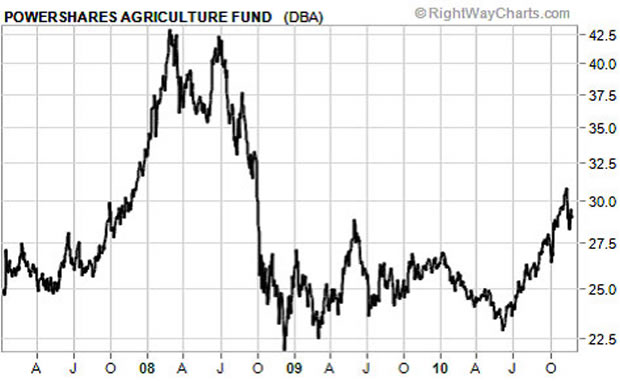

This price rise resulted from changing diets in developing countries and the U.S.'s move to use corn as a fuel source (ethanol). From 2006 to 2008, total global grain consumption increased 3% per year, up from 2% per year from 2000 to 2006. People were eating more meat. You need seven pounds of feed grain to produce one pound of beef.

Increasing affluence leads to a desire for greater luxury in everything, including food. Developing and developed countries are now competing for what they want to eat. And that means prices are going up again.

Notice the right edge of the chart. The price of the DBA basket of agricultural commodities is breaking higher. A large component of this fund is the United State's second largest crop, soybeans.

The U.S. produced $31 billion worth of soybeans in 2009. It's our largest agricultural export. Total exports in 2009 exceeded $16 billion, setting a record.

The U.S. produced almost one-third of the world's soybeans in 2009 (91.4 million metric tons). Brazil and Argentina combined for 50% more of the globe's production. China produced 7%, and India produced 4%.

Soybeans are also used for animal feed. They have twice as much protein content as any other major vegetable or grain. Their protein also makes up many common meat and dairy substitutes, including soymilk and tofu. Soybean oil is used for food and industrial applications.

When it comes to soy consumption, the story has changed in recent years. China has overtaken the U.S. as the leader...

In 2005, China was second, consuming 45 million metric tons of soybeans compared with the U.S.'s 51 million metric tons. Last year, China consumed at least 60 million metric tons. The U.S. consumed less than 50 million metric tons.

Unfortunately for China, its domestic production can't begin to satisfy its growing soybean consumption. In 2009, the Chinese imported more than 45 million metric tons of soybeans. Almost half came from the United States. Chinese producers harvested a little more than 15 million metric tons on their own.

The China National Grain and Oils Information Center is projecting total Chinese imports for 2010 will total 60 million metric tons. That would be a 33% increase over 2009. The U.S. will likely supply half of this. This demand is already driving soybean prices back toward their record 2008 levels of $16 per bushel...

The combination of increasing global demand coupled with the Fed's quantitative easing makes a huge move higher in these commodities (and funds like the DBA) likely. Prices could soar high enough to trigger a global crisis.

When you read about this in the next year or two, don't say you weren't warned... and don't say you aren't prepared.

Good investing,

Porter Stansberry and Braden Copeland


Ireland bailout: From €1,100 a week to living on the streets of Dublin

Homeless man s descent from full time worker to a tent in a car park shows the plight of Ireland s economic losers

The banker s tale: Governor who got out just in time

Living in a tent inside an empty underground car park Malcolm Quigley s fall from full time worker and home owner to destitution personifies the plight of those who have lost out in Ireland s economic crash.

The… » Full Story on The Guardian

Anger, wit and sadness: banners @ the Dublin march against austerity. | Ganly Reckons

Anger, wit and sadness: banners @ the Dublin march against austerity.

Banners are perhaps the most succinct way to get a point across in a protest environment such as the November 2010 Dublin march against austerity. There’s something very ‘human’ about them, particularly when pitched against the might of [the rotten legacy of] a corrupt government and exploitative bankers who steered Ireland toward such severe economic and social uncertainty.

Amongst the images of inexhaustible Irish wit and defiance was the most poignant picture I have seen so far; a little girl with a banner that read ‘please look after me’.

Putting the N in cuts

Putting the N in cuts!

I don't need sex...

I don't need sex...

Where's Justin Bieber?

Marching under duress? :)

Says it all

Simple messages are often the most effective...

Save the children

Here's to a brighter future...


November 25, 2010

REVEREND BILLY’S BUY NOTHING DAY ANGEL PARADE - Nerdfighters

REVEREND BILLY’S BUY NOTHING DAY ANGEL PARADE - Nerdfighters


just so you know it's there.
the garden

Join The Life After Shopping Singers, Preachers and Angels!
Friday, November 26, 3 – 4 PM
Start from Columbus Circle East, near the angel statue
All trains to 59th Street
Wear white and bring your angel wings..


This is our 8th Annual Buy Nothing Day Parade in NYC
We gather at Columbus Circle and then
take a fairly direct route through the heart of bank land to UBS,
defining evil in 2010. This year’s question: What part do banks play in
Devilish Consumerism?

Along our parade route bank branches are
everywhere: Chase, Citi, B of A, HSBC, Barclay’s, Amalgamated, TD, UBS,
and Chase again. A pack of Demons! The marketing techniques of retail
banking resembles any corporate consumer campaign, the same smiling
actors with their promises of happiness, power, youth… The big banks
also move hundreds of millions to super malls and chains, overwhelming
neighborhood and community shops. Some of the banks, UBS especially –
finance such earth-abusive activities as “Mountaintop Removal.”

On Friday November 26, 2010 – BUY NOTHING! EARTH-A-LUJAH!
Lets Talk about it & a VIDEO to inspire you

questions? savitri(at)revbilly.com
media makers welcome!

Join the Order of Digital Mysteries!
Revbilly.com // Facebook // Twitter // Myspace // blip.tv

▶ Reply to This

For Ken Delay ...

YouTube - Black Friday by Steely Dan: "http://www.youtube.com/watch?v=UVQKiqCZ9No"

The Beginning of the End for the War on Drugs? | Human Rights Watch

The Beginning of the End for the War on Drugs? | Human Rights Watch


by

Joseph Amon


NOVEMBER 21, 2010

A report to the U.N. General Assembly at the end of October about the need for better sex education was met with a flurry of angry voices. African nations rejected the report. Caribbean countries said they took "umbrage" and wanted to "put on record" their strong disapproval.

The report dared to say that comprehensive sex education shouldn't merely seek to scare adolescents by emphasizing deadly or disfiguring sexually transmitted infections or lecture on family planning. Instead, it suggested attention to pleasure and enjoyment of sexuality, including as an objective of sex education "abolishing guilt feelings about eroticism."

A few minutes after the report was delivered, the U.N. Special Rapporteur on Health, Anand Grover, called for countries around the world to end the so-called war on drugs. He urged countries to decriminalize drug possession and use, and offer services to drug users that can reduce HIV and hepatitis infection. Efforts to create a "drug-free" world, he said, had failed: Drug dependency is a complex problem, and drug use is deeply embedded in tradition and culture. As an example, he mentioned his father's use of "bhang lassi" - a marijuana milk shake, if you will - on religious holidays.

In the not-too-distant past, these suggestions would have caused as much outrage as the recommendation to teach kids about sex. Yet the reaction from the U.N. delegates was muted. Could it be that the collateral damage of the drug "war" and the realization of its ineffectiveness are finally creating some space to discuss alternative approaches?

There can be no doubt that current approaches to drugs are not only ineffective but also cruel. Criminalization of drug use and drug users fuels human-rights abuses and the spread of disease. In many countries, drug users are sent to "rehabilitation" centers where, without ever seeing a lawyer, judge or jury, they might spend years forced to do menial work. In some countries, drug users are experimented on, given unproven "cures" for heroin addiction. In China, more than 500 drug users were given partial lobotomies to "treat" drug use. A paper published in a scientific journal by Chinese doctors in 2003 describing the procedure led to an international outcry. Even in countries with better human-rights records, prisons are filled with nonviolent drug users, often disproportionately minorities.

Outside sub-Saharan Africa, nearly one-third of HIV cases are drug-related. In many places, as many as half of drug users are HIV-positive. Yet fewer than 5 percent of injecting drug users receive HIV-prevention services. Where drug users can access methadone and sterile needles, rates are much lower. Nonetheless, punitive approaches and preaching abstinence predominates. This focus on criminalization and law enforcement drives drug users underground, discouraging them from getting the health services they need.

Unnecessarily strict drug-control laws also have undermined the availability and accessibility of controlled medicines essential for palliative care. Access to morphine and codeine is virtually nonexistent in more than 150 countries. Tens of millions of people suffering from everything from cancer to car crashes experience untreated severe pain every year despite the fact that morphine is a cheap and effective generic drug. They are unseen casualties of the drug war.

Countries around the world are starting to recognize the failure of the current approach. Portugal's recent decision to increase drug treatment and decriminalize purchase, possession and personal use of small amounts of drugs has worked. The explosion of drug use and criminal acts predicted by critics has not emerged.

Argentina has taken similar measures. And in Mexico, where possession of small amounts of drugs for personal use has recently been decriminalized, comments by President Felipe Calderon and former President Vicente Fox regarding legalizing the production, sale and distribution of drugs have set off a wide-ranging public discussion. Many have come out in favor.

"Just say no" approaches haven't worked - for sex or drugs. Emphasizing health and education do, but this requires confronting countries that prioritize ideology over effective approaches and a respect for human rights. For both issues, millions of lives are at stake, and new approaches are desperately needed.

Joseph Amon is the director of the health and human rights division at Human Rights Watch.


Several Lawmakers Invested in L-3 Communications, Maker of Airport Body-Scanning Machines - OpenSecrets Blog | OpenSecrets

Several Lawmakers Invested in L-3 Communications, Maker of Airport Body-Scanning Machines - OpenSecrets Blog | OpenSecrets


There is PLENTY of material on L-3 on this blog. A NASTY piece of work.

By Michael Beckel on November 23, 2010 6:05 PM

A handful of federal lawmakers are invested in one of the companies behind the controversial full-body scanning machines now in more than 60 U.S. airports. The individual investments are worth thousands, and in some cases tens or hundreds of thousands, of dollars.

According to a Center for Responsive Politicsreview of the most recent personal financial disclosure filings, eight members of Congress -- three Democrats and five Republicans -- owned at least $2,000 worth of stock in L-3 Communications, which is one of the two main contractors involved in the full-body scanning machines.

Sen. John Kerry (D-Mass.) disclosed possessing the most stock in L-3 Communications -- with a minimum investment of at least $500,000 and a maximum value of $1 million. The L-3 Communications stock is fully owned by his wife, Teresa Heinz, according to federal financial disclosure reports.

Members of Congress file annual personal financial disclosures detailing their assets and liabilities, as well as those of their spouses and dependent children. These forms also allow lawmakers to describe the value of their holdings and debts in broad ranges, so it's impossible to know exactly how much the holdings of Kerry's family, or any other lawmaker's household, are worth.

Republican Reps. Michael Castle (R-Del.) and Michael McCaul (R-Texas) both disclosed possessing between $16,002 and $65,000 worth of L-3 Communications stock in 2009.

And Rep. Judy Biggert (R-Ill.) was the member of Congress with the next most valuable holdings in L-3 Communications, worth between $15,001 and $50,000.

Here is a table of all eight lawmakers whose 2009 personal financial disclosure forms, which were filed in May, noted holdings in L-3 Communications, along with the minimum and maximum value of these holdings, according to the Center's research.

NameValue
Sen. John Kerry (D-Mass.)$500,001 to $1,000,000
Rep. Michael Castle (R-Del)$16,002 to $65,000
Rep. Michael McCaul (R-Texas)$16,002 to $65,000
Rep. Judy Biggert (R-Ill.)$15,001 to $50,000
Rep. Ron Klein (D-Fla.)$1,001 to $15,000
Rep. Robert Scott (D-Va.)$1,001 to $15,000
Sen. Jon Kyl (R-Ariz.)$2,173
Rep. Kenny Marchant (R-Texas)$2,086

The government's investment in full-body scanners has broadened since the "underwear bomber's" failed terrorism attempt last Christmas. Days later, L-3 Communications was awarded a $165 million contract for the machines, and another company, RapiScan, was also awarded a $173 million contract.

scanner images.jpgBoth companies have seen significant jumps in their federal lobbying expenses since just a few years ago, and both are employing officials with well-heeled government connections, asOpenSecrets Blog previously reported.

For instance, RapiScan utilizes the services of Michael Chertoff, the secretary of Homeland Security under Republican President George W. Bush. And former Republican Sen. Alfonse D'Amato (R-N.Y.) and Linda Daschle, the wife of former Senate Majority Leader Tom Daschle (D-S.D.), are both actively lobbying for L-3 Communications.

ShareThis