Showing posts sorted by date for query recovery. Sort by relevance Show all posts

January 24, 2011

Klusterfuck coming, 2011 - Michael T. Klare


The Year Of Living Dangerously
By Michael T. Klare
24 January, 2011


Rising commodity prices and extreme weather events threaten global stability
Get ready for a rocky year. From now on, rising prices, powerful storms, severe droughts and floods, and other unexpected events are likely to play havoc with the fabric of global society, producing chaos and political unrest. Start with a simple fact: the prices of basic food staples are already approaching or exceeding their 2008 peaks, that year when deadly riots erupted in dozens of countries around the world.
It’s not surprising then that food and energy experts are beginning to warn that 2011 could be the year of living dangerously -- and so could 2012, 2013, and on into the future. Add to the soaring cost of the grains that keep so many impoverished people alive a comparable rise in oil prices -- again nearing levels not seen since the peak months of 2008 -- and you can already hear the first rumblings about the tenuous economic recovery being in danger of imminent collapse. Think of those rising energy prices as adding further fuel to global discontent.
Already, combined with staggering levels of youth unemployment and a deep mistrust of autocratic, repressive governments, food prices have sparked riots in Algeria and mass protests in Tunisia that, to the surprise of the world, ousted long-time dictator President Zine al-Abidine Ben Ali and his corrupt extended family. And many of the social stresses evident in those two countries are present across the Middle East and elsewhere. No one can predict where the next explosion will occur, but with food prices still climbing and other economic pressures mounting, more upheavals appear inevitable. These may be the first resource revolts to catch our attention, but they won’t be the last.
Put simply, global consumption patterns are now beginning to challenge the planet’s natural resource limits. Populations are still on the rise, and from Brazil to India, Turkey to China, new powers are rising as well. With them goes an urge for a more American-style life. Not surprisingly, the demand for basic commodities is significantly on the rise, even as supplies in many instances are shrinking. At the same time, climate change, itself a product of unbridled energy use, is adding to the pressure on supplies, and speculators are betting on a situation trending progressively worse. Add these together and the road ahead appears increasingly rocky.
Breadbaskets without Bread
Let’s begin with food, the most important and volatile of these commodities. Food prices declined in October 2008 after the onset of the global financial crisis, but that seems to have been an anomaly. The December 2010 index of global food prices compiled by the U.N.’s Food and Agricultural Organization (FAO) hit a record 215, one point higher than in the spring of 2008. (In that index, based on a “bundle” of food staples, a baseline of 100 represents average prices in 2002-2004.) In fact, some food products, including sugar, cooking oils, and fats, are now trading substantially above their 2008 levels; others, including dairy products, grains, and meat, are inching perilously close to record levels.
As 2011 begins, food experts fear that, within months, prices for key staples will climb above the 2008 threshold and stay there, causing extreme hardship for poor people around the world. “We are at a very high level,” said a worried Abdolreza Abbassian, an economist at the FAO. “These levels in the previous episode led to problems and riots across the world.”
Of particular concern to Abbassian and his colleagues is the rising cost of corn, rice, and wheat, the staple crops of billions in many of the poorest countries. According to the FAO, by the end of 2010 international corn and wheat prices were already approaching their 2008 peak levels (about $260 and $340 per metric ton, respectively).
Analysts attribute the rise in grain prices to growing demand in both developed and developing nations, along with a number of cataclysmic weather-related events and speculation by investors. An extreme drought and fierce fires last summer destroyed a large percentage of the wheat crop in Russia and Ukraine, while heavy flooding in India and the inundation of 20% of Pakistan damaged significant parts of the grain output of those countries. At the same time, unusually hot and dry weather suppressed production in a number of other key farming areas.
What makes the picture look so worrisome today are indications that the severity and frequency of extreme weather events appear to be on the rise. In the past few weeks alone, several such events point the way to serious supply problems ahead. Most significant has been the unprecedented rainfall and flooding in Australia that put an area more than twice the size of California largely underwater, significantly disrupting wheat cultivation there. Australia is one of the world’s leading wheat producers. Unusually dry conditions in the American Midwest and Argentina have also hinted at future problems in grain and corn output. It’s still too early to predict the size of this year’s grain and corn harvests, but many analysts are warning of a shortfall in supplies, along with sky-high prices.
Mainstream analysts and government officials are loathe to attribute this traffic jam of extreme weather events to global warming. Huge variations in rainfall can be normal, especially in places like Australia that are susceptible to El Niño/La Niña ocean-temperature oscillations, and politicians are fearful of assuming responsibility for a problem as massive as climate change. But climate change theory has long suggested that the warming trend -- 2010 tied 2005 for the warmest year on record and nine of the 10 warmest years have come in the last decade -- will be accompanied by an increase in the frequency and severity of storms. It’s hard to escape the conclusion that recent events, including those Australian floods, are tied to rising global temperatures.
The Energy Crisis Returns
Soaring food prices are being driven as well by speculative investments and the rising price of oil. Partly in response to the diminishing value of the dollar, some investors are sinking their money into food futures (along with gold and silver) as a speculative hedge. At the same time, the price of oil is edging toward the $100 mark, making it increasingly profitable for farmers to switch from growing corn for human consumption to growing it for the manufacture of ethanol, which in turn reduces the amount of farm acreage devoted to staples. Oil would have to fall below $50 per barrel to make the cultivation of corn as a food product competitive with ethanol production -- and that’s not likely to happen. So even if more corn is produced this year, less will be available for food purposes and the price of what remains is bound to rise.
The precipitous rise in oil prices has startled the experts. Not so long ago, the U.S. Department of Energy (DoE) was projecting a price range of $70-$80 per barrel in 2011, but as the year began oil was already trading above $90 a barrel and some analysts predict that it will reach $100 before the year is out. A few are even talking about the $150 barrel and gas prices at the pump of $4 or more. If prices climb above $100, global consumer spending could take another nosedive.
“Oil prices are entering a dangerous zone for the global economy,” says Fatih Birol, the chief economist for the International Energy Agency (IEA). “The oil import bills are becoming a threat to the economic recovery.”
As with food, the rising cost of oil is a product of growing demand, insufficient supplies, and speculative investments. According to the most recent projections from the IEA, daily global oil consumption in 2011 will average 87.4 million barrels, an increase of about two million barrels from the first quarter of 2010. Much of the extra demand is coming from China, where a newly-minted middle class is buying automobiles at a record clip, as well as from the United States, where previously cautious consumers are slowly returning to pre-2008 driving habits.
At a time when the oil industry is experiencing declining rates of output at many existing oil fields and finding it ever more difficult to add production, even two million extra barrels per day can be a daunting challenge (and greater demand is expected in the coming years). In the United States, for example, much hope was placed in oil exploration in the deep waters of the Gulf of Mexico and offshore Alaska, but in the wake of the BP disaster, this seems like a forlorn prospect. Production in Mexico and the North Sea, two bright spots of recent years, is facing a sharp decline, while other key producers, including those in the Middle East, are struggling to maintain current output levels at existing fields.
Many energy analysts believe that the world is at (or will soon reach) peak oil -- the moment when global petroleum output achieves a maximum sustainable daily rate and begins a long-term, irreversible decline. Others contend that higher levels of output are still possible. Whatever the truth of the matter, at this moment the oil industry is finding it increasingly difficult, and ever more costly, to boost output above current levels. This, combined with insatiable demand, is driving prices skyward.
Under these circumstances, speculators are again being drawn into the oil market as a rare sure bet. Such speculators helped push oil prices to a record $147 per barrel back in 2008, but fled the market when prices crashed as the American economy headed to a meltdown. Now, they’re coming back. “Hedge funds and private investors are buying up financial instruments tied to the price of crude, and thereby helping push up oil prices,” the Wall Street Journal reported in late December.
Most analysts are expecting a price surge this spring or summer when American motorists hit the road. “We will have a spring rally that will take us to between $3.10 and $3.50 a gallon for gasoline at service stations in the United States,” predicted Tom Kloza, chief oil analyst at the Oil Price Information Service.
The rising price of gas will, in turn, hurt consumers just as they show signs of opening their wallets again. No less worrisome, oil-importing countries like the United States, Japan, and many in Europe will face soaring bills for fuel imports, further enfeebling economies already suffering from profound weakness.
According to some calculations, oil prices added another $72 billion to America’s mammoth balance-of-payments deficit last year. Europe had to cough up an additional $70 billion for imported oil and Japan $27 billion. “It is a very telling story,” says the IEA’s Fatih Birol of recent oil-price data. “2010 rang the first alarm bells and 2011 price levels could bring us to the same financial crisis times that we saw in 2008.”
Rising food prices leading to riots, protests, and revolts, mounting oil prices, mammoth worldwide unemployment, and a collapsed recovery -- it looks like the perfect set of preconditions for a global tsunami of instability and turmoil. Events in Algeria and Tunisia give us just an inkling of what this maelstrom might look like, but where and how it will next erupt, and in what form, is anyone’s guess. A single guarantee: we haven’t seen the last of resource revolts which, in the coming years, could reach an intensity we scarcely imagine today.
Michael T. Klare is a professor of peace and world security studies at Hampshire College, a TomDispatch regular, and the author, most recently, of Rising Powers, Shrinking Planet. To listen to Timothy MacBain's latest TomCast audio interview in which Klare discusses what rising food prices mean globally, click here or, to download it to your iPod, here. A documentary movie version of his previous book, “Blood and Oil,” isavailable from the Media Education Foundation.
Copyright 2011 Michael T. Klare

:: www.uruknet.info :: informazione dal medio oriente :: information from middle east :: [vs-1]

You’re talking bollox, Mr Regev
A short primer on Israeli propaganda for media dummies*

By Stuart Littlewood

34gaza539w.jpg

June 8, 2010

What were Israel’s excuses for hijacking the Free Gaza ships in international waters and imprisoning their passengers after gunning down nine of them and wounding several more?

  • There is no humanitarian crisis in Gaza, and
  • Israel already allows sufficient humanitarian aid into Gaza so the flotilla was "an armada of hate and violence", said Israel’s deputy foreign minister.

But according to John Ging, United Nations Relief and Works Agency (UNRWA) director of operations in Gaza, "It’s a struggle to survive [with] the infrastructure and water and sanitation in a state of collapse and all that goes with that... People are at their wits’ end to understand when all of this will come to an end."

  • If the Free Gaza ships delivered the humanitarian cargo to the Israeli port of Ashdod, Israel would ensure it was delivered to Gaza after checking it for arms.

That’s very unlikely. The report "Failing Gaza: No rebuilding, no recovery, no more excuses" by a group of 16 European non-governmental organizations, published in December 2009, showed that the Israelis allow only a feeble trickle and what is permitted changes from day to day.

  • Israel could not allow the ships into Gaza without searching them for arms that might be of use to Hamas.

There are peaceful alternatives for checking cargoes. Besides, it’s time Israel implemented The Agreement on Movement and Access it signed in November 2005, under which it promised to allow its crossings into Gaza to "operate continuously" so that people and goods could move freely.

The agreement also provides for

  • the reduction of obstacles to movement within the West Bank
  • bus and truck convoys between the West Bank and Gaza
  • the building of a new seaport in Gaza
  • reopening of the airport in Gaza

There would then be no need for ships bringing humanitarian aid.

The European Council on 8 December 2009 stated: "The EU again reiterates its calls for an immediate, sustained and unconditional opening of crossings for the flow of humanitarian aid, commercial goods and persons to and from Gaza. In this context, the council calls for the full implementation of The Agreement on Movement and Access."

Israel has ignored countless verbal appeals. The EU is in position to twist its arm because it has granted Israel privileged access to European markets under the EU-Israel Association Agreement and the plug can be pulled. These trading advantages are conditional on Israel showing respect for human rights and democratic principles. Compliance is an essential element, not an option.

  • Israel’s interference with the mercy ships was an act of self-defence against the threat posed by Hamas firing rockets and mortars out of Gaza.

This isn’t about rockets. A ceasefire, brokered by Egypt, was negotiated with Hamas in June 2008. Hamas honoured the agreement, firing no rockets and restraining other resistance groups. Israel broke the ceasefire on 4 November by suddenly making a military incursion into Gaza and killing seven members of Hamas. Operation Cast Lead followed, supposedly to stop the rockets. The deaths of over 1,400 people and the maiming of thousands more were unnecessary. All Israel needed to do was observe the ceasefire. It chose not to.

And whatever Israel may say, the blockade inflicts "collective punishment" on the people of Gaza, which is a violation of international law and Article 33 of the Fourth Geneva Convention.

  • Hamas wants to destroy Israel.

Not true. Hamas has said it will accept Israel within its internationally-recognized 1967 borders, which is the same position the United Nations has adopted.

  • Prime Minister Binyamin Netanyahu now says "dozens of thugs" from what he called "an extremist, terrorism-supporting" organization were on-board the flotilla.

No evidence has been produced so far.

  • Israel is a vibrant democracy.

Actually, Israel is a racist ethnocracy, which discriminates in countless vile ways against its Arab minority.

As usual, Israel's chief propagandist, Mark Regev, was on hand to give the tragedy the benefit of his spin.

  • "We did everything we could to avoid violence... They [the aid workers] chose the path of confrontation… Our boarding party was attacked with live fire…"

No such weapons were found.

  • "Violence was initiated by these activists..."

No, violence was initiated by armed troops storming the peace ships in the dead of night.

  • "We didn't attack them, they attacked us... We tried to do, in accordance with international law, a peaceful intervention as they were entering a blockaded area..."

International law does not permit armed intervention in international waters, and the blockaded area has no legal basis.

  • "There are no shortages in Gaza..."

That is not what the UN and countless NGOs and charities say.

Meanwhile, in London, Israel’s ambassador, Ron Prosor, was saying:

  • "The people on board the ships behaved appallingly… they really did everything in order to provoke and confront…"

What is confrontational about sailing lawfully and peacefully on a humanitarian mission?

  • "We disengaged completely out of Gaza…"

No, Israel remains in occupation of Gaza's airspace and coastal waters and in control of all entrances and exits except on the Egyptian border. It has Gaza bottled up.

As always, newspaper and television editors, reporters and presenters were happy to retell the Israeli version of events, the distortion and the plain lies, along with the exaggerated language such as "extremists" and "militants" to describe aid workers, without bothering to examine or question the material in any way.

More pearls of wisdom from Regev

Mark Regev, the Israeli prime minister’s spokesman, is a rich source of propaganda nonsense, for example…

  • "It’s not just Israel who refuses to speak to Hamas. It’s the whole international community… Most of the democratic world refuses to have a relationship with Hamas because Hamas has refused to meet the most minimal benchmarks of international behaviour."

Isn’t that a little cheeky, Mr Regev, coming from a regime widely condemned for war crimes, piracy and mega-lawlessness?

  • "It was the former UN secretary-general, Kofi Annan, that put four benchmarks on the table. And he said, speaking for the international community…That if Hamas reforms itself… If Hamas recognizes my country’s right to live in freedom… If Hamas renounces terrorism against innocent civilians… If Hamas supports international agreements that are being signed and agreed to concerning the peace process… then the door is open. But unfortunately – tragically – Hamas has failed to meet even one of those four benchmarks. And that’s why today Hamas is isolated internationally. Even the United Nations refuses to speak to Hamas.

Which of those benchmarks has Israel met, Mr Regev?

If you’re getting the impression that Israel is going all-out to demonize Hamas you’d be right, as we’ll see later.

  • "Iran’spPresident openly talks about wiping Israel off the map. The Iranian nuclear programme is a threat, not just to my country, but to the entire region. And it’s incumbent upon us all to do what needs to be done to keep from proliferating."

Why is Israel the only state in the region not to have signed the Nuclear Non-Proliferation Treaty, Mr Regev? Are we all supposed to believe that Israel's 200 (or is it 400?) nuclear warheads pose no threat to the region? Would you also tell us why Israel hasn’t signed the Biological and Toxin Weapons Convention, and hasn’t ratified the Comprehensive Nuclear Test-Ban Treaty or the Chemical Weapons Convention? What proof do you have of Iran's nuclear weapons plans?

And why do you deliberately misquote Mr Ahmadinejad? For the record, the Iranian president said, quoting the late Ayatollah Khomeini: "The Imam said this regime occupying Jerusalem must vanish from the page of time."

Israel’s Crapaganda Handbook

The rest is on the link ...

January 10, 2011

DOD AGENCIES HAVE PROHIBITED WATERBOARDING, IG SAYS


Defense agencies have complied with a recommendation to prohibit the use of military survival training techniques -- such as waterboarding -- in prisoner interrogation, the DoD inspector general confirmed in a report (pdf) last year.

In response to a previous Inspector General report (pdf), a 2008 DoD directive (pdf) stated that "Use of SERE [survival, evasion, resistance, and escape] techniques against a person in the custody or effective control of the Department of Defense or detained in a DoD facility is prohibited."  Likewise, a 2009 memorandum for the military services and the Special Operations Command specified that use of "SERE techniques for interrogations of personnel in DoD custody or control is prohibited."

The 2010 IG report found that "all US Air Force, US Army, US Navy, US Marine Corps, and [Joint Personnel Recovery Agency] SERE training programs included, as part of their curriculum, a prohibition against the use of SERE techniques for interrogation of personnel in DoD custody or control."  See "Field Verification-Interrogation and Survival, Evasion, Resistance, and Escape (SERE) Techniques Recommendation," DoD Inspector General Report 10-INTEL-05, April 16, 2010 (released under FOIA in December 2010).

SERE training provides "a reasonable means to train [U.S. military personnel] for the most challenging captivity environment where captors do not abide by the Geneva Conventions," the IG report said.  But "the physical and psychological pressures developed for... SERE training were not intended for real-world interrogations.  Intelligence resistance training does not qualify a SERE Specialist instructor to conduct interrogations or provide subject matter expertise to those who are trained in that specialty."

January 07, 2011

Think about it; Epiphany

Richard's Daily Meditations

Still Waters, Dock Lake, photograph by and © Joelle Chase 

ADULT CHRISTIANITY

Thursday, January 6, 2010
12th Day of Christmas

Richard Roer


When you can get out of the three C’s (controlling, comparing, competing) of the first half of life, you can live in the “naked now” where everything essential to your joy, even in the midst of difficulty, is already given.  That is second half of life knowledge.
No one can do this homework for you.  My telling you about it can’t get you there.  All I can do is encourage you to stay on your journey and tell you that the journey is real.  This will keep you from losing hope. Then one day you’ll know for yourself, although you won’t exactly know what it is that you know.  You just know it is okay.
Such a person is grounded in God.  Their foundation is outside of themselves.  This is the basis for any true and lasting happiness.  Alcoholics Anonymous speaks of this central process as “turning over our will and our lives to the care of God as we understand him.”  Maybe that is why I meet so many in recovery who appear to be in the second half of life, spiritually speaking.  Yet they still carry their wounds, just as the Risen Jesus carried his. 
 

  Starter prayer:
You know who I am. 


January 05, 2011

One of Tom Englehart's finest moments ... War Is a Drug

Washington's 30-Year High 

By Tom Engelhardt

If, as 2011 begins, you want to peer into the future, enter my time machine, strap yourself in, and head for the past, that laboratory for all developments of our moment and beyond.
Just as 2010 ended, the American military's urge to surge resurfaced in a significant way.  It seems that "leaders" in the Obama administration and "senior American military commanders" in Afghanistan were acting as a veritable WikiLeaks machine.  They slipped information to New York Times reporters Mark Mazzetti and Dexter Filkins about secret planning to increase pressure in the Pakistani tribal borderlands, possibly on the tinderbox province of Baluchistan, and undoubtedly on the Pakistani government and military via cross-border raids by U.S. Special Operations forces in the new year.
In the front-page story those two reporters produced, you could practically slice with a dull knife American military frustration over a war going terribly wrong, over an enemy (shades of Vietnam!) with "sanctuaries" for rest, recuperation, and rearming just over an ill-marked, half-existent border.  You could practically taste the chagrin of the military that their war against... well you name it: terrorists, guerrillas, former Islamic fundamentalist allies, Afghan and Pakistani nationalists, and god knows who else... wasn't proceeding exactly swimmingly.  You could practically reach out and be seared by their anger at the Pakistanis for continuing to take American bucks by the billions while playing their own game, rather than an American one, in the region.
If you were of a certain age, you could practically feel (shades of Vietnam again!) that eerily hopeful sense that the next step in spreading the war, the next escalation, could be the decisive one.  Admittedly, these days no one talks (as they did in the Vietnam and Iraq years) about turning "corners" or reaching "tipping points," but you can practically hear those phrases anyway, or at least the mingled hope and desperation that always lurked behind them. 
Take this sentence, for instance: "Even with the risks, military commanders say that using American Special Operations troops could bring an intelligence windfall, if militants were captured, brought back across the border into Afghanistan and interrogated." Can't you catch the familiar conviction that, when things are going badly, the answer is never "less," always "more," that just another decisive step or two and you'll be around that fateful corner? 
In this single New York Times piece (and other hints about cross-border operations), you can sense just how addictive war is for the war planners. Once you begin down the path of invasion and occupation, turning back is as difficult as an addict going cold turkey.  With all the sober talk about year-end reviews in Afghanistan, about planning and "progress" (a word used nine times in the relatively brief, vetted "overview" of that review recently released by the White House), about future dates for drawdowns and present tactics, it's easy to forget that war is a drug.  When you're high on it, your decisions undoubtedly look as rational, even practical, as the public language you tend to use to describe them.  But don't believe it for a second.
Once you've shot up this drug, your thinking is impaired.  Through its dream-haze, unpleasant history becomes bunk; what others couldn't do, you fantasize that you can.  Forget the fact that crossing similar borders to get similar information and wipe out similar sanctuaries in Cambodia and Laos in the Vietnam War years led to catastrophe for American planners and the peoples of the region.  It only widened that war into what in Cambodia would become auto-genocide.  Forget the fact that, no matter whom American raiders might capture, they have no hope of capturing the feeling of nationalism (or the tribal equivalent) that, in the face of foreign invaders or a foreign occupation, keeps the under-armed resilient against the mightiest of forces.
Think of the American urge to surge as a manifestation of the war drug's effect in the world. In what the Bush administration used to call "the Greater Middle East," Washington is now in its third and grimmest surge iteration.  The first took place in the 1980s during the Reagan administration's anti-Soviet jihad in Afghanistan and proved the highest of highs; the second got rolling as the last century was ending and culminated in the first years of the twenty-first century amid what can only be described as delusions of grandeur, or even imperial megalomania.  It focused on a global Pax Americana and the wars that extend it into the distant future.  The third started in 2006 in Iraq and is still playing itself out in Afghanistan as 2011 commences.
In Central and South Asia, we could now be heading for the end of the age of American surges, which in practical terms have manifested themselves as the urge to destabilize.  Geopolitically, little could be uglier or riskier on our planet at the moment than destabilizing Pakistan -- or the United States.  Three decades after the American urge to surge in Afghanistan helped destabilize one imperial superpower, the Soviet Union, the present plans, whatever they may turn out to be, could belatedly destabilize the other superpower of the Cold War era.  And what our preeminent group of surgers welcomed as an "unprecedented strategic opportunity" as this century dawned may, in its later stages, be seen as an unprecedented act of strategic desperation. 
That, of course, is what drugs, taken over decades, do to you: they give you delusions of grandeur and then leave you on the street, strung out, and without much to call your own.  Perhaps it's fitting that Afghanistan, the country we helped turn into the planet's leading narco-state, has given us a 30-year high from hell.
So, as the New Year begins, strap yourself into that time machine and travel with me back into the 1980s, so that we can peer into a future we know and see the pattern that lies both behind and ahead of us.
Getting High in Afghanistan
As 2011 begins, what could be eerier than reading secret Soviet documents from the USSR's Afghan debacle of the 1980s?  It gives you chills to run across Communist Party General Secretary Mikhail Gorbachev at a Politburo meeting in October 1985, almost six years after Soviet troops first flooded into Afghanistan, reading letters aloud to his colleagues from embittered Soviet citizens ("The Politburo had made a mistake and must correct it as soon as possible -- every day precious lives are lost."); or, in November 1986, insisting to those same colleagues that the Afghan war must be ended in a year, "at maximum, two." Yet, with the gut-wrenching sureness history offers, you can't help but know that, even two years later, even with a strong desire to leave (which has yet to surface among the Washington elite a decade into our own Afghan adventure), imperial pride and fear of loss of "credibility" would keep the Soviets fighting on to 1989.
Or what about Marshal Sergei Akhromeev offering that same Politburo meeting an assessment that any honest American military commander might offer a quarter century later about our own Afghan adventure: "There is no single piece of land in this country that has not been occupied by a Soviet soldier.  Nevertheless, the majority of the territory remains in the hands of the rebels." Or General Boris Gromov, the last commander of the Soviet 40th Army in Afghanistan, boasting "on his last day in the country that "[n]o Soviet garrison or major outpost was ever overrun.'"
Or Andrei Gromyko, Chairman of the Presidium of the Supreme Soviet, emphasizing in 1986 the strategic pleasure of their not-so-secret foe, that other great imperial power of the moment: "Concerning the Americans, they are not interested in the settlement of the situation in Afghanistan.  On the contrary, it is to their advantage for the war to drag out." (The same might today be said of a far less impressive foe, al-Qaeda.)
Or in 1988, with the war still dragging on, to read a "closed" letter the Communist Party distributed to its members explaining how the Afghan fiasco happened (again, the sort of thing that any honest American leader could say of our Afghan war): "In addition, [we] completely disregarded the most important national and historical factors, above all the fact that the appearance of armed foreigners in Afghanistan was always met with arms in the hands [of the population]... One should not disregard the economic factor either.  If the enemy in Afghanistan received weapons and ammunition for hundreds of millions and later even billions of dollars, the Soviet-Afghan side also had to shoulder adequate expenditures.  The war in Afghanistan costs us 5 billion rubles a year."
Or finally the pathetic letter the Soviet Military Command delivered to the head of the UN mission in Afghanistan on February 14, 1989, arguing (just as the American military high command would do of our war effort) that it was "not only unfair but even absurd to draw... parallels" between the Soviet Afghan disaster and the American war in Vietnam.  That was, of course, the day the last of 100,000 Soviet soldiers -- just about the number of American soldiers there today -- left Afghan soil heading home to a sclerotic country bled dry by war, its infrastructure aging, its economy crumbling.  Riddled by drugs and thoroughly demoralized, the Red Army limped home to a society riddled by drugs and thoroughly demoralized led by a Communist Party significantly delegitimized by its disastrous Afghan adventure, its Islamic territories from Chechnya to Central Asia in increasing turmoil.  In November of that same year, the Berlin Wall would be torn down and not long after the Soviet Union would disappear from the face of the Earth.
Reading those documents, you can almost imagine CIA director William Webster and "his euphoric "Afghan Team'" toasting the success of the Agency's 10-year effort, its largest paramilitary operation since the Vietnam War.  The Reagan administration surge in Pakistan and Afghanistan had been profligate, involving billions of dollars and a massive propaganda campaign, as well as alliances with the Saudis and a Pakistani dictator and his intelligence service to fund and arm the most extreme of the anti-Soviet jihadists of that moment -- "freedom fighters" as they were then commonly called in Washington.
It's easy to imagine the triumphalist mood of celebration in Washington among those who had intended to give the Soviet Union a full blast of the Vietnam effect.  They had used the "war" part of the Cold War to purposely bleed the less powerful, less wealthy of the two superpowers dry.  As President Reagan would later write in his memoirs: "The great dynamic of capitalism had given us a powerful weapon in our battle against Communism -- money.  The Russians could never win the arms race; we could outspend them forever."
By 1990, the urge to surge seemed a success beyond imagining.  Forget that it had left more than a million Afghans dead (and more dying), that one-third of that impoverished country's population had been turned into refugees, or that the most extreme of jihadists, including a group that called itself al-Qaeda, had been brought together, funded, and empowered through the Afghan War.  More important, the urge to surge in the region was now in the American bloodstream.  And who could ever imagine that, in a new century, "our" freedom fighters would become our sworn enemies, or that the Afghans, that backward people in a poor land, could ever be the sort of impediment to American power that they had been to the Soviets?
The Cold War was over.  The surge had it.  We were supreme.  And what better high could there be than that?
Fever Dreams of Military Might
Of course, with the Soviet Union gone, there was no military on the planet that could come close to challenging the American one, nor was there a nascent rival great power on the horizon.  Still, a question remained: After centuries of great power rivalry, what did it mean to have a "sole superpower" on planet Earth, and what path should that triumphant power head down? It took a few years, including passing talk about a possible "peace dividend" -- that is, the investment of monies that would have gone into the Cold War, the Pentagon, and the military in infrastructural and other domestic projects -- for this question to be settled, but settled it was, definitively, on September 12, 2001.
And for all the unknown paths that might have been taken in this unique situation, the one chosen was familiar.  It was, of course, the very one that had helped lead the Soviet Union to implosion, the investment of national treasure in military power above all else.  However, to those high on the urge to surge and now eager to surge globally, when it came to an American future, the fate of the Soviet Union seemed no more relevant than what the Afghans had done to the Red Army.  In those glory years, analogies between the greatest power the planet had ever seen and a defeated foe seemed absurd to those who believed themselves the smartest, clearest-headed guys in the room.
Previously, the "arms race," like any race, had involved at least two, and sometimes more, great powers.  Now, it seemed, there would be something new under the sun, an arms race of one, as the U.S. prepared itself for utter dominance into a distant, highly militarized future.  The military-industrial complex would, in these years, be further embedded in the warp and woof of American life; the military expanded and privatized (which meant being firmly embraced by crony corporations and hire-a-gun outfits of every sort); and the American "global presence" -- from military bases to aircraft-carrier task forces -- enhanced until, however briefly, the United States became a military presence unique in the annals of history.
Thanks to the destructive acts of 19 jihadis, the urge to surge would with finality overwhelm all other urges in the fall of 2001 -- and there would be a group ready for just such a moment, for (as the newspaper headlines screamed) a "Pearl Harbor of the twenty-first century."
To take full stock of that group, however, we would first have to pilot our time machine back to June 3, 1997, the day a confident crew of Washington think-tank, academic, and political types calling themselves the Project for the New American Century (PNAC) posted a fin de siècle "statement of principles." In it, they called for "a military that is strong and ready to meet both present and future challenges; a foreign policy that boldly and purposefully promotes American principles abroad; and national leadership that accepts the United States' global responsibilities."  Crucially, they were demanding that the Clinton administration, or assumedly some future administration with a better sense of American priorities, "increase defense spending significantly."
The 23 men and two women who signed the initial PNAC statement urging the United States to go for the military option in the twenty-first century would, however, prove something more than your typical crew of think-tank types.  After all, not so many years later, after a disputed presidential election settled by the Supreme Court, Dick Cheney would be vice president; I. Lewis ("Scooter") Libby would be his right-hand man; Donald Rumsfeld would be Secretary of Defense, Paul Wolfowitz, Deputy Secretary of Defense; Zalmay Khalilzad, head of the Bush-Cheney transition team at the Department of Defense and then the first post- invasion U.S. ambassador to Afghanistan, as well as ambassador to Iraq and UN ambassador; Elliot Abrams, special assistant to the president with a post on the National Security Council; Paula Dobriansky, Under Secretary of State for Democracy and Global Affairs; Aaron Friedberg, Deputy Assistant for National Security Affairs and Director of Policy Planning in the office of the vice president; and Jeb Bush, governor of Florida.  (Others like John Bolton, who signed on to PNAC later, would be no less well employed.)
This may, in fact, be the first example in history of a think tank coming to power and actually putting its blue-sky suggestions into operation as government policy, or perhaps it's the only example so far of a government-in-waiting masquerading as an online think tank.  In either case, more than 13 years later, the success of that group can still take your breath away, as can both the narrowness -- and scope -- of their thinking, and of their seminal document, "Rebuilding America's Defenses," published in September 2000, two months before George W. Bush took the presidency.
This crew of surgers extraordinaires was considering a global situation that, as they saw it, offered Americans an "unprecedented strategic opportunity."  Facing a new century, their ambitions were caught by James Peck in his startling upcoming book, Ideal Illusions: How the U.S. Government Co-opted Human Rights, in this way: "In the [Reagan] era, Washington organized half the planet; in the [Bush era] it sought to organize the whole."
"Rebuilding America's Defenses," if remembered at all today, is recalled mainly for a throwaway sentence that looked ominous indeed in retrospect: "Further, the process of transformation [of the military], even if it brings revolutionary change, is likely to be a long one, absent some catastrophic and catalyzing event -- like a new Pearl Harbor."  It remains, however, a remarkable document for other reasons.  In many ways canny about the direction war would take in the near future, ranging from the role of drones in air war to the onrushing possibility that cyberwar (or "Net-War," as they called it) would be the style of future conflict, it was a clarion call to ensure this country's "unchallenged supremacy" into the distant future by military means alone.
In 1983, in an address to the National Association of Evangelicals, President Ronald Reagan famously called the Soviet Union an "evil empire."  It wanted, as he saw it, what all dark empires (and every evildoer in any James Bond film) desires: unchallenged dominion over the planet -- and it pursued that dominion in the name of a glorious "world revolution."  Now, in the name of American safety and the glories of global democracy, we were -- so the PNAC people both pleaded and demanded -- to do what only evil empires did and achieve global dominion beyond compare over planet Earth.
We could, they insisted in a phrase they liked, enforce an American peace, a Pax Americana, for decades to come, if only we poured our resources, untold billions -- they refused to estimate what the real price might be -- into war preparations and, if necessary, war itself, from the seven seas to the heavens, from manifold new "forward operating bases on land" to space and cyberspace.  Pushing "the American security perimeter" ever farther into the distant reaches of the planet  (and "patrolling" it via "constabulary missions") was, they claimed, the only way that "U.S. military supremacy" could be translated into "American geopolitical preeminence."  It was also the only that the "homeland" -- yes, unlike 99.9% of Americans before 9/11, they were already using that term -- could be effectively "defended."
In making their pitch, they were perfectly willing to acknowledge that the United States was already a military giant among midgets, but they were also eager to suggest as well that our military situation was "deteriorating" fast, that we were "increasingly ill-prepared" or even (gasp!) in "retreat" on a planet without obvious enemies.  They couldn't have thought more globally.  (They were, after all, visionaries, as druggies tend to be.)  Nor could they have thought longer term.  (They were twenty-first century mavens.)  And on military matters, they couldn't have been more up to date.
Yet on the most crucial issues, they -- and so their documents -- couldn't have been dumber or more misguided.  They were fundamentalists when it came to the use of force and idolaters on the subject of the U.S. military.  They believed it capable of doing just about anything.  As a result, they made a massive miscalculation, mistaking military destructiveness for global power.  Nor could they have been less interested in the sinews of global economic power (though they did imagine our future enemy to be China).  Nor were they capable of imagining that the greatest military power on the planet might be stopped in its tracks -- in the Greater Middle East, no less -- by a ragtag crew of Iraqis and Afghans.  To read "Rebuilding America's Defenses" today is to see the rabbit hole down which, as if in a fever dream, we would soon disappear.
It was a genuine American tragedy that they came to power and proceeded to put their military-first policies in place; that, on September 12th of the year that "changed everything," the PNAC people seized the reins of defense and foreign policy, mobilized for war, began channeling American treasure into the military solution they had long desired, and surged.  Oh, how they surged!
That urge to surge was infamously caught in notes on Secretary of Defense Donald Rumsfeld's comments taken on September 11, 2001.  "[B]arely five hours after American Airlines Flight 77 plowed into the Pentagon... Rumsfeld was telling his aides to come up with plans for striking Iraq," even though he was already certain that al-Qaeda had launched the attack. ("'Go massive,' the notes quote him as saying. 'Sweep it all up. Things related and not.'")
And so they did.  They swept up everything and then watched as their dreams and geopolitical calculations were themselves swept into the dustbin of history.  And yet the urge to surge, twisted and ever more desperate, did not abate.
The Soviet Path
To one degree or another, we have been on the Soviet path for years and yet, ever more desperately, we continue to plan more surges.  Our military, like the Soviet one, has not lost a battle and has occupied whatever ground it chose to take.  Yet, in the process, it has won less than nothing at all.  Our country, still far more wealthy than the Soviet Union ever was, has nonetheless entered its Soviet phase.  At home, in the increasing emphasis on surveillance of every sort, there is even a hint of what made "soviet" and "totalitarian" synonymous. 
The U.S. economy looks increasingly sclerotic; moneys for an aging and rotting infrastructure are long gone; state and city governments are laying off teachers, police, even firefighters; Americans are unemployed in near record numbers; global oil prices (for a country that has in no way begun to wean itself from its dependence on foreign oil) are ominously on the rise; and yet taxpayer money continues to pour into the military and into our foreign wars.  It has recently been estimated, for instance, that after spending $11.6 billion in 2011 on the training, supply, and support of the Afghan army and police, the U.S. will continue to spend an average of $6.2 billion a year at least through 2015 (and undoubtedly into an unknown future) -- and that's but one expense in the estimated $120 billion to $160 billion a year being spent at present on the Afghan War, what can only be described as part of America's war stimulus package abroad.
And, of course, the talk for 2011 is how to expand the American ground war -- the air version of the same has already been on a sharp escalatory trajectory -- in Pakistan. History and common sense assure us that this can only lead to further disaster.  Clear-eyed leaders, military or civilian, would never consider such plans.  But Washington's 30-year high in the region, that urge to surge still coursing through its veins, says otherwise, and it's not likely to be denied.
Sooner than later, Washington, the Pentagon, and the U.S. military will have to enter rehab.  They desperately need a 12-step program for recovery.  Until then, the delusions and the madness that go with surge addiction are not likely to end.

Tom Engelhardt, co-founder of the American Empire Project, runs the Nation Institute's TomDispatch.com.  His latest book is The American Way of War: How Bush's Wars Became Obama's (Haymarket Books). You can catch him discussing war American-style and that book in a Timothy MacBain TomCast video by clicking here.

[Note on sources:  The National Security Archive, filled to bursting with documents from our imperial and Cold War past, is an online treasure.  I have relied on it for both the Soviet documents quoted on the Afghan war of the 1980s and an analysis of the American version of that war.  For those who are interested in reading PNAC's "Rebuilding America's Defenses," click here and then on the link to the pdf file of the document.]
Copyright 2011 Tom Engelhardt


Author's Bio: Tom Engelhardt, who runs the Nation Institute's Tomdispatch.com ("a regular antidote to the mainstream media"), is the co-founder of the American Empire Project and, most recently, the author of Mission Unaccomplished: Tomdispatch Interviews with American Iconoclasts and Dissenters (Nation Books), the first collection of Tomdispatch interviews. 

December 31, 2010

17 National Debt Statistics Which Prove That We Have Sold Our Children And Grandchildren Into Perpetual Debt Slavery

What we have done to future generations over the past 30 years is absolutely criminal. 30 years ago the U.S. national debt was a bit under one trillion dollars, and at that time it was considered a huge national crisis. Today, the national debt is 14 times larger and the years ahead look absolutely apocalyptic at this point. We have literally sold our children and our grandchildren into perpetual debt slavery. We have accumulated the biggest mountain of debt in the history of the world, and our children and our grandchildren will be burdened with it for the rest of their lives. All of our politicians keep talking about how it is vitally important that we do something about all of this debt "soon", but they just can't seem to stop wildly spending our money. They keep telling us that now is not the time for deficit reduction because it would harm "the economic recovery", but the "right time" for deficit reduction never seems to come along. The national debt statistics in this article are meant to shock you. Hopefully they will shock you enough to actually take action. Up to this point, the vast majority of Americans have been extremely apathetic about the horrific crime that we are committing against future generations.

How would you feel if you found out one day that your parents had run up a million dollars in debt that now you were obligated to pay off?

Would you be absolutely furious?

Of course you would be, and rightly so.

So how do you think future generations will feel about us?

We were once the wealthiest nation on the planet, but we have taken that great inheritance and we have squandered it.

Now we are handing our children and our grandchildren the largest debt the world has ever seen.

How in the world can we do that?

How can we consign our descendants to perpetual debt slavery and still feel good about ourselves?

The America that we have all been enjoying so much today is going to be wiped out by all of this debt.

We have literally stolen the future.

We just had to keep spending more and more and more and more.

The greed of this generation will be remembered for a very, very long time.

The truth is that both political parties are responsible. Both of them have voted over and over and over to keep running up these huge budget deficits.

If you have voted for big spending Democrats at any point over the past 30 years then you have contributed to the problem. If you have voted for big spending Republicans at any point over the past 30 years then you have contributed to the problem.

Now we have reached a point where a horrific financial meltdown is basically inevitable. We are living in the greatest debt bubble in the history of the world, and it is only a matter of time until it bursts.

The following are 17 national debt statistics which prove that we have sold our children and our grandchildren into perpetual debt slavery....

#1 As of December 28th, the U.S. national debt was $13,877,230,355,933.00.

#2 If the federal government began right at this moment to repay the U.S. national debt at a rate of one dollar per second, it would take over 440,000 years to pay off the national debt.

#3 If the federal government began repaying the national debt at a rate of $10 million dollars a day it would take approximately 3,800 years to pay off the national debt.

#4 Today, the U.S. national debt is increasing by roughly 4 billion dollars every single day.

#5 The U.S. government is borrowing approximately 2.63 million more dollars every single minute.

#6 On September 30th, 1980 the U.S. national debt was 907 billion dollars. Just thirty years later, the U.S. national debt is over 14 times larger.

#7 According to a recent U.S. Treasury report to Congress, the U.S. national debt will reach 19.6 trillion dollars in 2015.

#8 It is being projected that the U.S. government will be paying 900 billion dollars just in interest on the national debt by the year 2019.

#9 A trillion $10 bills, if they were taped end to end, would wrap around the globe more than 380 times. That amount of money would still not be enough to pay off the U.S. national debt.

#10 The U.S. Congress has raised the federal debt ceiling six times in just the past three years.

#11 The 111th Congress added more to the U.S. national debt than the first 100 U.S. Congresses combined.

#12 The 111th Congress got us into so much new debt that it breaks down to $10,429.64 for each of the 308,745,538 people counted by the 2010 U.S. census.

#13 The U.S. government currently has to borrow approximately 41 cents of every single dollar that it spends.

#14 When you break down the debt that the U.S. government owes to China alone it comes to over $10,000 for every single American family.

#15 If you were alive when Christ was born and you spent one million dollars every single day since that point, you still would not have spent one trillion dollars by now. Almost unbelievably, the U.S. government will accumulate well over a trillion dollars more debt in 2011.

#16 If right this moment you went out and started spending one dollar every single second, it would take you more than 31,000 years to spend one trillion dollars.

#17 The Congressional Budget Office is projecting that U.S. government debt held by the public will reach a staggering 716 percent of GDP by the year 2080.

But the American people don't want to hear that we have spent decades creating a horrific debt crisis that is not going to be easy to fix. They just want someone to "tweak" a few things and get us back to being the greatest economy on earth. Unfortunately, it is simply not that easy.

Just check out the chart posted below. Our debt is exploding at an almost exponential rate....

But what do you tell a nation that is completely addicted to debt?

On an individual level, it can be a lot of fun to wildly run up credit card debt, but at some point you have to stop and start paying down that debt.

Unfortunately, on a national level we can't even get our politicians to slow down the rate at which our debt is increasing.

Sadly, the chart above does not tell the real story. It is based on fraudulent government accounting. If the government used GAAP accounting (like all public companies on Wall Street must), the numbers would look much worse.

John Williams of Shadow Government Statistics says that if the federal government would have used GAAP accounting standards to calculate the federal budget deficit for 2009, it would have been approximately 8.8 trillion dollars and that there is simply no way out of all this debt....

The government’s finances not only are out of control, but the actual deficit is not containable. Put into perspective, if the government were to raise taxes so as to seize 100% of all wages, salaries and corporate profits, it still would be showing an annual deficit using GAAP accounting on a consistent basis. In like manner, given current revenues, if it stopped spending every penny (including defense and homeland security) other than for Social Security and Medicare obligations, the government still would be showing an annual deficit. Further, the U.S. has no potential way to grow out of this shortfall.

The U.S. government is essentially bankrupt at this point. It is just a matter of playing out the hand.

The rest of the world is starting to realize this, and confidence in the U.S. dollar is beginning to significantly decline.

Things did not have to turn out this way, but Americans did not listen to the warnings and so now this is where we are at as a nation.

The next time you see a small child, look into the hopeful eyes of that child and just think about what we have done to the future of all of our children.

We have obliterated the financial future of this nation. Someone should be put into prison for all this. But instead the mainstream media treats prominent politicians from both political parties like rock stars.

The mainstream media continues to perpetuate the myth that the U.S. economy is on the road to a grand recovery and that eventually we can get a handle on all this debt and that somehow everything is going to be okay.

Well, everything is not going to be okay.

All that is on the horizon is great financial pain, and the sad thing is that it could have all been avoided.

But now the game is over and the day of reckoning is coming soon.

We are going to reap what we have sown. 

November 28, 2010

Michel Chossudovsky: Financial Meltdown on Wall Street - ladybroadoak@gmail.com

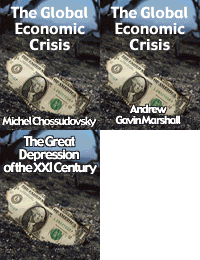
Global Economic Crisis
The Great Depression of the XXI Century

Michel Chossudovsky and Andrew Gavin Marshall (Editors)

Montreal, Global Research Publishers. Centre for Research on Globalization (CRG), 2010.
ISBN 978-0-9737147-3-9 (416 pages)


This book takes the reader through the corridors of the Federal Reserve, into the plush corporate boardrooms on Wall Street where far-reaching financial transactions are routinely undertaken. Each of the authors in this timely collection digs beneath the gilded surface to reveal a complex web of deceit and media distortion which serves to conceal the workings of the global economic system and its devastating impacts on people`s lives.

Despite the diversity of viewpoints and perspectives presented within this volume, all of the contributors ultimately come to the same conclusion: humanity is at the crossroads of the most serious economic and social crisis in modern history.

“This important collection offers the reader a most comprehensive analysis of the various facets – especially the financial, social and military ramifications – from an outstanding list of world-class social thinkers.”
-Mario Seccareccia, Professor of Economics, University of Ottawa

"From the first page of the preface of The Global Economic Crisis, the reasons for all unravel with compelling clarity. For those asking “why?” this book has the answers." –Felicity Arbuthnot, award-winning author and journalist based in London.

"Today, the economic meltdown is reconfiguring everything – global society, economy and culture. This book is engineering a revolution by introducing an innovative global theory of economics." -Michael Carmichael, prominent author, historian and president of the Planetary Movement
The Global Economic Crisis


Michel Chossudovsky
Andrew G. Marshall (editors)


Financial Meltdown on Wall Street

Excerpt from Michel Chossudovsky's Introduction to Global Research Publishers' recent book on the Global Economic Crisis.

We are at the crossroads of the most serious economic crisis in world history.

The economic crisis has by no means reached its climax, as some economists have predicted.

The crisis is deepening, with the risk of seriously disrupting the structures of international trade and investment.


The Nature of the Economic Crisis

In contrast to Roosevelt’s New Deal, adopted at the height of the Great Depression, the macroeconomic policy agenda of the Obama administration does not constitute a solution to the crisis. In fact, quite the opposite: it directly contributes to the concentration and centralization of financial wealth, which in turn undermines the real economy.

The crisis did not commence with the 2008 meltdown of financial markets. It is deeply rooted in major transformations in the global economy and financial architecture which unfolded in several stages since the early 1980s. The September-October 2008 stock market crash was the outcome of a process of financial deregulation and macroeconomic reform.

We are dealing with a long-term process of economic and financial restructuring. In its earlier phase, starting in the 1980s during the Reagan-Thatcher era, local and regional level enterprises, family farms and small businesses were displaced and destroyed. In turn, the merger and acquisition boom of the 1990s led to the concurrent consolidation of large corporate entities both in the real economy as well as in banking and financial services.

International commodity trade has plummeted. Bankruptcies are occurring in all major sectors of activity: agriculture, manufacturing, telecoms, consumer retail outlets, shopping malls, airlines, hotels and tourism, not to mention real estate and the construction industry.

What is distinct in this particular phase of the crisis is the ability of the financial giants – through stock market manipulation as well as through their overriding control over credit – not only to create havoc in the production of goods and services, but also to undermine and destroy large and well established business corporations.

This crisis is far more serious than the Great Depression. All major sectors of the global economy are affected. Factories are closed down. Assembly lines are at a standstill. Unemployment is rampant. Wages have collapsed. Entire populations are precipitated into abysmal poverty. Livelihoods are destroyed. Public services are disrupted or privatized. The repercussions on people’s lives in North America and around the world are dramatic.

The Financial Meltdown

The subprime residential mortgage crisis leading to millions of people losing their homes reached its climax in the last days of August 2008, when financial institutions reported billions of dollars in losses.

Friday, September 12, 2008, Lehman Brothers faced collapse in weekend negotiations behind closed doors on Wall Street. Black Monday descended on September 15, 2008. Following the filing for Chapter 11 Bankruptcy by Lehman on Monday morning, the Dow Jones industrial average declined by 504 points (4.4 percent), its largest drop since September 17, 2001, when trading resumed on Wall Street after the 9/11 attacks.

The following day, it was the turn of AIG, the insurance conglomerate. On the evening of September 16, the Bush administration “granted an $85 billion loan to AIG in exchange for a controlling 79.9% equity share of the company”.[1]

The financial slide proceeded unabated throughout September. Barely two weeks later, on Monday, September 29, the Dow Jones plummeted by 778 points, its largest one-day drop in the history of the New York Stock Exchange. This followed the rejection by the U.S. House of Representatives of the Bush administration’s 700 billion dollar bailout plan, which was slated to come to the rescue of the banks affected by the subprime mortgage crisis. In a single day, 1.2 trillion dollars had seemingly evaporated.

The world’s stock markets are interconnected around the clock through instant computer link-up. Instability on Wall Street immediately spills over into the European and Asian stock markets, thereby rapidly permeating the entire financial system.

Speculative Onslaught on Black Monday, September 29, 2008

There was something disturbing about the Black Monday, September 29, 2008 collapse of Wall Street, following the decision of the U.S. House of Representatives. Did this paper money “vanish into thin air” as claimed by financial analysts, or was it “appropriated” by institutional speculators in one of the largest transfers of money wealth in American history?

There was prior knowledge on how the Congressional vote would proceed. President Bush’s speeches had intimated that a collapse would occur. There was also an expectation that the market would crumble if the proposed 700 billion dollar bailout were to be rejected by the U.S. Congress.

Speculators, including major financial institutions, had already positioned themselves. Powerful financial actors with prior knowledge and access to privileged information prior to the House’s rejection of the bill made billions in speculative trade on Black Monday when the market crumbled. And thenon Tuesday, September 30, they made billions when themarket rebounded, with the Dow jumping up by 485 points, a 4.68 percent increase, compensating in part for Monday’s decline. Those financial actors who had foreknowledge and/or who had the ability to influence the vote in the U.S. Congress also made billions of dollars.

Ironically, almost twice as much money was wiped out from the U.S. stock market on Black Monday, September 29 (1.2 trillion dollars) than the value of the Bush administration’s bank bailout under the Troubled Assets Relief Program (TARP) (700 billion dollars).

Even before the opening bell, Monday looked ugly. But by the time that bell sounded again on the New York Stock Exchange, seven and a half frantic hours later, $1.2 trillion had vanished from the U.S. stock market.[2]

This money did not vanish. It was confiscated from the pockets of people who had invested their lifelong savings in the stock market.

While public opinion celebrated the refusal of the U.S. Congress to accept the Bush administration’s bailout, the decision of the legislature had fed the speculative onslaught.

Political uncertainty regarding the proposed bailout constituted ammunition for the speculators.

In a bitter irony, the Wall Street banks are “double dippers”; they are the recipients of the bank bailout. And at the same time they made money speculating first on the rejection by the U.S. Congress and subsequently on the later adoption of the bank bailout legislation.

On October 1, Wachovia Bank was taken over by Wells Fargo, overriding a competing bid from Citigroup. The deal was sealed with the support of Warren Buffett, the richest man in the world, according to Forbes, and a major shareholder of Wells Fargo.[3]

The first week in October 2008 represented a crucial turning point. The Dow Jones fell by 21 percent over the week, with Thursday, October 9 suffering its biggest fall since Black Monday, October 19, 1987. The S&P 500 index lost 22 percent of its value. The entire western banking landscape was in disarray. Iceland’s banking system was destabilized and the country was put in receivership. The Reykjavik government gave the green light for the forced bankruptcy of the entire banking system.

Following a pledge by G7 finance ministers and central bank governors on the weekend of October 10-11 to prevent further bank collapses, the world’s stock markets rebounded on October 13. The G7 had committed itself to “taking all necessary steps to unfreeze credit and money markets”. The Dow increased by 936 points (eleven percent) at the close of trading on October 13, its largest one day increase since 1933.4 Most European exchanges had “recovered”, with the Paris CAC index rebounding by an astounding 8.8 percent at the close of trading.

This short-lived “recovery” was part of the speculative game. Two days later, on October 15, Black Wednesday, the Dow Jones plummeted by 7.9 percent.

The sequence of a “one day collapse” followed by a “one day surge” and recovery, followed by another “one day collapse” a few days later, is part of the process of financial manipulation. Day to day instability and swings in stock market values are the source of large windfall profits accruing to “institutional speculators” and hedge funds.

Financial Warfare: The Powers of Deception

The September-October 2008 financial meltdown was not the consequence of a cyclical downturn of economic activity. It was the result of a complex process of financial manipulation, which included speculative trade in derivatives.

Financial manipulation has a direct bearing on the workings of the market. It potentially triggers instability in market transactions. This snowballing instability then becomes cumulative, leading to an overall slide of market values.

Inside information, high level political connections and foreknowledge of key policy announcements are crucial instruments in the conduct of large-scale speculative operations.

“Financial intelligence” and the powers of deceit were the driving forces behind the 2008 financial meltdown. Covert undercover financial operations were waged. Those powerful financial institutions, which had the ability to drive the market up at an opportune moment and then drive it down, had placed their bets accordingly. As a result, they reaped billions of dollars in windfall gains both on the upturn as well as on the downturn.

In contrast, for those who had put their faith in the free market, lifelong savings were erased in one fell swoop, appropriated by the shadow banking system. The crash of financial markets had led to a massive concentration of financial wealth.

The weapons used on Wall Street are prior knowledge and inside information, the ability to manipulate with the capacity to predict results and the spreading of misleading or false information on economic occurrences and market trends. These various procedures are best described as the powers of deception that financial institutions routinely use to mislead investors.

The art of deception is also directed against their banking competitors, who are betting in the derivatives and futures markets, stocks, currencies and commodities. Those who have access to privileged information (political, intelligence, military, scientific, etc.) will invariably have the upper hand in the conduct of these highly leveraged speculative transactions, which are the source of tremendous financial gains. The CIA has its own financial institutions on Wall Street.

In turn, the corridors of private and offshore banking enable financial institutions to transfer their profits with ease from one location to another. This procedure is also used as a safety net that protects the interests of key financial actors including CEOs and major shareholders of troubled financial institutions. Companies can be divested from within and large amounts of money can be moved out at an opportune moment, prior to the company’s demise on the stock market (e.g. Lehman, Merrill Lynch and AIG, not to mention Bernhard Madoff).

As events unfolded, Merrill Lynch was bought and Lehman Brothers was pushed into bankruptcy. These are not haphazard occurrences. They are the result of manipulation, using highly leveraged speculative operations to achieve their objective, which consists in either displacing or acquiring control over a rival financial institution. The 2008 financial meltdown has nothing to do with free market forces: it is characterized by financial warfare between competing institutional speculators.

The Federal Reserve Bank of New York and its powerful Wall Street stakeholders – which are Wall Street’s largest private banks – have inside information on the conduct of U.S. monetary policy. They are therefore in a position to predict outcomes and hedge their bets in highly leveraged operations on the futures and derivatives markets. They are in an obvious conflict of interest because their prior knowledge of particular decisions by the Federal Reserve Board enables them, as private banking institutions, to make multibillion dollar profits.

Links to U.S. intelligence, the CIA, Homeland Security and the Pentagon are crucial in the conduct of speculative trade, since that allows the speculators to predict events through prior knowledge of foreign policy and/or national security decisions which directly affect financial markets. An example: they purchased “put options” on airline stocks in the days preceding the 9/11 attacks.

Notes

1. Daniel R. Amerman, “AIG’s Dangerous Collapse”, Financialsense, http://www.financialsense.com/fsu/editorials/amerman/2008/ 0917.html, 17 September 2008.

2. Vikas Bajaj and Michael M. Grynbaum, “For Stocks, Worst Single-Day Drop in Two Decades”, New York Times, http://www.nytimes.com/2008/09/30/business/30markets.html, 29 September 2008.

3. Eric Dash and Ben White, “Wells Fargo Swoops In”, New York Times,http://www.nytimes.com/2008/10/04/business/04bank.html, 3 October 2008.

4. Michael M. Grynbaum, “Stocks Soar 11 Percent on Aid to Banks”, New York Times,http://www.nytimes.com/2008/10/14/business/14 markets.html, 13 October 2008.


Michel Chossudovsky is an award-winning author, Professor of Economics (Emeritus) at the University of Ottawa and Director of the Centre for Research on Globalization (CRG), Montreal. He is the author of The Globalization of Poverty and The New World Order (2003) and America’s “War on Terrorism” (2005). He is also a contributor to the Encyclopaedia Britannica. His writings have been published in more than twenty languages.


ShareThis