Video is Creative Commons
S01E03
TO HELP SEE:
http://www.resisters.ca/
Thanks to:
http://icanhascheezburger.com/
http://punditkitchen.com/
Music Creative Commons By:
http://www.jamendo.com/en/album/6002
http://www.jamendo.com/en/album/140
May be slow to load,items coming from other servers.
| ||||
| ||||
R E F U S E T O P A Y F O R W A R investigate the following sites for more information | |
| Join us in the March 19, 2008, nonviolent blockade of the IRS in Washington, DC, to protest war taxes | |
| Join the 2008 War Tax Boycott! | |
| WRL’s Overview of War Tax Resistance | |
| National War Tax Resistance Coordinating Committee | |

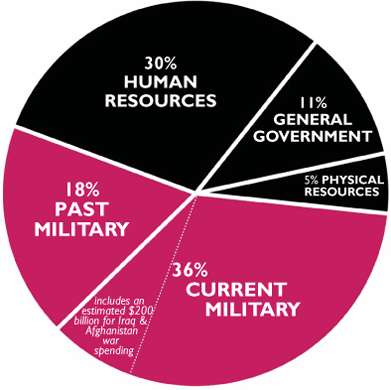
Total Outlays (Federal Funds): $2,650 billion
MILITARY: 54% and $1,449 billion
NON-MILITARY: 46% and $1,210 billion

HOW THESE FIGURES WERE DETERMINED
urrent military” includes Dept. of Defense ($653 billion), the military portion from other departments ($150 billion), and an additional $162 billion to supplement the Budget’s misleading and vast underestimate of only $38 billion for the “war on terror.” “Past military” represents veterans’ benefits plus 80% of the interest on the debt.*
Source: Congressional Budget Office for FY2008 |
These figures are from an analysis of detailed tables in the “Analytical Perspectives” book of the Budget of the United States Government, Fiscal Year 2009. The figures are federal funds, which do not include trust funds — such as Social Security— that are raised and spent separately from income taxes. What you pay (or don’t pay) by April 15, 2008, goes to the federal funds portion of the budget. The government practice of combining trust and federal funds began during the Vietnam War, thus making the human needs portion of the budget seem larger and the military portion smaller.
*Analysts differ on how much of the debt stems from the military; other groups estimate 50% to 60%. We use 80% because we believe if there had been no military spending most (if not all) of the national debt would have been eliminated. For further explanation, please see box at bottom of page.

SHUT DOWN THE IRS / SHUT DOWN THE WAR
On March 19, 2008, we will set up a nonviolent blockade of the national Internal Revenue Service headquarters in Washington, DC, as part of the day of actions against the wars in Iraq and Afghanistan.
Just as military recruiters supply the bodies for the war, the IRS supplies the funding. Just as some soldiers have the courage to resist the war, we — as tax payers — should have the courage to resist paying the taxes that send soldiers to war. We call on all war opponents to help dramatize our opposition and to disrupt business as usual by joining this nonviolent blockade.
For at least this one day — March 19, 2008 — we need to create a disturbance in the smug complacency of the IRS/Pentagon money-axis.
The Scenario
We will gather in our affinity groups at 7 am on Wednesday morning, March 19, at McPherson Sq., 15th & K Sts. NW. From these areas we will march — with the Rude Mechanical Orchestra — to the IRS main entrance at 1111 Constitution Ave. (at 12th Street), NW, and across from the Smithsonian’s Museum of Natural History. Once at the entrance, some of us will sit down to prevent the IRS from opening as usual, while others will hold signs and banners, pass out flyers, talk with passersby, and generally call attention to the cost of the war and our collective responsibility to stop funding it.
Legal Information
Click on this 5yearstoomany link to find a summary of legal information for Washington, DC, particular for those risking arrest.
Also, be sure to look at these other legal resources:
"Dealing with the Police” by the Midnight Special Law Collective
“Demonstration Manual — Know Your Rights!” by the DC Justice & Solidarity Collective
Resources
Click on an image to download a PDF of the call-to-action flyer. The flyer on the left is two-up on a page, so print then cut in half. The flyer on the right is a full sheet. Click here for a B&W version of the flyer to the right. The flyer below left is also 2-up on a page. Click here for a black and white version of that flyer.
“Where Your Income Tax Money Really Goes” — the War Resisters League tax pie chart analysis of the proposed 2009 federal budget.
Click on the image to the right to download the flyer we are using on March 19, the day of the demonstration, at the IRS.
Nonviolence Guidelines
For the purpose of building trust and a common foundation for safety, and ensure that we act in the spirit of nonviolence, participants in the action agree to the following:
• Our attitude will be one of openness and respect toward people we encounter.
• We will not use physical violence or verbal abuse toward any person.
• We will not damage any property.
• We will not bring or use any alcohol or drugs other than for medical purposes.
• We will not carry weapons.
Affinity Groups & Nonviolence Training
March 16 (Sunday), Manhattan, Local 1199, 330 W. 42 St., 9th floor, 1 - 4 pm
March 17 (Monday), Washington, DC, Warehouse Theatre, 1017 7th St. NW, two sessions: 1- 4:30 pm, and 6 - 9 pm
March 18 (Tuesday), Washington, DC, Warehouse Theatre, 1017 7th St. NW, noon - 3 pm
FINAL AFFINITY GROUP MEETING: March 18 (Tuesday), Washington, DC, Warehouse Theatre, 1017 7th St. NW (near New York Ave.), 6 - 8 pm
Transportation and Housing
The United for Peace & Justice has set up a ride board and a housing board at its 5yearstoomany Web site.
Mass housing available Sunday night (Mar. 16) through Tuesday night (Mar. 18). If you need housing, please email Leslie Harris at jharris866@aol.com. Make sure to include your name, email, cell phone number, and which nights you will need housing. All housing available is floor space— please bring a sleeping bag and anything else you need. UfPJ also has a list of affordable housing in DC.
Public Buses from NYC: For Greyhound, there is an E-ticket discount (the code is NYDCR). The two main Chinatown bus companies leave from 88 East Broadway (near "East Broadway" stop on the F train). Apex has buses at 7 AM, 8, 9:45, 10, 11, 1 PM, 1:30, 3, 4 pm, drop off at 610 I Street NW in Washington, DC. New Century leaves at 7, 8, 9, 10:50, 1:30 and 3 pm drop off at 513 H NW in DC. Both buses are $20 each way and drop off near the METRO (Gallery Place). Greyhound leaves from the Port Authority Bus Terminal at 7 am, 8, 9, 10, 11, 12, 1 pm, 2, 3, 4 and is $22 each way, if you use an E-ticket. The terminal in DC is at 1005 I St. NE, which is not close to a METRO station.
Sponsoring Organizations
War Resisters League, United for Peace and Justice, Code Pink, Socialist Party USA/NYC, Ground Zero for Peace, Jonah House, Brooklyn for Peace, Green Party of Brooklyn, Park Slope Greens, Witness Against Torture, National War Tax Resistance Coordinating Committee, Ya-Ya Network, Movement for a Democratic Society (MDS Staten Island, Jacksonville MDS, MDS Austin, Central Florida MDS, SF Bay Area chapters), Kairos, Raging Grannies/NYC, Granny Peace Brigade/NYC, Mouths Wide Open, ART, Artists Against the War, The Critical Voice, New York Collective of Radical Educators (list in formation)
Other March 13th - 19th Actions
March 13-16, Winter Soldier: UFPJ is committed to providing major support to Iraq Veterans Against the War and its Winter Soldier hearings in Washington, DC, on March 13-16. We will help local groups plan events that directly link to and amplify the Winter Soldier hearings, where those who have served in Iraq and Afghanistan, as well as Iraqis and Afghans, will tell the nation the real story of this war.
March 19, Mass Nonviolent Direct Action in Washington, DC: UFPJ has initiated the planning and organizing for what we hope will be the largest day of nonviolent direct action and civil disobedience yet against the war in Iraq. We encourage people to be in Washington, DC, on March 19th to be part of the civil disobedience, or to assist in support work. We are working to have all 50 states represented in this massive action.
March 19, Local Actions Throughout the Country: We encourage those who are not able to make it to Washington on March 19 to organize local actions. These actions may vary in location or character, but they will all be tied to the protest in Washington and all sending a message to the policy makers: It is time to end this war and occupation!
For more information, go to www.5yearstoomany.org.
How to Get Involved
For more information about this action, to become a sponsor, or to learn how to get involved, e-mail us or call 718-768-7306.

cartoon by Rini Templeton
Ralph DiGia
Ralph DiGia, lifelong war resister Ralph, 93, has been the heart and soul of War Resisters League since he came on staff shortly after the end of World War II and his release from federal prison, where he had served a term for refusing service as a conscientious objector. An associate of A. J. Muste, Bayard Rustin, Dave Dellinger, Barbara Deming, and many others, Ralph held key posts over the years with Liberation magazine as well as being on the staff of the War Resisters League. While Ralph was not a public speaker or a writer, he played a key a role within the radical pacifist movement, and was central to many of the major antiwar actions of the past six decades.
Ralph was deeply loved by the movement, especially by those at his political home, the War Resisters League. He is survived by his wife, Karin DiGia, his children, and his two brothers. A funeral and informal gathering was held on Click here to see the New York Times A New York Times article about Ralph “Remembering Ralph” by David McReynolds
top photo: from 1992 | |||
War Resisters League | |||
I. Powers and Rights Reserved To We the People, Never Delegated or Violated Without Consent
A. The People are expressly defined as human beings and does not refer to corporations or contractual relationships.
B. No contract, agreement, or promise may ever bind any human to refuse to enforce the law, or prohibit them from speaking on matters of public interest.
C. We the People may believe anything, including the possible belief that this Constitution must be discarded and replaced with a superior document which defends the People and protects their power to enforce this Constitution against the Government.
D. The People are educated to apply the lessons of history to ensure rights are preserved, power asserted, and this Constitution is protected from domestic and foreign enemies.
E. The People have the enforceable right and power to review any public document and access any public official.
F. The People have the enforceable right to engage in any speech, communication, or discussion on issues of war crimes, government incompetence, or allegations of reckless government planning and maladministration.
G. Government officials, agencies, departments may not invoke any power or right they have denied to the People.
H. The People have the right to affordable housing. Where none is available, the government is denied the power to prosecute anyone for not living in a home, or residing in a public park, open forest, or public lands.
I. The People have the enforceable right to freely travel, without questions, and without delay. Any law enforcement officer, agents, or contacted security official who uses any ruse, scheme, or deception to engage in pretextual stops shall be enforced as a violation of this Constitution.
J. The People have the enforceable right to compel govenment officials, contractors, and securty personnel to identify themselves, disclose their policies and procedures, and respond to complaints about violations of this Constitution, the Supreme Law, or laws of war.
K. The People may not be subject to any electronic surveillance except on probable cause and a warrant before a judicial tribunal. The President, Congress and others are expressly denied the power to enact, create, use, or rely on quasi-judicial tribunals to self-certify warrants to conduct surveillance.
L. All denied powers to the US Government in this Constitution are reserved to the People to be used to defend the Constitution.
II. Powers and Rights Reserved to States
A. States shall have authority to enforce any law within their jurisdiction. Failure to enforce the laws of war shall be prosecuted as a war crime.
B. States shall, when the Federal Government refuses to enforce the Constitution or Supreme Law, enforce the national and international law against contractors, legal counsel, state or US government officials.
C. Any state may start impeachment investigations or proceedings against the President, Member of Congress, or US government official on issues of international laws of war, domestic rebellion, or violations of the Supreme Law oath of office, or Geneva Conventions. The States shall, upon receipt of an impeachment investigation or conviction from any other state, shall within 10 days debate that resolution. If convicted by 2/3 of the States, that US government official shall be removed from office. Any effort to thwart State efforts to enforce the US Constitution through impeachment investigations or impeachment proceedings at the State level may be construed as a subsequent violation of this Constitution and laws of war.
D. The States may, without notice, organize themselves to collectively defend this Constitution from the domestic enemies in the United States government. The States Governors have the standing power, right, and authority to use deadly combat force to enforce this Constitution against US government officials.
E. A failure of any State official to enforce the laws of war shall be subject to a war crimes trial within 90 days of discovering that evidence. Where there are credible allegations of war crimes, a failure to investigate shall be construed as a subsequent war crime, punishable by the death penalty.
F. States have the power to enforce contract obligations between contractors and the US government which affect the rights of their State citizens. Failure to enforce these contractual obligations against the contractors or US government could be construed as a subsequent violation under the laws of war and US Constitution against legal counsel, state officials, or court officers.
III. Independent Branch
A. All US government, contractor-provided, and legal counsel data shall be retained in an independent branch.
B. The President, Congress, and Judicial branches have no power, right or claim to not fully fund this Independent Branch.
C. The Independent Branch conducts electronic surveillance of the US government, stores that data, and ensures there are independent, safe, retained records of all US government transaction, including conversations and memos between legal counsel and government officials. Once created for the government or connected with any legal or illegal activity, these records are public records.
D. The data may be seen only upon a showing of reasonable belief or suspicion by the United States Congress, Court, or Executive Branch that the information may be useful in enforcing the Constitution, Supreme Law, or Geneva Conventions.
E. Private citizens may view any data, unless the US government provides sufficient, detailed evidence why that request for information should not be met for bonafide, lawful secrets. Any effort to hide evidence behind a claim of "state secrets," where that claim is linked with an effort to bypass the Constitution, oath of office, Supreme Law, or laws of war may be punishable by the death penalty.
F. All government data belongs to the People. Any legal counsel working for the US government shall ensure that the People's right to reliable information is protected. A failure to protect this information could be construed as a war crime.
IV. Prosecutorial Branch
A. All prosecutorial options are denied of the President.
B. The Prosecutorial branch has the power to raise independent combat power, support them, and may lawfully use that deadly combat force to confront Members of Congress, the Judicial Branch Officers, or the Presidents upon showing of probable cause for war crimes.
C. The prosecutorial power is the exclusive power of the prosecution branch. However, anyone may make a claim of illegal activity, and enforce the laws of the United States and States respectively. Any effort to block anyone from unilaterally attempting to enforce the laws of war through discovery, investigation, and open discussion of those alleged war crimes shall be construed as a possible subsequent offense under the laws of war.
D. Legal counsel are subject to public review, audit, and can be required, with fair notice, of a requirement to demonstrate before any court their compliance with the laws of war.
E. Legal counsel may be denied authority to conduct discovery during any investigation when that discovery is linked with efforts that would thwart war crimes investigation, enforcement of the Supreme law or Geneva Conventions.
V. Judicial Branch
A. The Judicial Branch is above the Legislative Branch and Executive Branch only in order of precedence. The Judicial Branch is a co-equal branch, and closest to the People and Constitution. It is least responsive, and most slow to the People's daily interests to enforce the Constitution and Supreme Law or Geneva Conventions.
B. Where the Judicial Branch does not timely enforce the Constitution, Supreme Law, or laws of war, the States and People retain the power and right to investigate and prosecute allegations of US government illegal activity, war crimes, or violations of the Supreme law.
C. All precedents under the laws of war are binding on the Judicial Branch, US government, and the People through enforcement actions.
D. Any decision by any judicial officer not to fully enforce the laws of war, Supreme Law, or this Constitution may be construed as a war crime, subject to the death penalty.
VI. Legislative Branch
A. The Legislative Branch is listed after the Judicial Branch because it is less responsive to the People.
B. The Members of Congress may be stopped between sessions and held to account for their failure to enforce the laws of war.
C. Refusing to investigate or impeach the President, Judicial Officers, or any current or former US government official for alleged war crimes, maladministration, illegal warfare, or other crimes against the People, States, or US Government shall be prima facie evidence of an intent to not fully assert ones oath of office, and punishable by the death penalty under the laws of war.
D. There are three chambers to the Congress. The Senate and House have a legal duty to fully enforce the laws. Any decision to not timely review evidence of impeachable offenses, or not investigate war crimes or maladministration could be construed as subsequent offenses under the laws of war.
E. The Superior Chamber shall decide, before any debate, whether the proposed bill is or is not Constitutional. This determination is subject to approval, challenge, and rejection by the People, States, and Judicial Branch.
F. The Congress is denied the exclusive power to make rules. Any rule which prohibits any investigation into alleged malfeasance in re the laws of war, Supreme Law, or oath of office is illegal, and may be construed as a subsequent offense under the laws of war.
G. The Congress shall comply with public audits, and timely provide within 45 days of an audit report a statement of remedy, and outline a plan within 90 days to fully comply with all legal obligations under the Statute, Supreme Law, oath of office, and laws of war.
H. The Congress may raise and support an army, and independently order that army only against the President when the President refuses to enforce the laws of war, or comply with his legal obligations under this Constitution.
VII. Executive Branch
A. The Executive Branch is led by three Presidents, co-equal with non-overlapping jurisdictions. The Executive Branch has one power: Executive Power. All actions taken under that one power are lesser authorities not powers. The Executive Branch has no power to create new powers or assign itself broader power.
B. The Executive Branch is listed last because it is the least responsive to the People, and the greatest threat of tyranny to this Constitution. The President is a clerk, not a King or Emperor. The President only manages programs. The President has no power to ignore, rewrite, or refuse to enforce the law. Each of the three Presidents shall have an ongoing requirement to demonstrate to the People and States and Congress and Courts compliance with the Constitution, Supreme Law, oath of office, and laws of war.
C. The Domestic Affairs President is responsive to the States and US Government on internal affairs.
D. The Foreign Affairs President shall have exclusive power to interact with foreign powers. The Foreign Affairs President is denied any power to violate the laws of war, or use covert activity against American citizens.
E. The Executive Branch, Congress, Judiciary, and Foreign Affairs President are denied the power to thwart any lawful State action to organize with foreign powers and agents to defend the US Constitution, enforce the laws of war, or protect the rights and powers of the People and States against domestic encroachments by the US government, legal counsel, or other US government officials.
F. The Commander in Chief shall only have power to lead combat operations during war time. Congress shall conduct ongoing, public reviews whether the Commander in Chief is or is not competent in managing combat operations. The Presidents and Commander in Chief are denied the power to prohibit Congress from using electronic surveillance or use separately raised and supported armies to conduct this oversight during wartime and peacetime.
G. The Executive Branch is denied the power to block anyone from getting access to illegal activity related to the laws of war.
H. During Peacetime, the Commander in Chief shall periodically cooperate with ongoing Oversight of US combat forces to ensure they are combat ready, fully trained on the laws of war, and prepared to lawfully be used to defend the Constitution against foreign and domestic enemies.
I. The Executive Branch and Presidents and officers, agents, contractors, and personnel are denied the power, right, or authority to order anyone to ignore any statute, law, legal requirement, or obligation under the Constitution.
J. The Executive Branch has no power or authority to directly contact the Legislative Branch by name. The President may only request, not order other branches of government. All Communications between the Executive and Legislative Branch shall pass through the Prosecutorial Branch, and retained in the National Archives. Those records are available for public inspection at any time. The People have the enforceable right to compel the Executive Branch, Legislature, and Judicial Branch to produce documents.
K. The Executive Branch, Congress, Judicial Branch, and Prosecutorial Branch, and States are denied the power to wage warfare, information warfare, or harass American civilians through his agents, combat troops, or third parties in the United states or from overseas. Any funds used for this illegal purpose belong to the People and States. Contracts used to enforce, compel, or organize this illegal activity are not enforceable, and contrary to public policy.
L. The Presidents are denied a presumption of competence until proven. The President shall always have the burden of proof, and is expressly denied a presumption of good faith until demonstrated with overwhelming evidence in public. An election result is not proof of competence nor does it satisfy a presumption of good faith, only of mastery to win an election through legal or illegal methods and deception.
M. The Executive Branch and Presidents and subordinate agency head, contractor, and employees are expressly denied any assurance any conversation he has related to illegal activity, war crimes, unlawful acts, or other threats to the US Constitution shall remain secret behind any shield, scheme, agreement, or technology. Any order a President or anyone gives to anyone to hide, destroy,not provide, or conceal evidence of illegal activity may be construed as a subsequent war crime, punishable by the death penalty. This restriction against following illegal orders may not be bypassed by claiming the order was from a non-person, electronic device, or other non-Constitutionally recognized entity, database, policy, guide, or other document.
N. The Presidents are denied the power to use any combat force, technology, or other military weapon or plan against American civilians, except in cases of internal rebellion which only the Congress shall approve in writing. When the Congress fails to act, or abuses its authority, the State Governors may lawfully use deadly combat force to detain and enforce the laws of war prohibiting illegal use of force against American civilians.
O. The Presidents are denied the power to induce any civilian to take any action that might deny them on any Geneva protections as a civilian. Any order, ruse, scheme, propaganda, or unreliable information to induce anyone to wage war, information warfare, or any action to harass civilians is punishable by the death penalty, and may be enforced as a violation of the laws of war.
P. The President, when delegating any power to any agency head, agrees that that agency shall be organized as if it were a separate, lesser, and not coequal branch. Those agencies shall fully cooperate with the other branches of government to ensure power within the branch or department is divided. There is no single agency, division, or office in the Executive Branch that is beyond ongoing oversight by the other four branches.
Q. The President shall have no power to block the Congress, States, Judiciary, Prosecutorial, and Independent Branch from a having co-equal status to oversee, manage, and organize that lesser branch. If the President refuses to substantially comply with that requirement, Congress may not lawfully provide funding for that agency, and the funds return to the States and People.