Statement from Joseph and Valerie Wilson in Response to Pres. Bush's Assertion of Executive Privilege to Protect V.P. Cheney
CREWCopyright Business Wire 2008
Naomi Seligman, 202-408-5565
May be slow to load,items coming from other servers.
CREWCopyright Business Wire 2008
Naomi Seligman, 202-408-5565
Jul 16, 2008
Copyright 2008 POLITICO
Richard Cowan
Reuters
Wed, 16 Jul 2008 17:12 EDT
President George W. Bush, asserting executive privilege, has rejected Congress' request for documents on FBI interviews with Bush and Vice President Dick Cheney from a probe to find who leaked the identity of CIA agent Valerie Plame Wilson.
Bush administration said on Wednesday that turning over such records would violate the president's rights to counsel from his staff.
![]() |
| ©REUTERS/Jim Young |
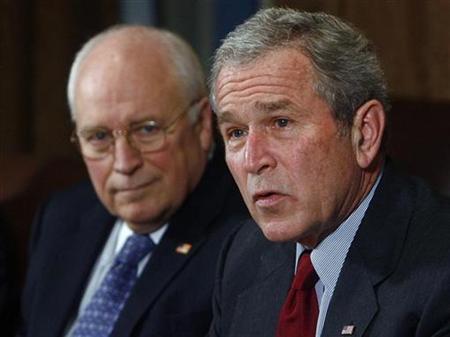
| President George W. Bush (R) and Vice President Dick Cheney meet Joint Chiefs and Combatant Commanders in the Cabinet Room at the White House in Washington, January 29, 2008. |
In a letter to the House of Representatives Oversight and Government Reform Committee, U.S. Deputy Assistant Attorney General Keith Nelson wrote, "The attorney general has requested that the president assert executive privilege with respect to these documents and the president has done so."
The letter was delivered on the same day the committee was scheduled to vote on a possible contempt resolution against Attorney General Michael Mukasey for failing to provide the requested information.
Rep. Henry Waxman, the California Democrat who chairs the committee, called the executive privilege claim "ludicrous," but postponed committee action against Mukasey, saying lawmakers needed time to review Bush's claim.
In 2003, as the Bush administration was preparing for war with Iraq, media reports surfaced discussing Wilson's work at the CIA. She is married to former ambassador Joseph Wilson, who at the time accused the Bush administration of tailoring intelligence information to justify the Iraq war.
Following the federal probe into the matter, Cheney aide Lewis "Scooter" Libby was convicted on obstruction and perjury charges. Bush subsequently commuted Libby's 2 1/2-year sentence.
Waxman said the probe did not get to the bottom of Cheney's possible role in the leak, prompting his committee to seek the FBI documents.
"There is a key document that could explain what the vice president knew and what he did," Waxman said, referring to Libby's statement to the FBI that it was "possible" Cheney instructed him to blow Wilson's CIA undercover identity.
Waxman also noted that a letter from Mukasey to Bush dated Wednesday regarding the executive privilege stance "also raises questions about the president's involvement ... the documents being withheld summarize conversations held directly with the president."
Both Mukasey and Nelson wrote that the White House has attempted to accommodate Waxman's probe of the scandal by making available some FBI reports of interviews with senior White House staff and agency officials.
"We are not prepared to make the same accommodation for reports of interviews with the president and the vice president," Nelson said.
Dear Virginia,
EXCLUSIVE REPORT (Raw Story) Bush's new lawyer harbors secretive, criminal past By John Byrne The cult of secrecy surrounding President Bush’s newly retained lawyer in the Valerie Plame CIA leak case is so strong that the White House refuses even to confirm who the president’s lawyer is.
But the smokescreen around Sharp goes far deeper than that, and perhaps for good reason. The only other president to hire a private attorney for acts committed while president, Richard Nixon, eventually resigned from office. Sharp long has cloaked himself in secrecy, even taking the unusual move of paying to have his address and telephone number removed from the major Martindale legal directory. He was an assistant district attorney before he came to Washington and has a history of taking on cases with political implications. Sharp’s highest profile client was Maj. Gen. Richard V. Secord, a major figure in the Iran-Contra scandal who helped Lt. Col. Oliver North accumulate untaxed wealth in overseas accounts. Far lesser known, however, is a 1994 finding by the 11th Circuit Court of Appeals, where he engaged in “unethical and criminal activity” for pressuring a witness to commit perjury. The charge was leveled by one of Sharp’s witnesses when he represented his self-avowed “good friend” Joe Harry Pegg against a charge of conspiring to import marijuana in 1988 and 1989. In 1994, when the case was being heard on appeal, the lawyer for one of Pegg’s co-conspirators, Reggie Baxter, contacted the prosecuting attorney, Cynthia Collazo, saying that Sharp might have had “privileged conversations” that might cause Sharp to have a conflict of interest in representing Pegg. “In unsworn statements, Baxter told Collazo that shortly after he had been arrested in 1992 for participating in the marijuana importation conspiracy charged in the instant case, Sharp had met with him and arranged for Pegg to pay a portion of Baxter's legal fees,” the 11th Circuit Court of Appeals transcript states. “Baxter then stated that Pegg had retained attorney Dick Hibey to represent Baxter in the case. Baxter further claimed that Sharp and Hibey helped him concoct a false story to help exculpate Pegg.” After Collazo expressed her concerns to Sharp, he decided to remain on the case regardless. Though they did not dispute his actions were criminal, the government could not to pursue Sharp because they were unable to prove the conflict adversely affected his counsel of Pegg, a standard required by the Sixth Amendment. “The district court found and the government does not deny that Sharp labored under an actual conflict of interest created by co-conspirator Baxter's allegations that Sharp had engaged in unethical and criminal activity in connection with his representation of Pegg,” the transcript asserts. And, as the White House refuses to confirm Sharp’s identity, some speculate that he might also have been the Jim Sharp who served as an attorney to Jeb Magruder, a player in the Watergate scandal. It’s possible, one blogger notes, since James E. Sharp, born in 1940, would have been 33 at the time. If it is the same case, Sharp was accused of sneaky dealing there, too: A recent book by Tony Lukas — “Nightmare” — has Sharp telling a Watergate defendant that he’ll let him confess all first to get a plea deal, then subsequently scheduling an appointment for his client, Jeb Magruder, to get his deal first. Joseph E. diGenova, a former U.S. attorney who worked with Sharp as a young prosecutor, told the Washington Post that Sharp is known for his litigation skills. He’s “a brilliant tactician who is very persuasive” he said, and “folksy like a fox.” |
Fri. May 30, 2008ON AIR
Q&A: Joseph Wilson
The Former Ambassador Reacts To Scott McClellan's New Book
Q: Joe, my first question is, have you read Scott McClellan’s book yet, or have you seen any of his interviews?
Wilson: Well, I haven’t read the book. I’ve seen a couple of the excerpts that have been published, and I’ve seen a couple of his interviews.
Q: And what’s your first reaction?
Wilson: Well, I think he’s handled himself very well. This is part of American history. It’s contemporary, and I think it’s an important new piece to our understanding of the Bush administration and the machinations that it put our society through.
Q: You watched him, almost every day for a couple of years, talk about your wife, about you, about this case. What did you think when you saw him for the first time giving another part of the story?
Wilson: Well, my initial reaction was the same reaction I had to [former chief of staff to the secretary of state] Larry Wilkerson, [former CIA analyst] Paul Pillar, and [Washington Post reporter] Tom Ricks and some of the others when they kind of came to their senses on this: Where were you when it counted? You should’ve been out there then, making the case that you are making now. We would’ve been better served by that. That said, I understand people work on their own timelines, and I am just glad that he’s got it out now.
I’m amused, by the way, that when he takes the press on for not having been vigorous enough, what does the press do but bring out to rebut him the old administration liars and traitors that we’ve known for many years, including Ari Fleischer and Karl Rove.
Q: Are you surprised at the vehemence and the counter-response, I should say, to his book?
Wilson: Of course not, because I witnessed this in my own case over the article I wrote in the New York Times. I think Scott is just lucky that his wife is not a covert officer in the CIA, otherwise she would’ve been compromised as well.
Q: Did Valerie see the interviews? What did she think?
Wilson: I don’t know. I haven’t talked to her about it. She’s on the other side of the country. She’s in New York and traveling back today. We’ll have a chance to chat about it over the weekend.
Q: Well, I wanted to read a couple quotes from Scott’s book, since you haven’t read it, and get your reaction. On page 228, he’s talking about the CIA leak investigation -- he calls it “The Plame Affair,” by the way. He calls her Valerie Plame. In fact, if you look at the index of the book, it’s an entire page. You’re still fighting about what her name is, right?
Wilson: Her name is Valerie Wilson. It’s been Valerie Wilson since we got married.
Q: Well, it hasn’t changed in Scott’s book, however. I’m going to quote, this is Scott talking: "I imagine some people slipped at times, and found themselves complaining about their hours before the grand jury or gossiping about whodunit. On a few occasions, even the president couldn’t help himself. I remember hearing him in the Oval or on Air Force One, grousing about having to hire an attorney, and about the atmospherics of being questioned." Can you respond to that?
Wilson: Well, I don’t know what to say about that. The president has demonstrated, through commuting [Scooter] Libby’s sentence, that he is, at a minimum, an accessory to an ongoing obstruction of justice. The only question that I would like to ask the president is, what did you know about this before it happened? Scott apparently also answers part of that by saying that the president admitted to him that he had authorized the selective leak of intelligence through Libby to [former New York Times reporter] Judy Miller, which may well have been Valerie’s name.
Q: Well, do you think that your civil case would have ended differently if this information had been out before?
Wilson: I have no idea. Our case, by the way, is in the Court of Appeals now, and we’re not letting this drop. We think that the U.S. justice system would be ill-advised to actually establish a precedent permitting public officials to engage in private political vendettas on the taxpayers' dime. That’s the principle we’re trying to establish with this, and we will carry this as far forward as we can in order to get that principle established.
Q: Let me keep reading: "From the outset of the investigation, the president had made a decision not to pursue the matter internally." He’s confirming that the president didn’t want anything looked into, and as you just mentioned, also the fact that the president in a nonchalant way revealed to Scott that he had specifically authorized the declassification of the NIE for the explicit purpose of the vice president and company to defend against your charges.
Wilson: Right, and the fact that is so shocking to me is that there was no internal investigation. As Claude Rains said in Casablanca, “I’m shocked, I’m shocked.” This is an utterly corrupt and utterly bankrupt administration, and the fact that the press still gives it any sort of credibility whatsoever -- and Scott mentions this in his book -- is surprising to me. And I think it’s a real low point -- one, in the administration of this country, and two, in the willingness of the press corps to take it on.
Q: Well, here’s my other question about that. Because he goes on on a couple pages on how my old NBC colleague, David Gregory, [ABC News reporter] Terry Moran, [CBS News reporter] Bill Plante and other White House correspondents went out and defended him, saying he’s doing the best job he can in that position. Did you think that was appropriate?
Wilson: Well, I was really struck by some of the comments I’ve heard in the last couple of days which basically say, Scottie, now you tell us. Which reaffirms to me that for many of the members of the White House press corps, simply being a stenographer and listening to what the spokesman says at the podium is sufficient for them to earn their salaries. When in fact, investigative journalism requires that you actually trust, but verify and go to other sources, and I think that’s where the press really let us down.
I said to somebody the other day, if you just do a Google search of how many times Scowcroft, Wilson, Zinni, Baker, Wes Clark, were on discussing the run-up to the war, versus Perle, Feith, Mr. Cakewalk -- whatever his name is, I can’t remember his name offhand -- but some of these other neocons, I think you would easily see that the realists in this debate were overwhelmed by the ideologues. And, indeed, I think there have been a number of press services that have acknowledged that they were caught up in the fervor of sort of being more patriotic then their competitors.
Q: Well, did you feel like that, Joe? Because I was working at MSNBC when you first came out -- after you wrote the column and came out and talked about it. And I know a lot of reporters were talking to you and were really interested in what you had to say. I mean, in many ways, had you not come forward, none of this would’ve happened. But now you’ve got a guy within the White House doing the exact same thing and getting completely killed for it by his own folks. We had Terry McAuliffe -- which the listeners will hear coming up on the show a little bit later -- and he said there is absolutely no excuse for anyone working with the president or anyone in power to come forward and tell tales out of school. Mr. McAuliffe is your friend, right?
Wilson: I know Terry. I know him quite well. I disagree with that assessment. I understand the concern and actually share it about telling tales out of school, but this administration has operated so far out of the parameters of normal American political behavior as to be, in my judgment, legitimately suspected of engaging in a criminal enterprise. And so, if you look at it in that context, then any and all information from the inside is useful to our understanding just how badly they have subverted our democracy.
Q: When you hear about this -- and I’ve already heard your comments about how you applaud Scott for coming forward -- but aren’t you a little angry that he didn’t quit? Because if he had quit, everyone would’ve looked at this so differently.
Wilson: Well, I preface my answer to that by saying my first response to him is the same response I’ve had to people like Larry Wilkerson and Paul Pillar -- the CIA and Wilkerson was [Colin] Powell’s aide -- where were you when it counted? You should’ve come forward when it counted. We might have been able to stop this crazy invasion. We might have been able to actually put some sanity back in the discussion of what our national security policy and approach should be, and they didn’t. They went along, and they quit later.
The only people who were out there prior to the war... And by the way, the debate on the war didn't split on partisan lines. It split largely along lines of the realist first Gulf War, like myself, and the ideologues -- those who had some fantasies that one, we really did have to worry about chemical and biological weapons and nuclear programs to the extent we had to invade, conquer and occupy sovereign nations, to those who actually believe in the concept that a madman and bad man is worthy of our military response.
Q: I have to turn over now to Karl Rove -- which there is so much time spent on talking about the fact that McClellan had gone out and defended Rove after he specifically asked him that the president... that Rove had told the president he wasn't involved. And I've got to lead you over to page 261, where in this one page he talks about how Karl Rove apologized to him. I'll read: "I received a phone call from Rove." This is after one of the really controversial briefings. Quote: "I just want to say I'm sorry for what you're going through." And then later that day, Rove in a meeting with the other senior staff said, "I am so sorry." And then later on, he actually wrote a note to him, leaving it on his chair at the White House, saying, "I'm so sorry for what you're going through." What's your reaction to that?
Wilson: Well, you know, Karl Rove is a liar. Karl Rove is a traitor. Karl Rove is actively subverting the republic of the United States of America, and yet Karl Rove is still welcome on TV programs. He has not been driven out of town. He is still given space on newspapers, and until such time as Karl Rove is recognized for what he is and shunned, he should actually be put in stocks in the public square so that people can walk by and throw tomatoes at him for the damage that he has done to this country and the way we govern ourselves and, frankly, for the damage he has done to the Republican brand.
Q: Well, he's still out there, though. What do you do, Joe, when you see -- I hear what you're saying -- but there he is on FOX, he's working for Newsweek. He's out there. He's Mr. Pundit. He's everywhere you could ever want to be -- Wall Street Journal. What do you think of the fact that he has made a tradition like none before him? And I'm sure he's making big bucks, too.
Wilson: Well, I'm sure he is. I'm sure he's cashing in. I don't watch him. There is nothing that he has to say that is of any interest to me. In fact, I read about 12 news sources every day, and 10 of them are non-American, and the only two American news sources I read are the International Herald Tribune and then I glance at the Washington Post to see what sort of idiocies they're up to.
Q: Doesn't it bother you, though, that he is out there, that he was embraced so quickly -- and such a strong, firm embrace?
Wilson: I think it says a lot for the state of American journalism. I really do. I honestly believe that they have sold out, and the idea that somebody who is an admitted liar, and somebody who is quite literally responsible for compromising the national security of my country -- it just tells you where the right wing is.
Q: Are you going to call for the reopening of the leak investigation?
Wilson: Well, I heard Scott say last night that everything that is in his book he shared with a special prosecutor. So I suspect that this in and of itself will not cause the reopening of the case. What would've caused the case to go forward would've been had Libby been obliged to actually do hard time in taking the fall for [Dick] Cheney. That might have encouraged him to be more truthful.
Q: One more item... There is an anecdote in the book -- which I believe he's talked about on television, so maybe you've seen it -- about how he saw Karl Rove and Scooter Libby go off in a room together and have a private conversation. And he is straight up about the fact that he's not sure what they talked about. Do you have any evidence, have you ever heard anything, that confirms that they worked together -- this is, once the investigators started -- to get their stories straight or together, or to talk about the case in any inappropriate way which is a violation of law?
Wilson: I don't, other than what Scott has just mentioned. And, of course, one of the things we hoped to do with our civil suit is be able to put these guys under oath -- that, of course, if we were to get them under oath, we'd be able to compare their answers to our depositions to their grand jury testimony -- the special prosecutor would do that. That might bring them under another sort of criminal vulnerability.
Q: Thank you, Joe Wilson, for being with us on "National Journal On Air."
Monday, March 17, 2008
2004 PRESIDENTIAL ELECTION
Democratic presidential candidate Sen. John Kerry rallies support around anti-war sentiment. During debates with President Bush, he reminds voters that Bush failed to gain international support for the Iraq invasion, and that his major premise for the war - weapons of mass destruction - proved untrue. He calls for more NATO troops to be sent to Iraq and expanding the training of Iraqi security forces.
2006 CONGRESSIONAL ELECTIONS
Democrats take control of Congress after polls show a majority of Americans want a withdrawal or an end to U.S. military involvement in Iraq. "This election is about Iraq. If indeed it turns out the way that people expect it to turn out, the American people will have spoken, and they will have rejected the course of action the president is on," says San Francisco Democratic Rep. Nancy Pelosi.
2008 PRESIDENTIAL ELECTION
The Iraq war is a dominant campaign issue. On the Democratic side, Sen. Barack Obama, an early opponent of the war, and Sen. Hillary Rodham Clinton, who voted to authorize military force in Iraq, say they will end the war. While Obama says he will withdraw U.S. troops within 16 months, Clinton says she will bring them home "as quickly as we can." Both want to keep some U.S. troops in Iraq to battle al Qaeda in Iraq and protect diplomats and aid workers, and both are vague about how long those troops would stay.
Presumptive Republican nominee Sen. John McCain, on the other hand, revives a floundering candidacy over renewed optimism over the success of Bush's "surge." McCain says he will fight the Democrats on early withdrawal, which he dubs "a date for surrender." McCain says U.S. troops could spend "maybe 100" years in Iraq.
Jan. 10, 2007: Bush announces a plan to send 21,500 additional U.S. troops to Baghdad and Anbar province to improve security, avert civil war and provide time for political reconciliation among Iraq's major factions. Another 8,000 support forces are later deployed. The troop increase, which has dramatically reduced violence in those areas, is scheduled to end in July 2008. Critics, however, say the decline in violence is due more to anti-American Shiite cleric Muqtada al-Sadr's August 2007 unilateral cease-fire.
FUTURE U.S. TROOP WITHDRAWAL
To date, one of the five extra Army brigades sent to Iraq as part of the increase has returned without being replaced, reducing the number of brigades from a peak of 20 to 19. Lt. Gen. Carter Ham, operations chief for the Joint Chiefs of Staff, says the number will drop to 18 this month. By July, it will drop to 15, with troop levels likely to be about 140,000 U.S. soldiers. That compares with 132,000 when Bush approved the increase and the current total of 159,000.
BLACKWATER
Blackwater Worldwide, the largest of the private security firms in Iraq with some 1,000 employees, has received millions of dollars in contracts from the State Department to protect U.S. officials and some foreign diplomats. The North Carolina firm also has been involved in controversy:
On March 31, 2004, four Blackwater employees are killed in Fallujah and their bodies hung on a bridge. U.S. forces attack the city in response.
On Sept. 16, 2007, Blackwater employees shoot and kill 17 Iraqi civilians, at least 14 of whom are killed "without cause," according to an FBI investigation. Whether the group will be legally prosecuted is not clear.
On Oct. 5, 2007, the U.S. State Department announces new rules for Blackwater's armed guards in Iraq. Under new guidelines, State Department security agents will accompany all Blackwater employees in and around Baghdad, install video surveillance equipment in Blackwater armored vehicles, and record radio communications between Blackwater convoys and the military and civilian agencies that supervise their activities.
REFUGEES
The Iraq war has created nearly 4 million refugees, almost 16 percent of the population. This includes 2 million people who have fled the country - mostly to Syria and Jordan - and 1.9 million internally displaced people. Although Christians make up just 5 percent of the population, they comprise 40 percent of refugees now living in neighboring countries, according to the United Nations.
MOVIES AND DOCUMENTARIES
When filmmakers started weighing in on the Iraq war, ideologies clashed. No sooner had "Saving Jessica Lynch" painted a picture of heroism in a 2003 made-for-TV movie than heavyweight documentarian Michael Moore unleashed his "Fahrenheit 9/11" broadside in 2004. That film, along with Robert Greenwald's "Uncovered," scorned the Bush administration's case for going to war in the first place. "Gunner Palace," a documentary released in 2005, offered a ground-eye view of soldiers gritting it out under fire in Baghdad four months after Bush's "Mission Accomplished" declaration.
Many other documentaries followed, from "The Ground Truth" (about Iraq war vets) to "The War Tapes" (made from video footage shot by National Guardsmen in Iraq) in 2006 to last year's widely praised "No End in Sight" (about the mangled conduct of the war).
Steven Bochco broke new ground with his 2005 TV drama "Over There," a fictional treatment of both the Iraq war zone and the home front. The first major wave of Iraq war feature films hit theaters in 2007. They included the mournful "In the Valley of Elah," the angry "Rendition," Robert Redford's dogmatic "Lions for Lambs" and Brian de Palma's rough-hewn "Redacted," about the rape and murder of an Iraqi girl by American soldiers in 2006. Audiences stayed away from all of them, prompting many critics to speculate that the public wasn't ready to see an ongoing war and its fallout reflected back at them onscreen.
BOOKS
Books about the war came thick and fast, with many of them, like Tomas E. Ricks' best-selling "Fiasco: The American Military Adventure in Iraq" (2006) and George Packer's "The Assassins Gate: America in Iraq" (2006), capturing wide attention.
The Washington Post's Bob Woodward, of Watergate fame, wrote two popular histories of the Bush war years - "Plan of Attack" (2004) and "State of Denial" (2006).
Bernard Lewis' presciently timed "The Crisis of Islam: Holy War and Unholy Terror," came out in March 2003.
U.N. inspector Hans Blix recounted his aborted search for weapons of mass destruction in "Disarming Iraq" (2004).
Larry Diamond, a Stanford professor and colleague of Condoleezza Rice, published "Squandered Victory: The American Operation and the Bungled Attempt to Bring Democracy to Iraq" (2005).
Everyday soldiers told their side of the story - Colby Buzzell's "My War: Killing Time in Iraq" (2005) and John Crawford's "The Last True Story I'll Ever Tell: An Accidental Soldier's Account of the War in Iraq" (2005).
So did prominent figures such as former chief U.S. counterterrorism adviser Richard Clarke - "Against All Enemies: Inside America's War on Terror" (2004).
Satirists haven't sat out the conflict either - Matt Wuerker's "The Madness of King George" appeared in 2004.
DIXIE CHICKS
An all-woman country band from Texas became front-page news just before the war began. At a March 10, 2003, concert in England, band member Natalie Maines introduced the song "Travelin' Soldier" with the widely circulated remark, "We do not want this war, this violence, and we're ashamed that the president of the United States is from Texas." Less well reported was band member Emily Robinson's statement that they supported the American troops 100 percent. The Dixie Chicks became an instant cause celebre. Their concerts were boycotted (about half their appearance dates dried up) and their recordings were publicly destroyed in anti-Dixie Chicks demonstrations. Maines apologized on March 14: "I love my country, I am a proud American." But both the damage and the flash-point fame had taken over. In May of that year, the Dixie Chicks appeared on the cover of Entertainment Weekly, their nude bodies inscribed with words about the pressures of exercising free speech in wartime - "Boycott," "Dixie Sluts," "Peace," "Traitors." A 2006 documentary film, "Dixie Chicks: Shut Up and Sing," told the story of the band's tribulations.
PEACE MARCHES
Protesters took to the streets before the invasion began. The largest prewar demonstrations took place on Feb. 15, 2003, when millions marched in cities around the world.
The San Francisco protest took place the following day in what turned out to be a contentious event. Organizers said 200,000 showed up; The Chronicle used its own photographs to peg the number at about 65,000.
Protests continued internationally through the spring as combat neared and began; they included thousands of candlelight vigils on March 16 and a March 20 protest that blocked some San Francisco city streets. Signs, stilts, costumes, speeches and music helped conjure a form of political street theater not seen since the Vietnam era.
On April 7, 2003, protesters skirmished with police at the Port of Oakland. The occupation of Iraq drew marchers back to the streets later that year and on subsequent anniversaries of the war's onset and other dates. A June 5, 2004, protest march in San Francisco was answered by a healthy number of pro-U.S. policy demonstrators.
Cindy Sheehan, the mother of a soldier killed in Iraq, camped out near Bush's vacation home in Crawford, Texas, in August 2005.
Peace marches lost momentum as the war ground on, but have continued to the present, with actions planned around the world for this month's fifth anniversary of the invasion.
NAKED PROTESTS
Women began stripping in Marin in the fall of 2002, assembling on a beach, a playing field and a pasture to put their bodies on the line to protest the impending war. Unreasonable Women of West Marin Baring Witness, sometimes more than 200 of them at a single showing, gathered to spell out "No War" or a giant human peace symbol with their naked forms.
"It got your attention, didn't it?" asked organizer Donna Sheehan of a Chronicle reporter. Critics called it an empty stunt by bored housewives and exhibitionists.
In London a group called Bare Witness spelled out its feelings on a lawn in front of the Houses of Parliament when Bush visited in November 2003. Hundreds of naked protesters assembled in Australia, New Zealand and elsewhere.
And then there were the freelance soloists, like the woman who paraded naked through New York's Washington Square in 2005 with "Stop the War" painted on her backside and something written in Arabic on the front.
ABU GHRAIB
The abuse, humiliation, torture and alleged murder of Iraqis held at Baghdad's Abu Ghraib prison shocked the world in 2004 when photographs appeared on "60 Minutes," in the New Yorker magazine and around the world.
Prisoners were stripped, menaced with dogs, forced to simulate sexual activity, sodomized and posed with hoods over their heads and wires attached to their bodies.
A number of U.S. soldiers were court-martialed, convicted and sentenced, all of them of relatively low rank.
Secretary of Defense Donald Rumsfeld testified to Congress, "These events occurred on my watch." He said, "I am accountable for them." Rumsfeld resisted calls for his immediate resignation. He remained in office until 2006.
VALERIE PLAME WILSON
In July 2003, a former U.S. ambassador named Joseph Wilson published a New York Times opinion piece about his 2002 mission to Africa to investigate a possible nuclear build-up in Iraq.
He found no evidence that the Iraqi government had purchased or tried to purchase yellowcake uranium from Niger. The Bush administration, Wilson wrote, had distorted the truth to "exaggerate the Iraqi threat" as a justification for going to war.
The following week, newspaper columnist Robert Novak revealed the name of Wilson's wife, a covert CIA operations officer named Valerie Plame Wilson. Allegations that White House insiders had leaked her name to Novak and other reporters led to a grand jury investigation, the appointment of special prosecutor Patrick Fitzgerald and the 2005 indictment and 2007 conviction of Lewis "Scooter" Libby, Vice President Dick Cheney's chief of staff. Bush commuted the 30-month prison sentence.
2004 PRESIDENTIAL ELECTION Democratic presidential candidate Sen. John Kerry rallies support around anti-war sentiment. During debates with President Bush, he reminds voters that Bush failed to gain international support for the Iraq invasion, and that his major premise for the war - weapons of mass destruction - proved untrue. He calls for more NATO troops to be sent to Iraq and expanding the training of Iraqi security forces. 2006 CONGRESSIONAL ELECTIONS Democrats take control of Congress after polls show a majority of Americans want a withdrawal or an end to U.S. military involvement in Iraq. "This election is about Iraq. If indeed it turns out the way that people expect it to turn out, the American people will have spoken, and they will have rejected the course of action the president is on," says San Francisco Democratic Rep. Nancy Pelosi. 2008 PRESIDENTIAL ELECTION The Iraq war is a dominant campaign issue. On the Democratic side, Sen. Barack Obama, an early opponent of the war, and Sen. Hillary Rodham Clinton, who voted to authorize military force in Iraq, say they will end the war. While Obama says he will withdraw U.S. troops within 16 months, Clinton says she will bring them home "as quickly as we can." Both want to keep some U.S. troops in Iraq to battle al Qaeda in Iraq and protect diplomats and aid workers, and both are vague about how long those troops would stay. Presumptive Republican nominee Sen. John McCain, on the other hand, revives a floundering candidacy over renewed optimism over the success of Bush's "surge." McCain says he will fight the Democrats on early withdrawal, which he dubs "a date for surrender." McCain says U.S. troops could spend "maybe 100" years in Iraq. Jan. 10, 2007: Bush announces a plan to send 21,500 additional U.S. troops to Baghdad and Anbar province to improve security, avert civil war and provide time for political reconciliation among Iraq's major factions. Another 8,000 support forces are later deployed. The troop increase, which has dramatically reduced violence in those areas, is scheduled to end in July 2008. Critics, however, say the decline in violence is due more to anti-American Shiite cleric Muqtada al-Sadr's August 2007 unilateral cease-fire. FUTURE U.S. TROOP WITHDRAWAL To date, one of the five extra Army brigades sent to Iraq as part of the increase has returned without being replaced, reducing the number of brigades from a peak of 20 to 19. Lt. Gen. Carter Ham, operations chief for the Joint Chiefs of Staff, says the number will drop to 18 this month. By July, it will drop to 15, with troop levels likely to be about 140,000 U.S. soldiers. That compares with 132,000 when Bush approved the increase and the current total of 159,000. BLACKWATER Blackwater Worldwide, the largest of the private security firms in Iraq with some 1,000 employees, has received millions of dollars in contracts from the State Department to protect U.S. officials and some foreign diplomats. The North Carolina firm also has been involved in controversy: On March 31, 2004, four Blackwater employees are killed in Fallujah and their bodies hung on a bridge. U.S. forces attack the city in response. On Sept. 16, 2007, Blackwater employees shoot and kill 17 Iraqi civilians, at least 14 of whom are killed "without cause," according to an FBI investigation. Whether the group will be legally prosecuted is not clear. On Oct. 5, 2007, the U.S. State Department announces new rules for Blackwater's armed guards in Iraq. Under new guidelines, State Department security agents will accompany all Blackwater employees in and around Baghdad, install video surveillance equipment in Blackwater armored vehicles, and record radio communications between Blackwater convoys and the military and civilian agencies that supervise their activities. REFUGEES The Iraq war has created nearly 4 million refugees, almost 16 percent of the population. This includes 2 million people who have fled the country - mostly to Syria and Jordan - and 1.9 million internally displaced people. Although Christians make up just 5 percent of the population, they comprise 40 percent of refugees now living in neighboring countries, according to the United Nations. MOVIES AND DOCUMENTARIES When filmmakers started weighing in on the Iraq war, ideologies clashed. No sooner had "Saving Jessica Lynch" painted a picture of heroism in a 2003 made-for-TV movie than heavyweight documentarian Michael Moore unleashed his "Fahrenheit 9/11" broadside in 2004. That film, along with Robert Greenwald's "Uncovered," scorned the Bush administration's case for going to war in the first place. "Gunner Palace," a documentary released in 2005, offered a ground-eye view of soldiers gritting it out under fire in Baghdad four months after Bush's "Mission Accomplished" declaration. Many other documentaries followed, from "The Ground Truth" (about Iraq war vets) to "The War Tapes" (made from video footage shot by National Guardsmen in Iraq) in 2006 to last year's widely praised "No End in Sight" (about the mangled conduct of the war). Steven Bochco broke new ground with his 2005 TV drama "Over There," a fictional treatment of both the Iraq war zone and the home front. The first major wave of Iraq war feature films hit theaters in 2007. They included the mournful "In the Valley of Elah," the angry "Rendition," Robert Redford's dogmatic "Lions for Lambs" and Brian de Palma's rough-hewn "Redacted," about the rape and murder of an Iraqi girl by American soldiers in 2006. Audiences stayed away from all of them, prompting many critics to speculate that the public wasn't ready to see an ongoing war and its fallout reflected back at them onscreen. BOOKS Books about the war came thick and fast, with many of them, like Tomas E. Ricks' best-selling "Fiasco: The American Military Adventure in Iraq" (2006) and George Packer's "The Assassins Gate: America in Iraq" (2006), capturing wide attention. The Washington Post's Bob Woodward, of Watergate fame, wrote two popular histories of the Bush war years - "Plan of Attack" (2004) and "State of Denial" (2006). Bernard Lewis' presciently timed "The Crisis of Islam: Holy War and Unholy Terror," came out in March 2003. U.N. inspector Hans Blix recounted his aborted search for weapons of mass destruction in "Disarming Iraq" (2004). Larry Diamond, a Stanford professor and colleague of Condoleezza Rice, published "Squandered Victory: The American Operation and the Bungled Attempt to Bring Democracy to Iraq" (2005). Everyday soldiers told their side of the story - Colby Buzzell's "My War: Killing Time in Iraq" (2005) and John Crawford's "The Last True Story I'll Ever Tell: An Accidental Soldier's Account of the War in Iraq" (2005). So did prominent figures such as former chief U.S. counterterrorism adviser Richard Clarke - "Against All Enemies: Inside America's War on Terror" (2004). Satirists haven't sat out the conflict either - Matt Wuerker's "The Madness of King George" appeared in 2004. DIXIE CHICKS An all-woman country band from Texas became front-page news just before the war began. At a March 10, 2003, concert in England, band member Natalie Maines introduced the song "Travelin' Soldier" with the widely circulated remark, "We do not want this war, this violence, and we're ashamed that the president of the United States is from Texas." Less well reported was band member Emily Robinson's statement that they supported the American troops 100 percent. The Dixie Chicks became an instant cause celebre. Their concerts were boycotted (about half their appearance dates dried up) and their recordings were publicly destroyed in anti-Dixie Chicks demonstrations. Maines apologized on March 14: "I love my country, I am a proud American." But both the damage and the flash-point fame had taken over. In May of that year, the Dixie Chicks appeared on the cover of Entertainment Weekly, their nude bodies inscribed with words about the pressures of exercising free speech in wartime - "Boycott," "Dixie Sluts," "Peace," "Traitors." A 2006 documentary film, "Dixie Chicks: Shut Up and Sing," told the story of the band's tribulations. PEACE MARCHES Protesters took to the streets before the invasion began. The largest prewar demonstrations took place on Feb. 15, 2003, when millions marched in cities around the world. The San Francisco protest took place the following day in what turned out to be a contentious event. Organizers said 200,000 showed up; The Chronicle used its own photographs to peg the number at about 65,000. Protests continued internationally through the spring as combat neared and began; they included thousands of candlelight vigils on March 16 and a March 20 protest that blocked some San Francisco city streets. Signs, stilts, costumes, speeches and music helped conjure a form of political street theater not seen since the Vietnam era. On April 7, 2003, protesters skirmished with police at the Port of Oakland. The occupation of Iraq drew marchers back to the streets later that year and on subsequent anniversaries of the war's onset and other dates. A June 5, 2004, protest march in San Francisco was answered by a healthy number of pro-U.S. policy demonstrators. Cindy Sheehan, the mother of a soldier killed in Iraq, camped out near Bush's vacation home in Crawford, Texas, in August 2005. Peace marches lost momentum as the war ground on, but have continued to the present, with actions planned around the world for this month's fifth anniversary of the invasion. NAKED PROTESTS Women began stripping in Marin in the fall of 2002, assembling on a beach, a playing field and a pasture to put their bodies on the line to protest the impending war. Unreasonable Women of West Marin Baring Witness, sometimes more than 200 of them at a single showing, gathered to spell out "No War" or a giant human peace symbol with their naked forms. "It got your attention, didn't it?" asked organizer Donna Sheehan of a Chronicle reporter. Critics called it an empty stunt by bored housewives and exhibitionists. In London a group called Bare Witness spelled out its feelings on a lawn in front of the Houses of Parliament when Bush visited in November 2003. Hundreds of naked protesters assembled in Australia, New Zealand and elsewhere. And then there were the freelance soloists, like the woman who paraded naked through New York's Washington Square in 2005 with "Stop the War" painted on her backside and something written in Arabic on the front. ABU GHRAIB The abuse, humiliation, torture and alleged murder of Iraqis held at Baghdad's Abu Ghraib prison shocked the world in 2004 when photographs appeared on "60 Minutes," in the New Yorker magazine and around the world. Prisoners were stripped, menaced with dogs, forced to simulate sexual activity, sodomized and posed with hoods over their heads and wires attached to their bodies. A number of U.S. soldiers were court-martialed, convicted and sentenced, all of them of relatively low rank. Secretary of Defense Donald Rumsfeld testified to Congress, "These events occurred on my watch." He said, "I am accountable for them." Rumsfeld resisted calls for his immediate resignation. He remained in office until 2006. VALERIE PLAME WILSON In July 2003, a former U.S. ambassador named Joseph Wilson published a New York Times opinion piece about his 2002 mission to Africa to investigate a possible nuclear build-up in Iraq. He found no evidence that the Iraqi government had purchased or tried to purchase yellowcake uranium from Niger. The Bush administration, Wilson wrote, had distorted the truth to "exaggerate the Iraqi threat" as a justification for going to war. The following week, newspaper columnist Robert Novak revealed the name of Wilson's wife, a covert CIA operations officer named Valerie Plame Wilson. Allegations that White House insiders had leaked her name to Novak and other reporters led to a grand jury investigation, the appointment of special prosecutor Patrick Fitzgerald and the 2005 indictment and 2007 conviction of Lewis "Scooter" Libby, Vice President Dick Cheney's chief of staff. Bush commuted the 30-month prison sentence. The incident had several bizarre twists. Suspected leaker Karl Rove, Bush's closest adviser, said it was journalists who told him of the Wilson connection. New York Times reporter Judith Miller, who never wrote a word about the agent, went to jail for 85 days for refusing to reveal Libby as her source, even though he had released her from their confidentiality agreement. According to various sources, Deputy Secretary of State Richard Armitage was the first to leak Wilson's name to the press. Plame retired from the CIA in 2005. A civil suit (Plame vs. Cheney) was dismissed in 2007. Her memoir, "Fair Game: My Life as a Spy, My Betrayal by the White House," was published in 2007. BUSH APPROVAL RATINGS President Harry Truman had the lowest rating ever in the Gallup Poll with 23 percent approval in 1952 during the Korean War; President Richard Nixon reached 24 percent during the summer of 1974 before he resigned during the Watergate scandal. Bush reached his lowest approval rating in the Associated Press-Ipsos poll on Feb. 28, when only 30 percent said they like the job he is doing, including an all-time low in his support by Republicans. In March 2003, various polls, including ones conducted by ABC-Washington Post, CBS-New York Times and CNN-USA Today-Gallup showed Bush with an approval rating ranging from 62 to 70 percent.THE 'SURGE'
2/07/08
Ted Lang

The elephant that has been swept under the carpet to protect the Cheney-Bush regime could not go forever unnoticed by the American people. The unending laundry list of so-called “high crimes and misdemeanors” described in Section 4 of Article II, powers of the President, enumerates such treason that even the Founders and writers of the Constitution, in all likelihood, never had the capacity to either imagine or foresee. Section 4 states: “The President, Vice President and all civil officers of the United States, shall be removed from office on impeachment for, and conviction of, treason, bribery, or other high crimes and misdemeanors.” And Bush has gone on record as to what he thinks of the Constitution he swore to protect and uphold.
As former Bush Treasury Secretary Paul O’Neill pointed out, Bush was obsessed with invading Iraq and going after Saddam Hussein. We will probably never learn of the real reason behind his planned vendetta, but it seems that his need to do so can be summarized thus: Who will rid me of this meddlesome competitor?
Dick Cheney saw his opportunity to fill Bush’s burning need. Never being able to become the “top gun” in the White House, Cheney saw his chance to provide the solution for Bush’s burning quest. As David McCullough pointed out in his John Adams [© 2001, Simon & Schuster – New York]: “All the frustrations and feelings of stagnation that went with the vice presidency, all that so many others who followed in the office were to bemoan down the years, were felt intensely by the first Vice President.” But with the advent of The Establishment’s New World Order launched in reality by the Bush-Clinton dynasties, strict adherence to the Constitution was seen as counterproductive to the agenda requiring the abrogation national sovereignty.
Vice President Al Gore was given specific solemn duties in terms of “re-inventing government” and strengthening airline security immediately prior to September 11, 2001. And Cheney saw his opportunity to lead and be an effective Vice President. For it was Cheney that started pressuring the Central Intelligence Agency at their Langley, Virginia headquarters on a seemingly regular scheduled basis seeking to induce the needed intelligence thereby providing Bush with the pretext to pull the trigger on Iraq and Saddam. It was in fact Cheney that initiated inquiries regarding “yellowcake” uranium solicitation by Saddam from South Africa.
These inquiries from the office of the Vice President must have been very disturbing for high-level CIA supervisors and managers necessitating immediate verification and a thorough investigation. The first level of inquiry would obviously be localized and be an in-house review, but then progress to where a possible direct investigation of the alleged clandestine activities were said to have been taking place. One of the closest readily accessible and knowledgeable operatives was undercover CIA supervisory operative, Valerie Plame. Plame’s cover was the use of her maiden name, and her “occupation” as an international energy trader with the CIA corporate front of Brewster Jennings Associates. The CIA had set up this phony front as far back as 1994. Plame would have had first-hand knowledge of WMD solicitations, especially nuclear ones centered in Africa.
Most of the information that follows is from the Wikipedia encyclopedia entry under the title of the “Plame Affair.” Having established the Brewster Jennings front, Plame was acknowledged by the CIA to have been a secret operative there from January 1, 2000 forward. She operated in this capacity until exposed by The Establishment’s Bilderberg-connected Washington Post and its reporter, Robert Novak, on July 14, 2003. Here is the opening excerpt from Novak’s article, entitled “Mission to Niger”: “The CIA’s decision to send retired diplomat Joseph C. Wilson to Africa in February 2002 to investigate possible Iraqi purchases of uranium was made routinely at a low level without Director George Tenet’s knowledge. Remarkably, this produced a political firestorm that has not yet subsided.”
But if Novak is being honest here when referring to a “routinely “and “low level” inquiry, why did he feel it necessary to investigate and approach high-level “senior officials” in the Cheney-Bush regime? Six paragraphs later, he offers this: “Two senior administration officials told me that Wilson’s wife suggested sending him to Niger to investigate the Italian report. The CIA says its counterproliferation officials selected Wilson and asked his wife to contact him. ‘I will not answer any question about my wife,’ Wilson told me. Novak hints at a Plame/Wilson-arranged vacation junket on the taxpayer, playing down the higher level CIA officials’ request to Plame and the fact that Wilson offered to pay for the trip himself.
Why was it necessary to elevate George Tenet’s position by Novak’s posturing of the Cheney-initiated inquiry as being routine and low level, yet denigrate former Ambassador Joseph C. Wilson IV’s trip to Niger and his report as being less than definitive yet requiring comment from two high-level “senior administration officials” of the Cheney-Bush regime?
Consider Novak’s second paragraph: “Wilson’s report that an Iraqi purchase of uranium yellowcake from Niger was highly unlikely was regarded by the CIA as less than definitive, and it is doubtful Tenet ever saw it. Certainly President Bush did not, before his 2003 State of the Union address, when he attributed reports of attempted Iraqi uranium purchases to the British government. That the British relied on forged documents made Wilson’s mission, nearly a year earlier, the basis of furious Democratic accusations of burying intelligence, though the report was forgotten by the time the president spoke.” How does Novak know that “certainly President Bush did not” [see the report]?
Does Novak’s argument seem plausible? It totally disregards and omits the actual source from which the inquiry originated: the office of Vice President Dick Cheney. Why didn’t Novak start with the very origin of the Niger question? And Wilson’s report was regarded by high-level CIA officials “as less than definitive”? Here’s just the opposite view as cited in Wilson’s July 6, 2003 editorial piece in The New York Times and taken from the archives of CommonDreams.org:
“Given the structure of the consortiums that operated the mines, it would be exceedingly difficult for Niger to transfer uranium to Iraq. Niger’s uranium business consists of two mines, Somair and Cominak, which are run by French, Spanish, Japanese, German and Nigerian interests. If the government wanted to remove uranium from a mine, it would have to notify the consortium, which in turn is strictly monitored by the International Atomic Energy Agency. Moreover, because the two mines are closely regulated, quasi-governmental entities, selling uranium would require the approval of the minister of mines, the prime minister and probably the president. In short, there's simply too much oversight over too small an industry for a sale to have transpired.”
Now isn’t this a more plausible observation, and wouldn’t it go a long way to ending all doubt as regards the possibility of yellowcake from being secretly shipped to Iraq? Why did Novak choose to ignore this part of Wilson’s editorial? And why would the CIA regard Wilson’s findings as “less than definitive” given the unlikelihood of the huge and overarching coordinated conspiracy required to pull off a secret transfer of uranium to Iraq? And isn’t it possible, that if Tenet wasn’t interested, that it might be because such a possibility was so highly implausible and absurd? And who cares what British intelligence might have learned – what was our CIA’s take on the matter from the getgo?
As we all know today, there was intelligence uncovered through Italian media sources, with a somewhat undefined participation in some way by neocon war agitator Michael Ledeen. But Novak takes the neoconspirator approach in ignoring, for the most part, Cheney’s role, and plays down Bush’s use of those famous 16 words in his January 28, 2003 State of the Union address: “The British government has learned that Saddam Hussein recently sought significant quantities of uranium from Africa.” But much more revealing than those 16 words, is the ENTIRE paragraph documenting Bush’s lie, as pointed out by Dennis Hans in his Counterpunch article of July 24, 2004, entitled, “Those 16 Words Still Smell.”
Here’s the entire paragraph taken from Hans citing Bush’s January 28, 2003 State of the Union address:
“The International Atomic Energy Agency [IAEA] confirmed in the 1990s that Saddam Hussein had an advanced nuclear weapons development program, had a design for a nuclear weapon and was working on five different methods of enriching uranium for a bomb. The British government has learned that Saddam Hussein recently sought significant quantities of uranium from Africa. Our intelligence sources tell us that he has attempted to purchase high-strength aluminum tubes suitable for nuclear weapons production. Saddam Hussein has not credibly explained these activities. He clearly has much to hide.”
“Aluminum tubes: In the State of the Union address and elsewhere, the White House has claimed that Iraq was seeking to purchase high-strength aluminum tubes to use in processing uranium, tubes Bush said would be ‘suitable for nuclear weapons production.’ But a report in the Washington Post (9/19/02) months before Bush’s address noted that leading scientists and former weapons inspectors seriously questioned the administration’s explanation – pointing out that the tubes, which would be difficult to use for uranium production, were more plausibly intended for artillery rockets. The Post also noted charges that the ‘Bush administration is trying to quiet dissent among its own analysts over how to interpret the evidence.’ Commendably, some reporters, like NBC’s Andrea Mitchell (7/14/03), have questioned the aluminum tubes claim in recent reporting about Bush’s State of the Union address.”
Clearly disenchanted with the “obstructionism” of the intelligence community, Cheney, along with the help of then-Secretary of Defense, Donald Rumsfeld, set up an independent intelligence operation, Office of Special Plans headed up by neoconservative neoconspirator, Zionist Douglas Feith, that would fit cozily into Bush’ nebulous description of “our intelligence sources.”
Robert Novak, if for no other reason than his inborn curiosity tempered by years of balancing it against legal parameters in getting to the bottom of a story, should have known that attacking Wilson by exposing the latter’s wife as a “CIA operative” would blow her cover as well as that of Brewster Jennings, then a nine-year-old successful covert operation with a highly significant security mission. Here’s a segment from Wikipedia:
“According to Murray S. Waas in the American Prospect of February 12, 2004, the CIA source warned Novak several times against the publication: two ‘administration officials’ spoke to the FBI and challenged Novak’s account about not receiving warnings not to publish Plame’s name; according to one of the officials, ‘At best, he is parsing words .... At worst, he is lying to his readers and the public. Journalists should not lie, I would think.’ Novak's critics argue that after decades as a Washington reporter, Novak was well aware of Plame’s CIA status due to the wording he used in his column. A search of the LexisNexis database for the terms ‘CIA operative’ and ‘agency operative’ showed Novak had accurately used the terms to describe covert CIA employees, every time they appear in his articles.”
The primary sources of Novak’s supposedly new-found information on Plame were Richard Armitage and Karl Rove. It is now established that Armitage, Bush’s former Deputy Secretary of State, serving in that capacity from 2001 until 2005, was Novak’s primary “inside source.” Armitage was second in command at the State Department formerly headed by Secretary of State, Colin Powell.
The third ranking official at the State Department under the Cheney-Bush regime was Marc Grossman. Here’s the Wikipedia write-up of this Cheney-Bush character: “Ambassador Grossman was U.S. Ambassador to Turkey from 1994 to 1997. In Turkey, he promoted security cooperation, human rights and democracy, and a vibrant U.S.-Turkish economic relationship. Ambassador Grossman had previously served as the U.S. Embassy’s Deputy Chief of Mission from 1989 to 1992.”
It was while at a Washington DC reception held at the residence of the Turkish Ambassador that former Ambassador Joseph C. Wilson IV met Valarie Plame. They later married in 1998, the marriage being his third and her second. The strong ties that Plame had developed with Turkish diplomats and government officials is precisely what made her a valuable US intelligence asset. It has now, once again been revealed recently by fired former FBI linguist and Turkish translator, Sibel Edmonds, that she had uncovered astonishing, incriminating evidence that Turkey, along with Pakistan, was seeking to acquire nuclear military secrets through the United States State Department. Edmonds, along with others, has pointed the finger at Grossman. Grossman was number three at State, while Douglas Feith was number three at Rumsfeld’s Pentagon.
Contained in the Wikipedia entry under “Douglas Feith,” there is this revelation: “Upon leaving the Pentagon, Feith established the Washington, DC law firm of Feith & Zell. His law firm colleague, Marc Zell, was resident in Israel. Three years later, Feith was retained as a lobbyist by the Turkish government. Among other clients, his firm represented defense corporations Lockheed Martin and Northrop Grumman. Lockeed Martin and Northrop Grumman are among the largest defense corporations on the US government’s paid contractor list, Lockeed being the largest. And again, with Feith, we see the “Turkish connection.”
Is this why the FBI required a translator in Sibel Edmonds who was fluent in the Turkish language? In an article that succinctly articulates the situation concerning Sibel Edmonds and her gagging by the Cheney-Bush regime, Gary Leupp, in his January 29, 2008 piece for Counterpunch entitled, “We Can’t Afford to Let Them Spill the Beans,” offers:
“Over 120 Israelis were detained after 9/11, some failing polygraph tests when asked about their involvement in intelligence gathering. But they were not held or charged with any illegal activity but rather deported. As former FBI translator and whistle-blower Sibel Edmonds has revealed, there was a curious failure of the government before 9/11 to act upon intelligence pertaining to an al-Qaeda attack. Most importantly Edmonds, defying the gag order that former Attorney General Ashcroft imposed on her in 2002, is implicating Marc Grossman, formerly the number three man in the State Department, in efforts to provide U.S. nuclear secrets to Pakistan and Israel. She suggests this was done through Turkish contacts and Pakistani contacts, including the former head of Pakistan's ISI who funneled funds to Mohamed Atta!”
Leupp continues:
“Edmonds claims that during her time at the FBI (September 20, 2001 to March 22, 2002) she discovered that intelligence material had been deliberately allowed to accumulate without translation; that inept translators were retained and promoted; and that evidence for traffic in nuclear materials was ignored. More shockingly, she charges that Grossman arranged for Turkish and Israeli Ph.D. students to acquire security clearances to Los Alamos and other nuclear facilities; and that nuclear secrets they acquired were transmitted to Pakistan and to Abdul Qadeer Khan, the ‘father of the Islamic bomb,’ who in turn was selling nuclear technology to Libya and other nations.”
Leupp goes on:
“She links Grossman to the former Pakistani military intelligence chief Mahmoud Ahmad, a patron of the Taliban who reportedly arranged for a payment of $100,000 to 9/11 ringleader Atta via Pakistani terrorist Saeed Sheikh before the attacks. She suggests that he warned Pakistani and Turkish contacts against dealings with the Brewster Jennings Corp., the CIA front company that Valerie Plame was involved in as part of an effort to infiltrate a nuclear smuggling ring. All very heady stuff, published this month in the Times of London (and largely ignored by the U.S. media). She does not identify Grossman by name in the Times.”
Why is this blockbuster of a real conspiracy and proven treason against our nation not being reported by the American corporate mainstream media? We know why: the gatekeeper, with Senator Hillary Rodham Clinton’s full approval, is The New York Times, and as I pointed out in my earlier piece quoting news industry insider, Bernard Goldberg, “If the Times decrees a story important, by definition it is important. And when the Times ignores a story – or a book or a social trend or an idea – then it is invisible.”
The deliberate outing of covert CIA operative and a CIA front that had been effective for nine years was orchestrated by Vice President Dick Cheney. All of Novak’s sources came from that particular office of the Cheney-Bush operation. This occurred while Plame was probably as close as Sibel Edmonds was to exposing the sale of nuclear secrets by “our” State Department to Turkey, Pakistan and Israel. Turkey and Israel have very tight diplomatic and intelligence ties. Only a few months back, Edmonds revealed that in addition to the Israel lobby, American Israel Public Affairs Committee’s direct and egregious involvement in the espionage case involving former Pentagon analyst Larry Franklin that it was only the tip of the iceberg. She offered back then that at least FIVE espionage cases could have been made against Israel and its criminal lobby! How has our Zionist MSM handled this? By the way, Sibel Edmonds is Jewish!
So the Zionist New York Times is silent, as are the rest of the media in reverence to the Times’ dominating role over news and information in America. Isn’t it a lot easier to now see why co-traitor and Democrat Nancy Pelosi wants impeachment off the table? If Cheney is impeached, he could be arrested and tried for violating Title 18, Section 794, Part b, which covers espionage operations during time of war. Such a violation is punishable by either death or life in prison. Outing a covert CIA operative is precisely this kind of counter-espionage activity forbidden by this law, as well as is the selling of nuclear military secrets during a time of war. The State Department transfer of nuclear secrets to Turkey eventually found its way to Iran. Curious how Cheney-Bush are using the same approach as succeeded in igniting the war with Iraq towards Iran; yet, Cheney outed Plame who could have provided POSITIVE evidence that Iran DID at least receive nuclear secrets, albeit, however, from the Cheney-Bush crime machine’s State Department!
It is now easy to understand why there are no impeachment inquiries on the table; it is now also easy to see why there is in effect a “state’s secret” gag order on Edmonds; it is also easy to see why there is a gag order on former Lt. COL. Karen Kwiatkowski of Douglas Feith’s old office, and yet another on Valerie Plame. And Democrats Waxman, and Leahy, and Reid, and Pelosi, and Clinton all know the dirty, filthy treasonous secrets of the deadly, criminal Cheney-Bush regime. Virtually every member of this criminal dictatorship is guilty of one felony and/or capital offense or another. How asinine is it for US to attack Iran now, and also in light of the highly publicized negative NIE? And if the Cheney-Bush neoconspiracy is a treasonous operation, what about the complicit Democrats in Congress who are now accessories after the fact? And what of the continuing complicity of The New York Times and the rest of the “American” MSM? Our government, its political parties and our media are all corrupt, filthy cesspools in desperate need of a serious cleaning!
-###-
February 7, 2008 © Theodore E. Lang 2/03/08 All rights reserved. Ted Lang is a political analyst and freelance writer.
Posted by CRIMES AND CORRUPTION OF THE NEW WORLD ORDER NEWS mparent7777 Marc Parent CCNWON at 12:53 PM 0 comments Links to this post
Labels: Bush, Cheney, CIA, FBI, neocons, Niger forgeries, nuclear proliferation, Nuclear Weapons, Plame, Sibel Edmonds, treason, Turkey
I ran across a couple of articles which I found interesting pertaining to Sibel Edmonds- I haven’t fully explored the ramifications of them yet, but thought I’d note them here briefly. The first one, which is a couple of years old, focuses on Judge Reggie Walton; I’ve independently verified quite a bit of the information in it, but not all of it. The second one has to do with large financial transactions during the summer of 2001, and has just been published- article by Jim Hogue.
Judge Reggie Walton: From Oklahoma City to 9/11 to Valerie Plame/Libby Case by W. David Jenkins III
this article focuses on Judge Reggie Walton- dismissed Sibel Edmonds case, presided in the Valerie Plame/Scooter Libby trial, number two under drug czar Bill Bennett in the George HW Bush regime, dismissed a lawsuit on the Oklahoma City bombing in connection with Iraq, financial records for 2003 redacted, etc. http://911citizenswatch.org/?p=794 http://www.webcitation.org/5VEBCQ2jk http://www.webcitation.org/5VEBGGDa3
Follow the Money? God forbid by Jim Hogue
exerpt-
Warning bells about anomalies in the fiscal sector were sounded in the summer of 2001, but not heeded. Among those who has since raised questions was Bill Bergman. As a financial market analyst for the Federal Reserve, he was assigned in 2003 to review the record of July and August of 2001. He noticed an unusual surge in the currency component of the M1 money supply (cash circulating outside of banks) during that period. The surge totaled over $5 billion above the norm for a two-month increase. The increase in August alone was the third largest single monthly increase since 1947, even after a significantly above-average month in July.
This entry was posted on January 30, 2008 at 7:30 am and is filed under 9/11, Jim Hogue, Reggie Walton, Scooter Libby, Sibel Edmonds, Valerie Plame, W. David Jenkins III, finances, research, sibel. You can follow any responses to this entry through the RSS 2.0 feed. You can leave a response, or trackback from your own site.
I. Powers and Rights Reserved To We the People, Never Delegated or Violated Without Consent
A. The People are expressly defined as human beings and does not refer to corporations or contractual relationships.
B. No contract, agreement, or promise may ever bind any human to refuse to enforce the law, or prohibit them from speaking on matters of public interest.
C. We the People may believe anything, including the possible belief that this Constitution must be discarded and replaced with a superior document which defends the People and protects their power to enforce this Constitution against the Government.
D. The People are educated to apply the lessons of history to ensure rights are preserved, power asserted, and this Constitution is protected from domestic and foreign enemies.
E. The People have the enforceable right and power to review any public document and access any public official.
F. The People have the enforceable right to engage in any speech, communication, or discussion on issues of war crimes, government incompetence, or allegations of reckless government planning and maladministration.
G. Government officials, agencies, departments may not invoke any power or right they have denied to the People.
H. The People have the right to affordable housing. Where none is available, the government is denied the power to prosecute anyone for not living in a home, or residing in a public park, open forest, or public lands.
I. The People have the enforceable right to freely travel, without questions, and without delay. Any law enforcement officer, agents, or contacted security official who uses any ruse, scheme, or deception to engage in pretextual stops shall be enforced as a violation of this Constitution.
J. The People have the enforceable right to compel govenment officials, contractors, and securty personnel to identify themselves, disclose their policies and procedures, and respond to complaints about violations of this Constitution, the Supreme Law, or laws of war.
K. The People may not be subject to any electronic surveillance except on probable cause and a warrant before a judicial tribunal. The President, Congress and others are expressly denied the power to enact, create, use, or rely on quasi-judicial tribunals to self-certify warrants to conduct surveillance.
L. All denied powers to the US Government in this Constitution are reserved to the People to be used to defend the Constitution.
II. Powers and Rights Reserved to States
A. States shall have authority to enforce any law within their jurisdiction. Failure to enforce the laws of war shall be prosecuted as a war crime.
B. States shall, when the Federal Government refuses to enforce the Constitution or Supreme Law, enforce the national and international law against contractors, legal counsel, state or US government officials.
C. Any state may start impeachment investigations or proceedings against the President, Member of Congress, or US government official on issues of international laws of war, domestic rebellion, or violations of the Supreme Law oath of office, or Geneva Conventions. The States shall, upon receipt of an impeachment investigation or conviction from any other state, shall within 10 days debate that resolution. If convicted by 2/3 of the States, that US government official shall be removed from office. Any effort to thwart State efforts to enforce the US Constitution through impeachment investigations or impeachment proceedings at the State level may be construed as a subsequent violation of this Constitution and laws of war.
D. The States may, without notice, organize themselves to collectively defend this Constitution from the domestic enemies in the United States government. The States Governors have the standing power, right, and authority to use deadly combat force to enforce this Constitution against US government officials.
E. A failure of any State official to enforce the laws of war shall be subject to a war crimes trial within 90 days of discovering that evidence. Where there are credible allegations of war crimes, a failure to investigate shall be construed as a subsequent war crime, punishable by the death penalty.
F. States have the power to enforce contract obligations between contractors and the US government which affect the rights of their State citizens. Failure to enforce these contractual obligations against the contractors or US government could be construed as a subsequent violation under the laws of war and US Constitution against legal counsel, state officials, or court officers.
III. Independent Branch
A. All US government, contractor-provided, and legal counsel data shall be retained in an independent branch.
B. The President, Congress, and Judicial branches have no power, right or claim to not fully fund this Independent Branch.
C. The Independent Branch conducts electronic surveillance of the US government, stores that data, and ensures there are independent, safe, retained records of all US government transaction, including conversations and memos between legal counsel and government officials. Once created for the government or connected with any legal or illegal activity, these records are public records.
D. The data may be seen only upon a showing of reasonable belief or suspicion by the United States Congress, Court, or Executive Branch that the information may be useful in enforcing the Constitution, Supreme Law, or Geneva Conventions.
E. Private citizens may view any data, unless the US government provides sufficient, detailed evidence why that request for information should not be met for bonafide, lawful secrets. Any effort to hide evidence behind a claim of "state secrets," where that claim is linked with an effort to bypass the Constitution, oath of office, Supreme Law, or laws of war may be punishable by the death penalty.
F. All government data belongs to the People. Any legal counsel working for the US government shall ensure that the People's right to reliable information is protected. A failure to protect this information could be construed as a war crime.
IV. Prosecutorial Branch
A. All prosecutorial options are denied of the President.
B. The Prosecutorial branch has the power to raise independent combat power, support them, and may lawfully use that deadly combat force to confront Members of Congress, the Judicial Branch Officers, or the Presidents upon showing of probable cause for war crimes.
C. The prosecutorial power is the exclusive power of the prosecution branch. However, anyone may make a claim of illegal activity, and enforce the laws of the United States and States respectively. Any effort to block anyone from unilaterally attempting to enforce the laws of war through discovery, investigation, and open discussion of those alleged war crimes shall be construed as a possible subsequent offense under the laws of war.
D. Legal counsel are subject to public review, audit, and can be required, with fair notice, of a requirement to demonstrate before any court their compliance with the laws of war.
E. Legal counsel may be denied authority to conduct discovery during any investigation when that discovery is linked with efforts that would thwart war crimes investigation, enforcement of the Supreme law or Geneva Conventions.
V. Judicial Branch
A. The Judicial Branch is above the Legislative Branch and Executive Branch only in order of precedence. The Judicial Branch is a co-equal branch, and closest to the People and Constitution. It is least responsive, and most slow to the People's daily interests to enforce the Constitution and Supreme Law or Geneva Conventions.
B. Where the Judicial Branch does not timely enforce the Constitution, Supreme Law, or laws of war, the States and People retain the power and right to investigate and prosecute allegations of US government illegal activity, war crimes, or violations of the Supreme law.
C. All precedents under the laws of war are binding on the Judicial Branch, US government, and the People through enforcement actions.
D. Any decision by any judicial officer not to fully enforce the laws of war, Supreme Law, or this Constitution may be construed as a war crime, subject to the death penalty.
VI. Legislative Branch
A. The Legislative Branch is listed after the Judicial Branch because it is less responsive to the People.
B. The Members of Congress may be stopped between sessions and held to account for their failure to enforce the laws of war.
C. Refusing to investigate or impeach the President, Judicial Officers, or any current or former US government official for alleged war crimes, maladministration, illegal warfare, or other crimes against the People, States, or US Government shall be prima facie evidence of an intent to not fully assert ones oath of office, and punishable by the death penalty under the laws of war.
D. There are three chambers to the Congress. The Senate and House have a legal duty to fully enforce the laws. Any decision to not timely review evidence of impeachable offenses, or not investigate war crimes or maladministration could be construed as subsequent offenses under the laws of war.
E. The Superior Chamber shall decide, before any debate, whether the proposed bill is or is not Constitutional. This determination is subject to approval, challenge, and rejection by the People, States, and Judicial Branch.
F. The Congress is denied the exclusive power to make rules. Any rule which prohibits any investigation into alleged malfeasance in re the laws of war, Supreme Law, or oath of office is illegal, and may be construed as a subsequent offense under the laws of war.
G. The Congress shall comply with public audits, and timely provide within 45 days of an audit report a statement of remedy, and outline a plan within 90 days to fully comply with all legal obligations under the Statute, Supreme Law, oath of office, and laws of war.
H. The Congress may raise and support an army, and independently order that army only against the President when the President refuses to enforce the laws of war, or comply with his legal obligations under this Constitution.
VII. Executive Branch
A. The Executive Branch is led by three Presidents, co-equal with non-overlapping jurisdictions. The Executive Branch has one power: Executive Power. All actions taken under that one power are lesser authorities not powers. The Executive Branch has no power to create new powers or assign itself broader power.
B. The Executive Branch is listed last because it is the least responsive to the People, and the greatest threat of tyranny to this Constitution. The President is a clerk, not a King or Emperor. The President only manages programs. The President has no power to ignore, rewrite, or refuse to enforce the law. Each of the three Presidents shall have an ongoing requirement to demonstrate to the People and States and Congress and Courts compliance with the Constitution, Supreme Law, oath of office, and laws of war.
C. The Domestic Affairs President is responsive to the States and US Government on internal affairs.
D. The Foreign Affairs President shall have exclusive power to interact with foreign powers. The Foreign Affairs President is denied any power to violate the laws of war, or use covert activity against American citizens.
E. The Executive Branch, Congress, Judiciary, and Foreign Affairs President are denied the power to thwart any lawful State action to organize with foreign powers and agents to defend the US Constitution, enforce the laws of war, or protect the rights and powers of the People and States against domestic encroachments by the US government, legal counsel, or other US government officials.
F. The Commander in Chief shall only have power to lead combat operations during war time. Congress shall conduct ongoing, public reviews whether the Commander in Chief is or is not competent in managing combat operations. The Presidents and Commander in Chief are denied the power to prohibit Congress from using electronic surveillance or use separately raised and supported armies to conduct this oversight during wartime and peacetime.
G. The Executive Branch is denied the power to block anyone from getting access to illegal activity related to the laws of war.
H. During Peacetime, the Commander in Chief shall periodically cooperate with ongoing Oversight of US combat forces to ensure they are combat ready, fully trained on the laws of war, and prepared to lawfully be used to defend the Constitution against foreign and domestic enemies.
I. The Executive Branch and Presidents and officers, agents, contractors, and personnel are denied the power, right, or authority to order anyone to ignore any statute, law, legal requirement, or obligation under the Constitution.
J. The Executive Branch has no power or authority to directly contact the Legislative Branch by name. The President may only request, not order other branches of government. All Communications between the Executive and Legislative Branch shall pass through the Prosecutorial Branch, and retained in the National Archives. Those records are available for public inspection at any time. The People have the enforceable right to compel the Executive Branch, Legislature, and Judicial Branch to produce documents.
K. The Executive Branch, Congress, Judicial Branch, and Prosecutorial Branch, and States are denied the power to wage warfare, information warfare, or harass American civilians through his agents, combat troops, or third parties in the United states or from overseas. Any funds used for this illegal purpose belong to the People and States. Contracts used to enforce, compel, or organize this illegal activity are not enforceable, and contrary to public policy.
L. The Presidents are denied a presumption of competence until proven. The President shall always have the burden of proof, and is expressly denied a presumption of good faith until demonstrated with overwhelming evidence in public. An election result is not proof of competence nor does it satisfy a presumption of good faith, only of mastery to win an election through legal or illegal methods and deception.
M. The Executive Branch and Presidents and subordinate agency head, contractor, and employees are expressly denied any assurance any conversation he has related to illegal activity, war crimes, unlawful acts, or other threats to the US Constitution shall remain secret behind any shield, scheme, agreement, or technology. Any order a President or anyone gives to anyone to hide, destroy,not provide, or conceal evidence of illegal activity may be construed as a subsequent war crime, punishable by the death penalty. This restriction against following illegal orders may not be bypassed by claiming the order was from a non-person, electronic device, or other non-Constitutionally recognized entity, database, policy, guide, or other document.
N. The Presidents are denied the power to use any combat force, technology, or other military weapon or plan against American civilians, except in cases of internal rebellion which only the Congress shall approve in writing. When the Congress fails to act, or abuses its authority, the State Governors may lawfully use deadly combat force to detain and enforce the laws of war prohibiting illegal use of force against American civilians.
O. The Presidents are denied the power to induce any civilian to take any action that might deny them on any Geneva protections as a civilian. Any order, ruse, scheme, propaganda, or unreliable information to induce anyone to wage war, information warfare, or any action to harass civilians is punishable by the death penalty, and may be enforced as a violation of the laws of war.
P. The President, when delegating any power to any agency head, agrees that that agency shall be organized as if it were a separate, lesser, and not coequal branch. Those agencies shall fully cooperate with the other branches of government to ensure power within the branch or department is divided. There is no single agency, division, or office in the Executive Branch that is beyond ongoing oversight by the other four branches.
Q. The President shall have no power to block the Congress, States, Judiciary, Prosecutorial, and Independent Branch from a having co-equal status to oversee, manage, and organize that lesser branch. If the President refuses to substantially comply with that requirement, Congress may not lawfully provide funding for that agency, and the funds return to the States and People.